Liver resection was associated with better survival than chemoembolization for early-stage liver cancer
Liver resection versus radiofrequency ablation or trans-arterial chemoembolization for early-stage (BCLC A) oligo-nodular hepatocellular carcinoma: meta-analysis
Meta-analysis of 14 studiesMixed results
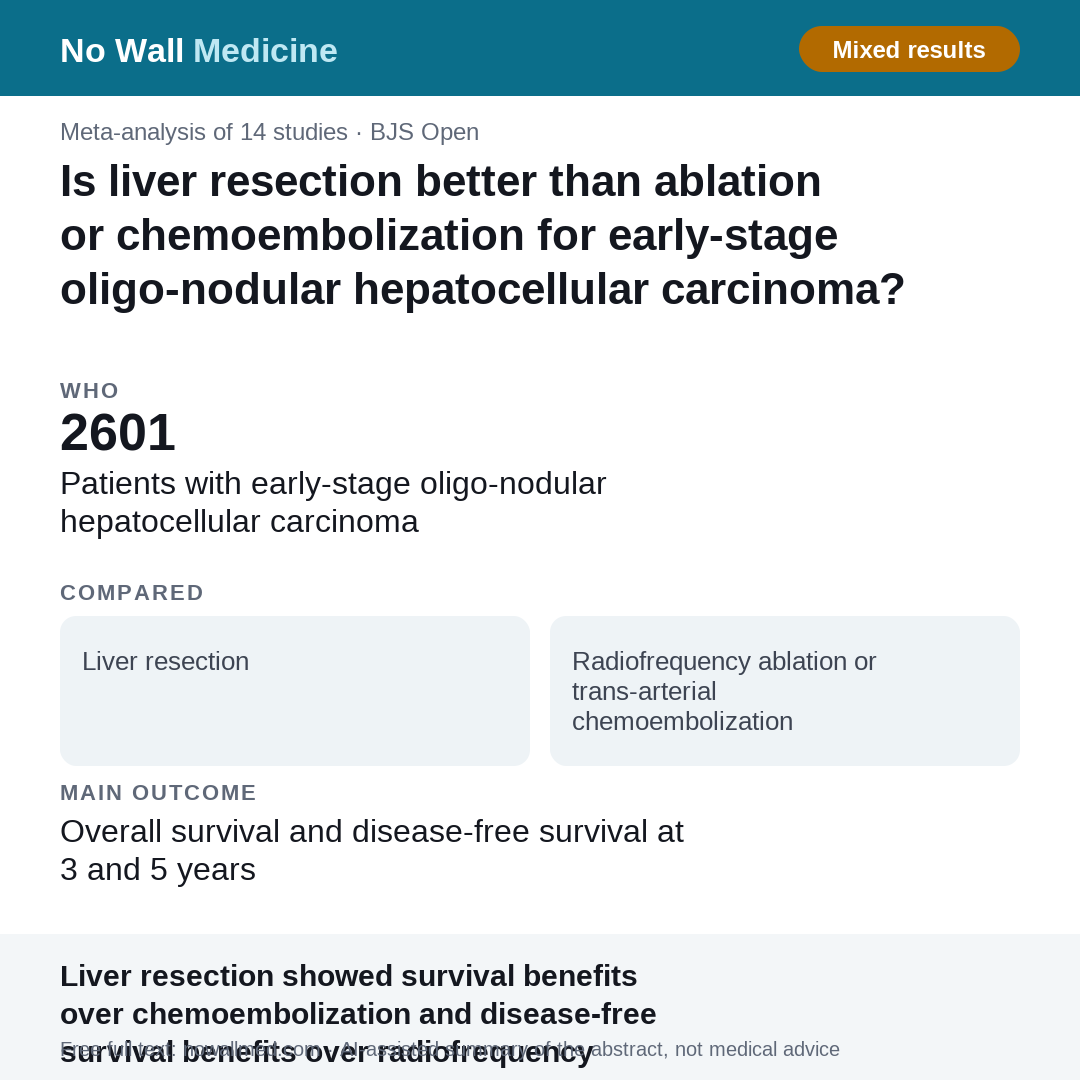
Is liver resection better than ablation or chemoembolization for early-stage oligo-nodular hepatocellular carcinoma?
Who
2601
Patients with early-stage oligo-nodular hepatocellular carcinoma
Compared
Liver resection
Radiofrequency ablation or trans-arterial chemoembolization
Main outcome
Overall survival and disease-free survival at 3 and 5 years
Bottom line: Liver resection showed survival benefits over chemoembolization and disease-free survival benefits over radiofrequency ablation.
Limitation: Additional comparative cohort studies are urgently needed to increase the certainty of this evidence.
BJS Open · 2024-02-07Download image
Clinical question: Is liver resection better than ablation or chemoembolization for early-stage oligo-nodular hepatocellular carcinoma?
Why it matters: Current guidelines do not recommend liver resection for patients with early-stage liver cancer containing two or three small nodules, creating a conflict with the therapeutic hierarchy concept.
Key points
- Researchers analyzed 2601 patients across 14 studies to compare liver resection against radiofrequency ablation or trans-arterial chemoembolization for early-stage liver cancer with two or three small nodules.
- Liver resection was associated with better 3-year overall survival (RR = 0.55, 95% c.i. 0.44 to 0.69) and 5-year overall survival (RR = 0.57, 95% c.i. 0.36 to 0.90) compared to chemoembolization.
- Liver resection was associated with better 3-year (RR = 0.70, 95% c.i. 0.54 to 0.93) and 5-year (RR = 0.82, 95% c.i. 0.72 to 0.95) disease-free survival than radiofrequency ablation, though overall survival differences were not significant.
Headline and key points written with AI from the paper’s abstract, with every number checked against it. Read the paper before relying on them.
Was this summary helpful?
Subject terms
Cite this article
Romano P, Busti M, Billato I, D'Amico F, Marchegiani G, Pelizzaro F. Liver resection versus radiofrequency ablation or trans-arterial chemoembolization for early-stage (BCLC A) oligo-nodular hepatocellular carcinoma: meta-analysis. BJS Open. 2024. doi:10.1093/bjsopen/zrad158
Spotted a mistake? Suggest a correction
Top studies every Monday
The week’s key trials and guidelines in your specialties, plus any topics you follow. By email, free.
Get the weekly digest