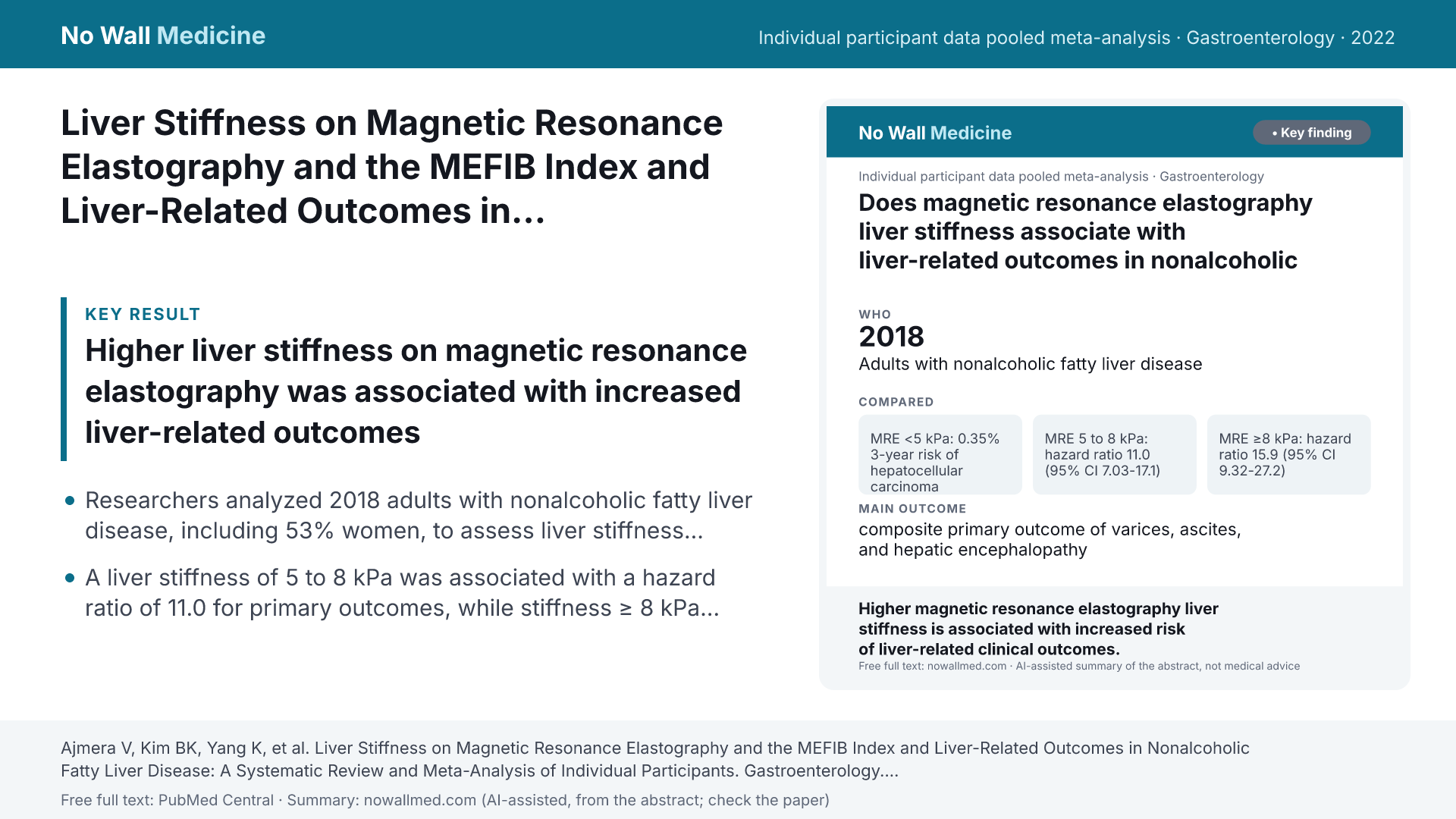
Liver Stiffness on Magnetic Resonance Elastography and the MEFIB Index and Liver-Related Outcomes in Nonalcoholic Fatty Liver Disease: A Systematic Review and Meta-Analysis of Individual Participants
Key result: Higher liver stiffness on magnetic resonance elastography was associated with increased liver-related outcomes
Key points
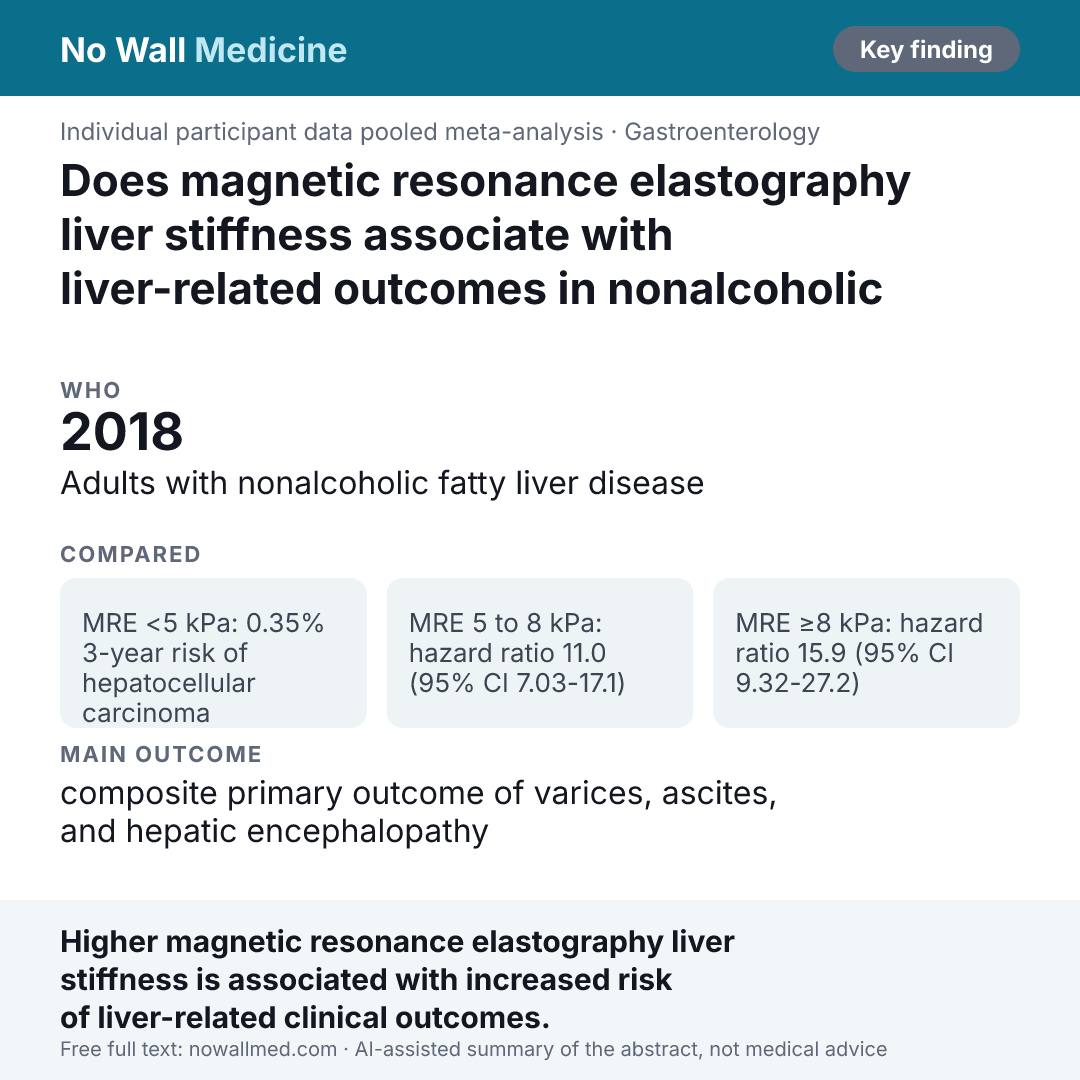
- Researchers analyzed 2018 adults with nonalcoholic fatty liver disease, including 53% women, to assess liver stiffness using magnetic resonance elastography.
- A liver stiffness of 5 to 8 kPa was associated with a hazard ratio of 11.0 for primary outcomes, while stiffness ≥ 8 kPa was associated with a hazard ratio of 15.9.
- The 3-year risk of hepatocellular carcinoma, a type of liver cancer, was 0.35% for stiffness <5 kPa, 5.25% for 5 to 8 kPa, and 5.66% for ≥8 kPa.
Why it matters: The association between magnetic resonance elastography liver stiffness and specific clinical outcomes in patients with nonalcoholic fatty liver disease was not fully characterized.
Discussion prompts
- Would these patients look like yours? Who was left out?
- Is the main outcome one that matters to patients?
- Is the difference large enough to change what you do?
Cite: Ajmera V, Kim BK, Yang K, et al. Liver Stiffness on Magnetic Resonance Elastography and the MEFIB Index and Liver-Related Outcomes in Nonalcoholic Fatty Liver Disease: A Systematic Review and Meta-Analysis of Individual Participants. Gastroenterology. 2022;163(4):1079-1089.e5. doi:10.1053/j.gastro.2022.06.073
Free full text: PubMed Central · Summary and visual abstract: nowallmed.com/a/liver-stiffness-on-magnetic-resonance-elastography-and-the-mefib-1e0g6s0/ (AI-assisted from the abstract; check the paper before relying on it).