Higher liver stiffness on magnetic resonance elastography was associated with increased liver-related outcomes
Liver Stiffness on Magnetic Resonance Elastography and the MEFIB Index and Liver-Related Outcomes in Nonalcoholic Fatty Liver Disease: A Systematic Review and Meta-Analysis of Individual Participants
Individual participant data pooled meta-analysisBenefit found
Does magnetic resonance elastography liver stiffness associate with liver-related outcomes in nonalcoholic fatty liver disease?
Who
2018
Adults with nonalcoholic fatty liver disease
Compared
MRE <5 kPa: 0.35% 3-year risk of hepatocellular carcinoma
MRE 5 to 8 kPa: hazard ratio 11.0 (95% CI 7.03-17.1)
MRE ≥8 kPa: hazard ratio 15.9 (95% CI 9.32-27.2)
Main outcome
composite primary outcome of varices, ascites, and hepatic encephalopathy
Result: hazard ratio 11.0 (95% CI 7.03-17.1) and 15.9 (95% CI 9.32-27.2)
Bottom line: Higher magnetic resonance elastography liver stiffness is associated with increased risk of liver-related clinical outcomes.
Gastroenterology · 2022-07-02Download image
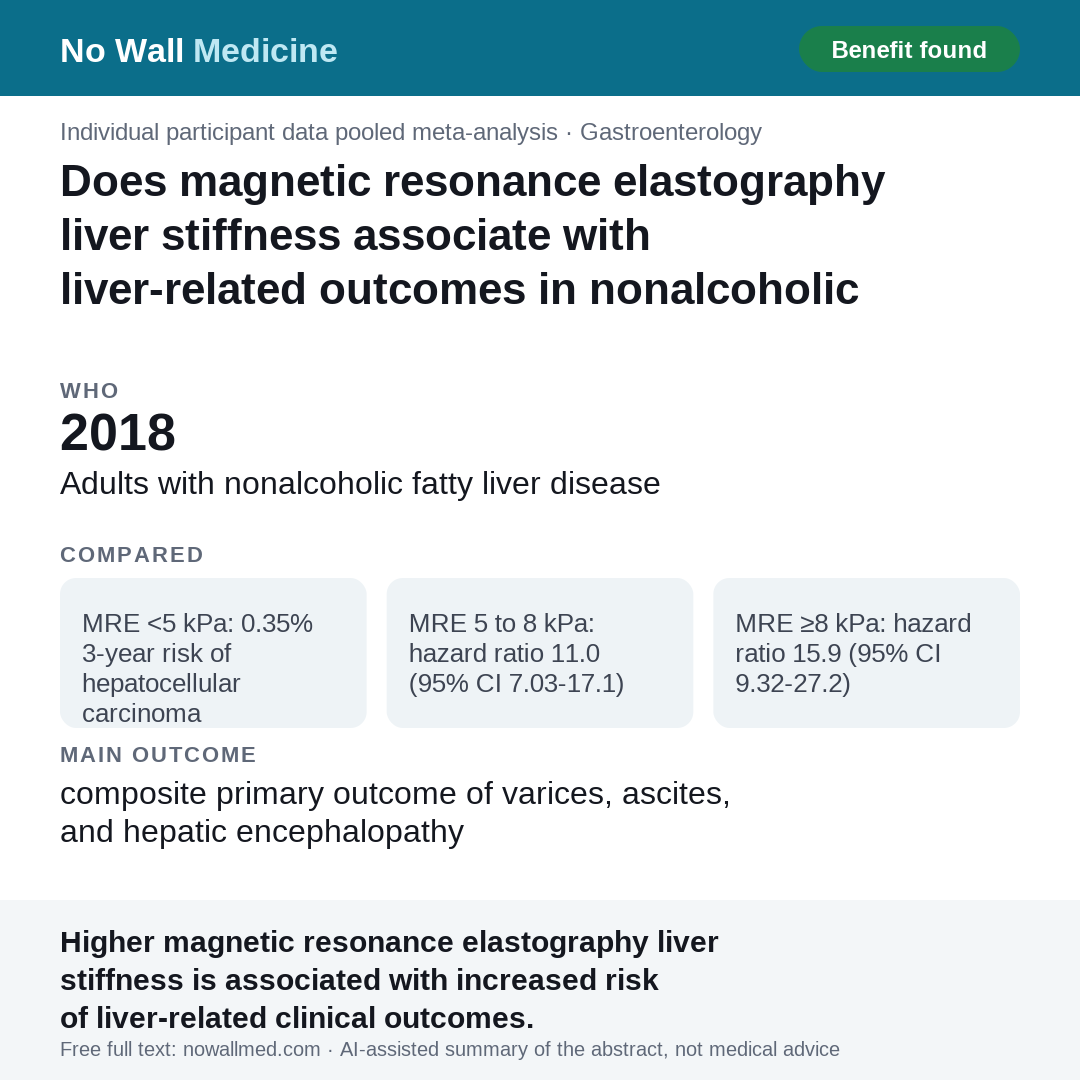
Clinical question: Does magnetic resonance elastography liver stiffness associate with liver-related outcomes in nonalcoholic fatty liver disease?
Why it matters: The association between magnetic resonance elastography liver stiffness and specific clinical outcomes in patients with nonalcoholic fatty liver disease was not fully characterized.
Key points
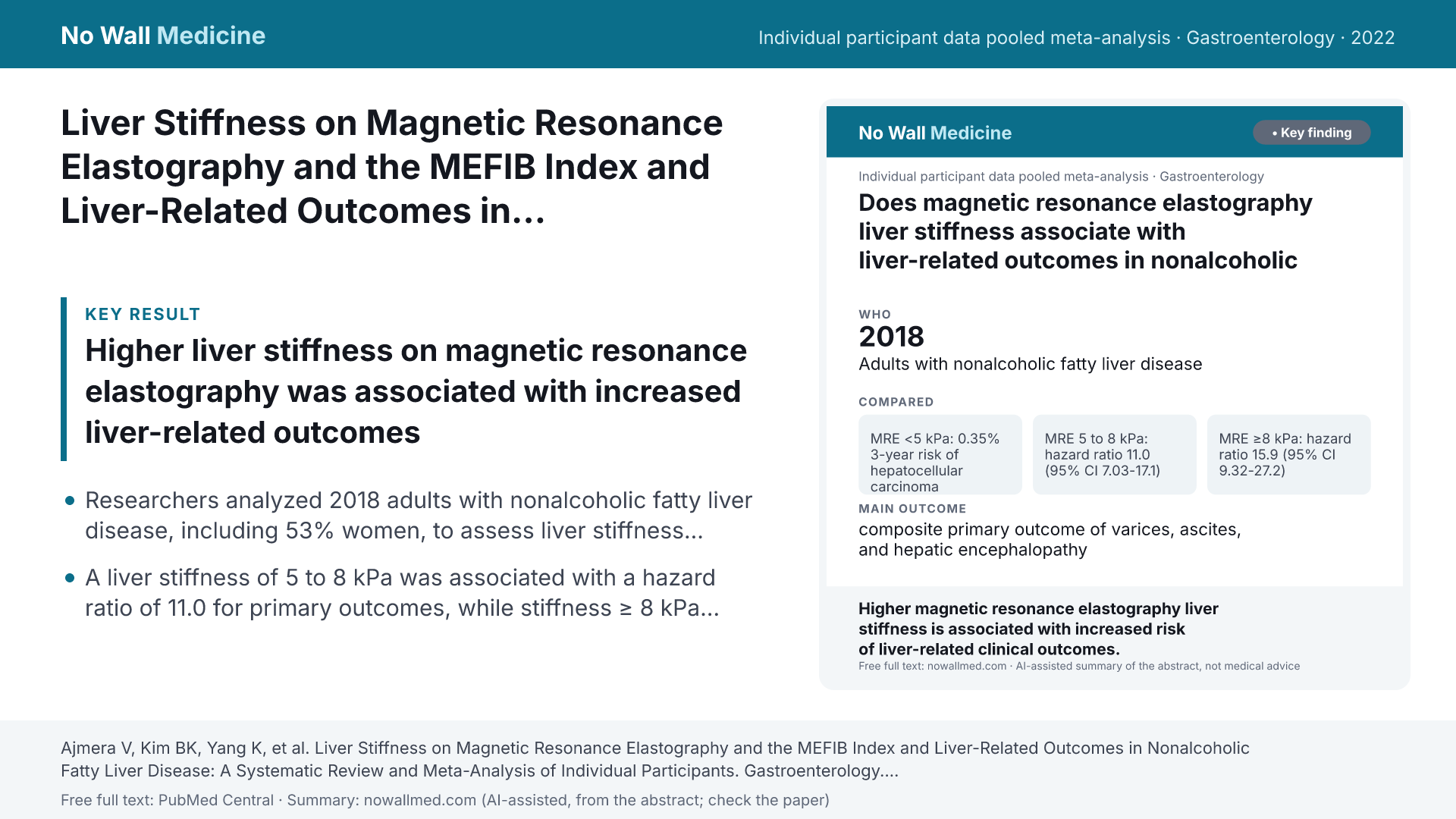
- Researchers analyzed 2018 adults with nonalcoholic fatty liver disease, including 53% women, to assess liver stiffness using magnetic resonance elastography.
- A liver stiffness of 5 to 8 kPa was associated with a hazard ratio of 11.0 for primary outcomes, while stiffness ≥ 8 kPa was associated with a hazard ratio of 15.9.
- The 3-year risk of hepatocellular carcinoma, a type of liver cancer, was 0.35% for stiffness <5 kPa, 5.25% for 5 to 8 kPa, and 5.66% for ≥8 kPa.
Headline and key points written with AI from the paper’s abstract, with every number checked against it. Read the paper before relying on them.
Was this summary helpful?
Subject terms
Cite this article
Ajmera V, Kim BK, Yang K, et al. Liver Stiffness on Magnetic Resonance Elastography and the MEFIB Index and Liver-Related Outcomes in Nonalcoholic Fatty Liver Disease: A Systematic Review and Meta-Analysis of Individual Participants. Gastroenterology. 2022. doi:10.1053/j.gastro.2022.06.073
Spotted a mistake? Suggest a correction