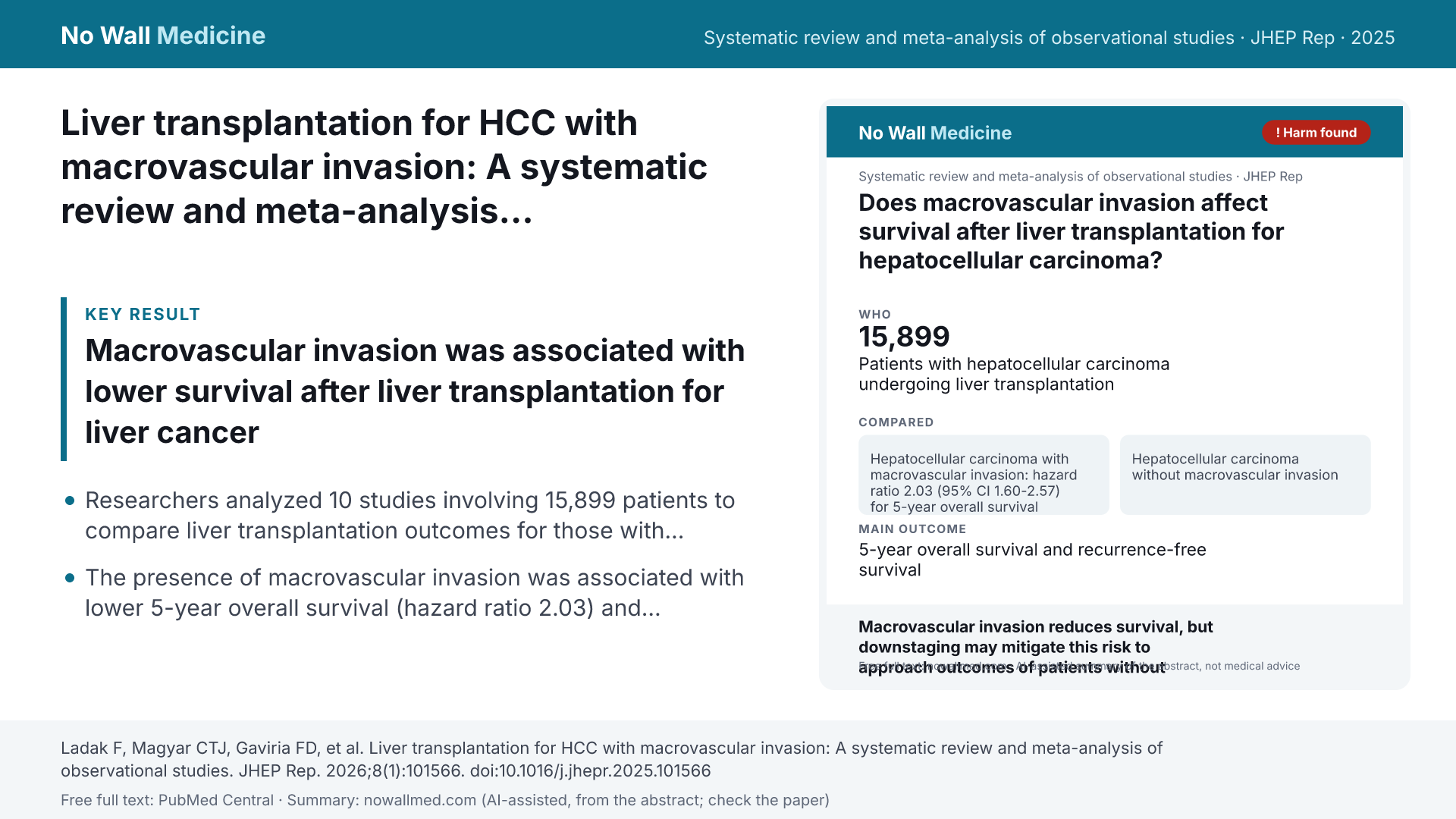
Macrovascular invasion was associated with lower survival after liver transplantation for liver cancer
Liver transplantation for HCC with macrovascular invasion: A systematic review and meta-analysis of observational studies
Systematic review and meta-analysis of observational studiesHarm found
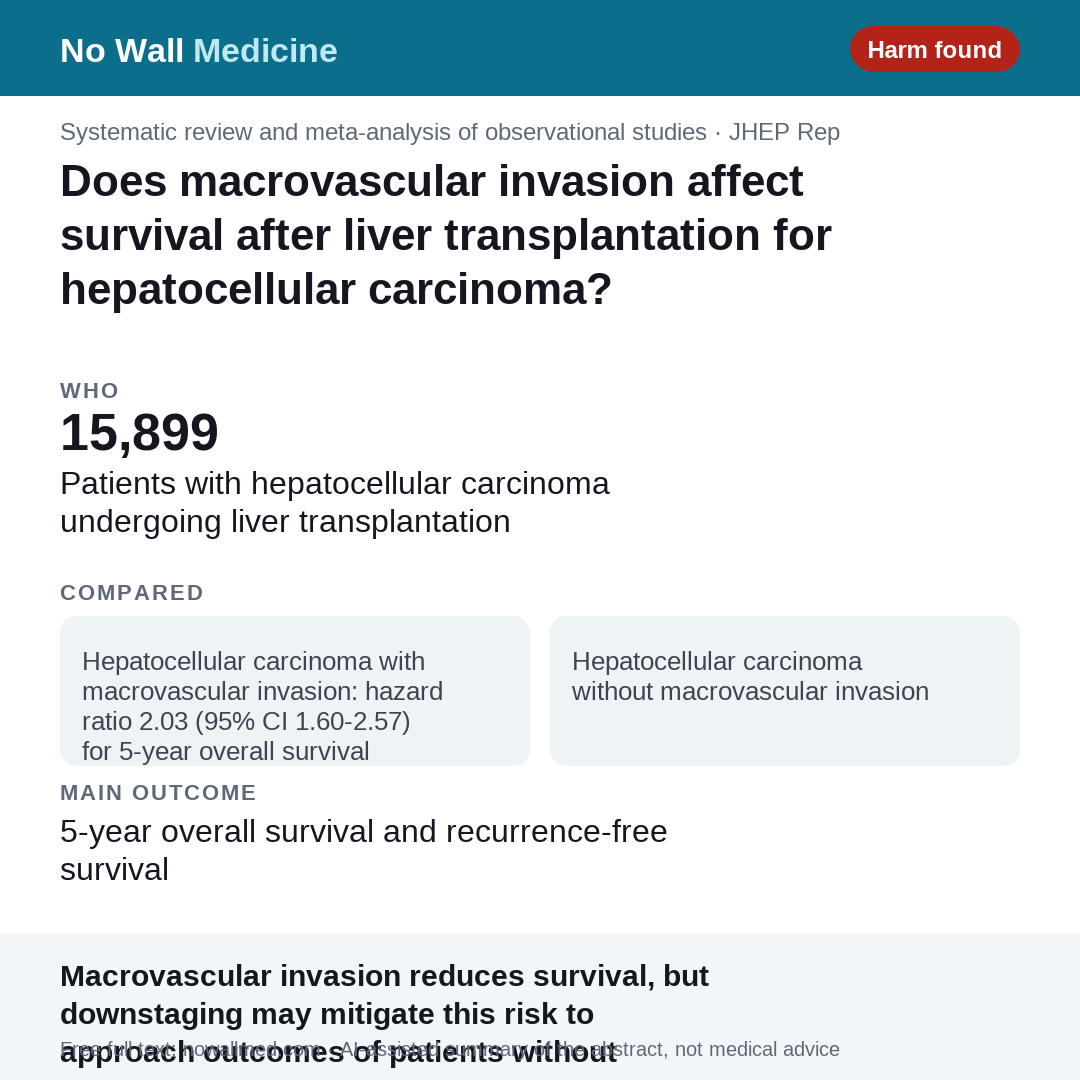
Does macrovascular invasion affect survival after liver transplantation for hepatocellular carcinoma?
Who
15,899
Patients with hepatocellular carcinoma undergoing liver transplantation
Compared
Hepatocellular carcinoma with macrovascular invasion: hazard ratio 2.03 (95% CI 1.60-2.57) for 5-year overall survival
Hepatocellular carcinoma without macrovascular invasion
Main outcome
5-year overall survival and recurrence-free survival
Result: hazard ratio 2.03 (95% CI 1.60-2.57) for 5-year overall survival
Bottom line: Macrovascular invasion reduces survival, but downstaging may mitigate this risk to approach outcomes of patients without invasion.
Limitation: Further studies are essential to validate findings and clarify which downstaging approaches confer benefit.
JHEP Rep · 2025-08-28Download image
Clinical question: Does macrovascular invasion affect survival after liver transplantation for hepatocellular carcinoma?
Why it matters: Traditional guidelines discourage liver transplantation in patients with hepatocellular carcinoma that has spread into large blood vessels, but evidence suggests downstaging may change these outcomes.
Key points
- Researchers analyzed 10 studies involving 15,899 patients to compare liver transplantation outcomes for those with and without macrovascular invasion, which is cancer spreading into large blood vessels.
- The presence of macrovascular invasion was associated with lower 5-year overall survival (hazard ratio 2.03) and lower 5-year recurrence-free survival (hazard ratio 2.55).
- When downstaging therapies, which are treatments used to shrink tumors, were applied uniformly, no statistically significant difference in 5-year overall survival was observed between the groups.
Headline and key points written with AI from the paper’s abstract, with every number checked against it. Read the paper before relying on them.
Was this summary helpful?
Cite this article
Ladak F, Magyar CTJ, Gaviria FD, et al. Liver transplantation for HCC with macrovascular invasion: A systematic review and meta-analysis of observational studies. JHEP Rep. 2025. doi:10.1016/j.jhepr.2025.101566
Spotted a mistake? Suggest a correction