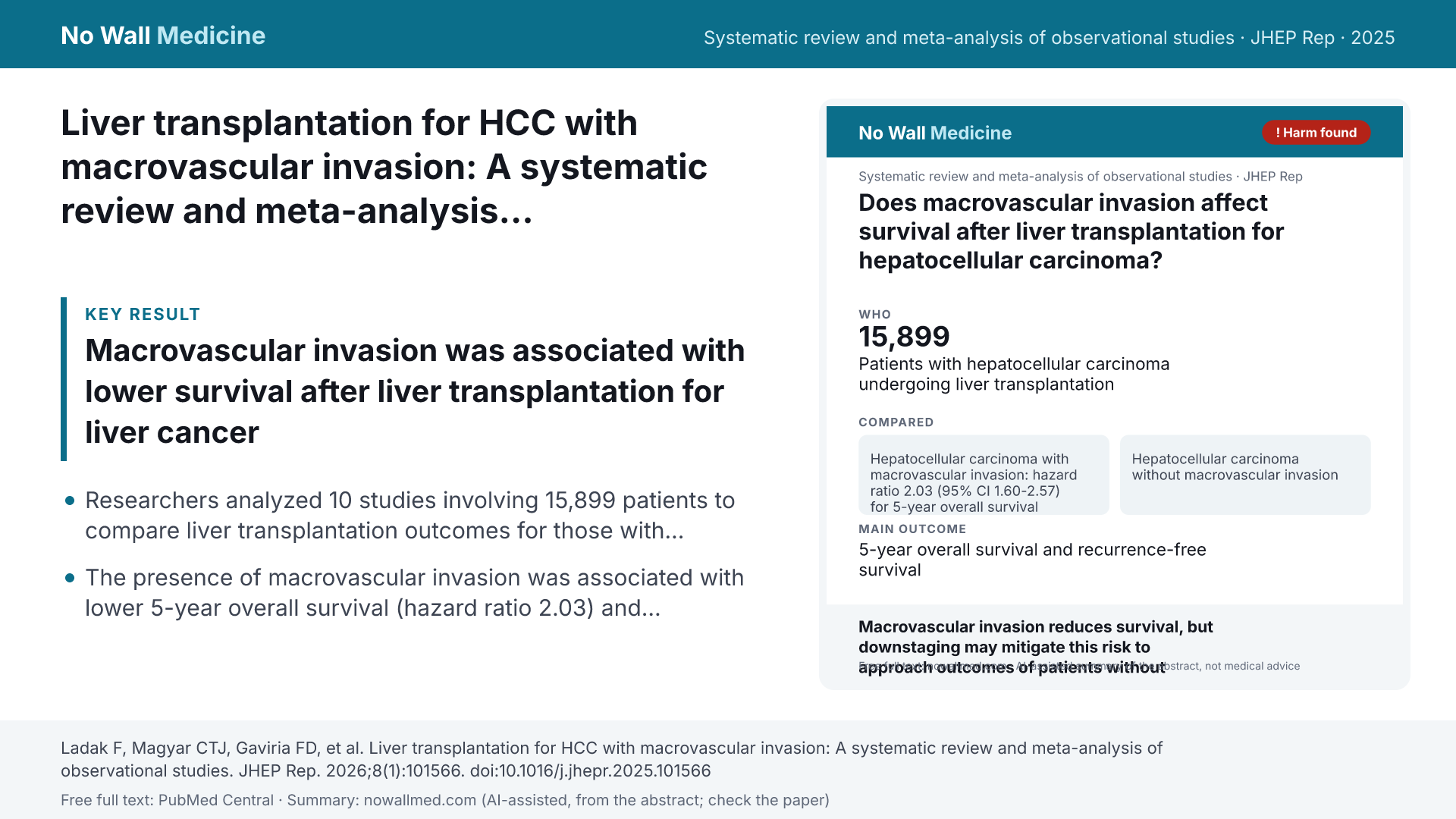
Liver transplantation for HCC with macrovascular invasion: A systematic review and meta-analysis of observational studies
Key result: Macrovascular invasion was associated with lower survival after liver transplantation for liver cancer
Key points
- Researchers analyzed 10 studies involving 15,899 patients to compare liver transplantation outcomes for those with and without macrovascular invasion, which is cancer spreading into large blood vessels.
- The presence of macrovascular invasion was associated with lower 5-year overall survival (hazard ratio 2.03) and lower 5-year recurrence-free survival (hazard ratio 2.55).
- When downstaging therapies, which are treatments used to shrink tumors, were applied uniformly, no statistically significant difference in 5-year overall survival was observed between the groups.
Why it matters: Traditional guidelines discourage liver transplantation in patients with hepatocellular carcinoma that has spread into large blood vessels, but evidence suggests downstaging may change these outcomes.
Discussion prompts
- Would these patients look like yours? Who was left out?
- Is the main outcome one that matters to patients?
- Is the difference large enough to change what you do?
Cite: Ladak F, Magyar CTJ, Gaviria FD, et al. Liver transplantation for HCC with macrovascular invasion: A systematic review and meta-analysis of observational studies. JHEP Rep. 2026;8(1):101566. doi:10.1016/j.jhepr.2025.101566
Free full text: PubMed Central · Summary and visual abstract: nowallmed.com/a/liver-transplantation-for-hcc-with-macrovascular-invasion-a-pmjx2y/ (AI-assisted from the abstract; check the paper before relying on it).