Transperineal biopsy detected more significant prostate cancer than the traditional transrectal approach
Local anaesthetic transperineal biopsy versus transrectal prostate biopsy in prostate cancer detection (TRANSLATE): a multicentre, randomised, controlled trial
Randomised, controlled trialBenefit found
Does local anaesthetic transperineal biopsy detect more Gleason Grade Group 2 or higher prostate cancer than transrectal biopsy?
Who
1126
Biopsy-naive individuals investigated for suspected prostate cancer · Ten hospitals in the United Kingdom
Compared
Local anaesthetic transperineal biopsy: 329 (60%) of 547
Transrectal biopsy: 294 (54%) of 540
Main outcome
Detection of Gleason Grade Group 2 or higher prostate cancer
Result: odds ratio 1·32 (95% CI 1·03-1·70)
Bottom line: Local anaesthetic transperineal biopsy detected more Gleason Grade Group 2 or higher prostate cancer than transrectal biopsy.
Lancet Oncol · 2025-03-23Download image
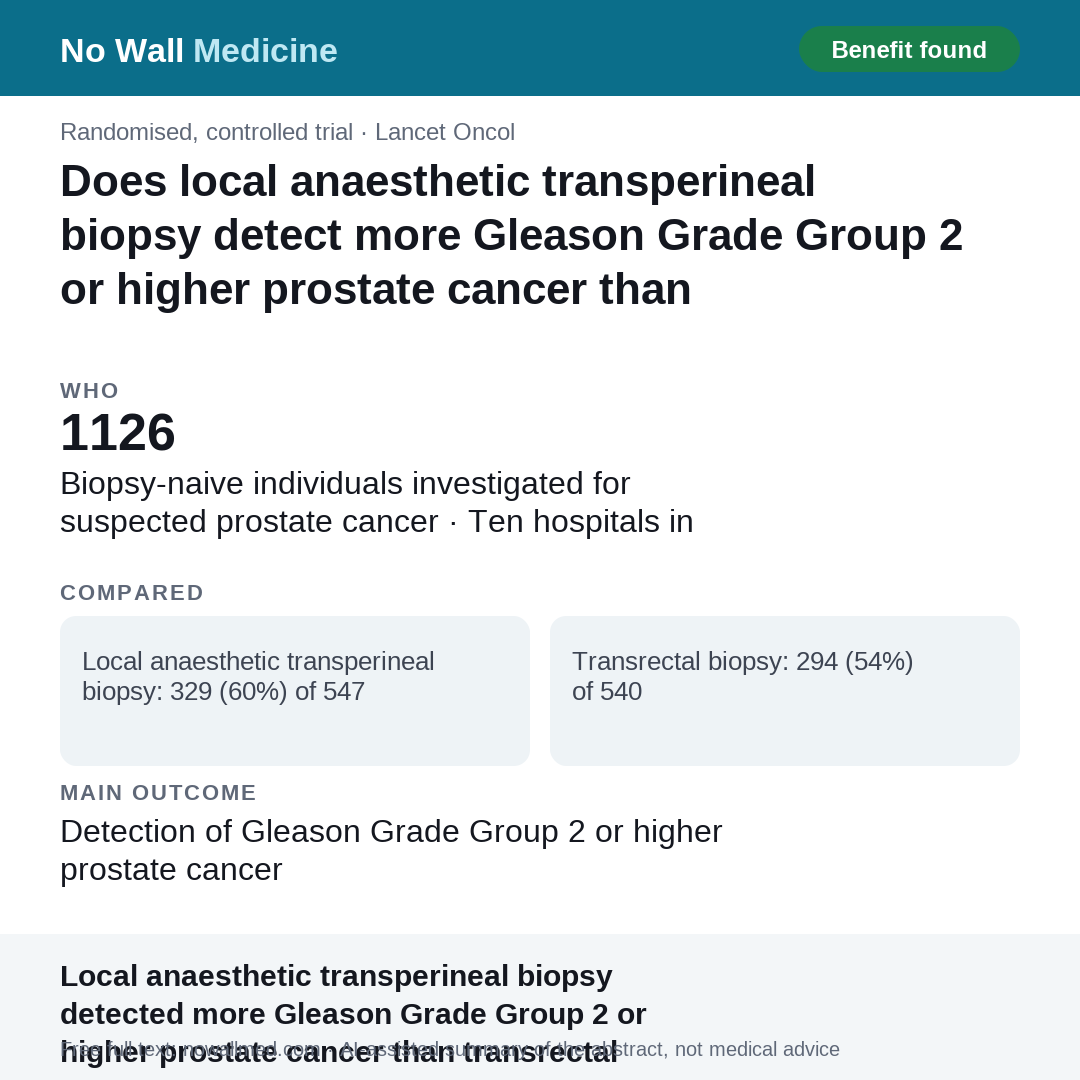
Clinical question: Does local anaesthetic transperineal biopsy detect more Gleason Grade Group 2 or higher prostate cancer than transrectal biopsy?
Why it matters: It is uncertain how transperineal biopsy compares to the traditional transrectal approach regarding cancer detection, side effects, and patient experience.
Key points
- In this trial of 1126 participants, 562 received local anaesthetic transperineal biopsy and 564 received transrectal ultrasound-guided biopsy.
- Significant prostate cancer, defined as Gleason Grade Group 2 or higher, was found in 60% of the transperineal group compared to 54% of the transrectal group.
- The transperineal group reported more immediate pain and embarrassment, but there were no significant differences in urinary symptoms, sexual function, or overall complications at 4 months.
Headline and key points written with AI from the paper’s abstract, with every number checked against it. Read the paper before relying on them.
Abstract
Background
Prostate cancer diagnosis requires biopsy, traditionally performed under local anaesthetic with ultrasound guidance via a transrectal approach (TRUS). Local anaesthetic ultrasound-guided transperineal biopsy (LATP) is gaining popularity in this setting; however, there is uncertainty regarding prostate sampling, infection rates, tolerability, side-effects, and cost-effectiveness. TRANSLATE was a randomised clinical trial that aimed to compare detection of Gleason Grade Group (GGG) 2 or higher prostate cancer, side-effects, tolerability, and patient-reported outcomes, after LATP versus TRUS biopsy. Methods
In this randomised clinical trial which was done at ten hospitals in the UK, patients aged 18 years or older were eligible if investigated for suspected prostate cancer based on elevated age-specific prostate-specific antigen or abnormal digital rectal examination, and if biopsy-naive having received pre-biopsy MRI on a 1·5 or higher Tesla scanner. Individuals were excluded if they had any previous prostate biopsy, extensive local disease easily detectable by any biopsy (prostate-specific antigen >50 ng/mL or entire gland replaced by tumour on MRI), symptoms of concurrent or recent urinary tract infection, history of immunocompromise, need for enhanced antibiotic prophylaxis, absent rectum, or inability to position in lithotomy. Participants were randomly assigned in a 1:1 ratio to receive LATP or TRUS biopsy, using web-based software with a randomisation sequence using a minimisation algorithm to ensure balanced allocation across biopsy groups for minimisation factors (recruitment site, and location of the MRI lesion). The primary outcome was detection of GGG 2 or higher prostate cancer, analysed in the modified intention-to-treat population (all randomly assigned to treatment who had a biopsy result available). Key secondary endpoints assessing post-biopsy adverse events were infection, bleeding, urinary and sexual function, tolerability, and patient-reported outcomes. This trial is registered with ClinicalTrials.gov (NCT05179694) and at ISRCTN (ISRCTN98159689), and is complete. Findings
Between Dec 3, 2021, and Sept 26, 2023, 2078 (76%) of 2727 assessed individuals were eligible, and 1126 (41%) of 2727 agreed to participate. 1044 (93%) of the 1126 participants were White British. Participants were allocated to TRUS (n=564) or LATP (n=562) biopsy, and were followed up at time of biopsy, and at 7 days, 35 days, and 4 months post-biopsy. We found GGG 2 or higher prostate cancer in 329 (60%) of 547 participants with biopsy results randomly assigned to LATP compared with 294 (54%) of 540 participants with biopsy results randomly assigned to TRUS biopsy (odds ratio [OR] 1·32 [95% CI 1·03-1·70]; p=0·031). Infection requiring admission to hospital within 35 days post-biopsy occurred in 2 (<1%) of 562 participants in the LATP group compared with 9 (2%) of 564 in the TRUS group. No statistically significant difference was observed in the reporting of overall biopsy-related complications (LATP 454 [81%] of 562 vs TRUS 436 [77%] of 564, OR 1·23 [95% CI 0·93 to 1·65]), urinary retention requiring catheterisation (LATP 35 [6%] of 562 vs TRUS 27 [5%] of 564), urinary symptoms (median International Prostate Symptom Score: LATP 8 [IQR 4-14] vs TRUS 8 [4-13], OR 0·36 [95% CI -0·38 to 1·10]), nor sexual function (median International Index of Erectile Function score: LATP 5 [2-25] vs TRUS 8 [3-24], OR -0·60 [-1·79 to 0·58]) at 4 months after biopsy. Trial participants more commonly reported LATP biopsy to be immediately painful and embarrassing compared with TRUS (LATP 216 [38%] of 562 vs TRUS 153 [27%] of 564; OR 1·84 [95% CI 1·40 to 2·43]). Serious adverse events occurred in 14 (2%) of 562 participants in the LATP group and 25 (4%) of 564 in the TRUS group. Interpretation
Among biopsy-naive individuals being investigated for possible prostate cancer, biopsy with LATP led to greater detection of GGG 2 or higher disease compared with TRUS. These findings will help to inform patients, clinicians, clinical guidelines, and policy makers regarding the important trade-offs between LATP and TRUS prostate biopsy. Funding
National Institute for Health and Care Research (NIHR) Health Technology Assessment.
Abstract reproduced under the article’s CC BY licence.
Topics
Cite this article
Bryant RJ, Marian IR, Williams R, Lopez JF, Mercader C, Raslan M. Local anaesthetic transperineal biopsy versus transrectal prostate biopsy in prostate cancer detection (TRANSLATE): a multicentre, randomised, controlled trial. Lancet Oncol. 2025. doi:10.1016/S1470-2045(25)00100-7
Spotted a mistake? Suggest a correction
Top studies every Monday
The week’s key trials and guidelines in your specialties, by email. Free.
Get the weekly digest