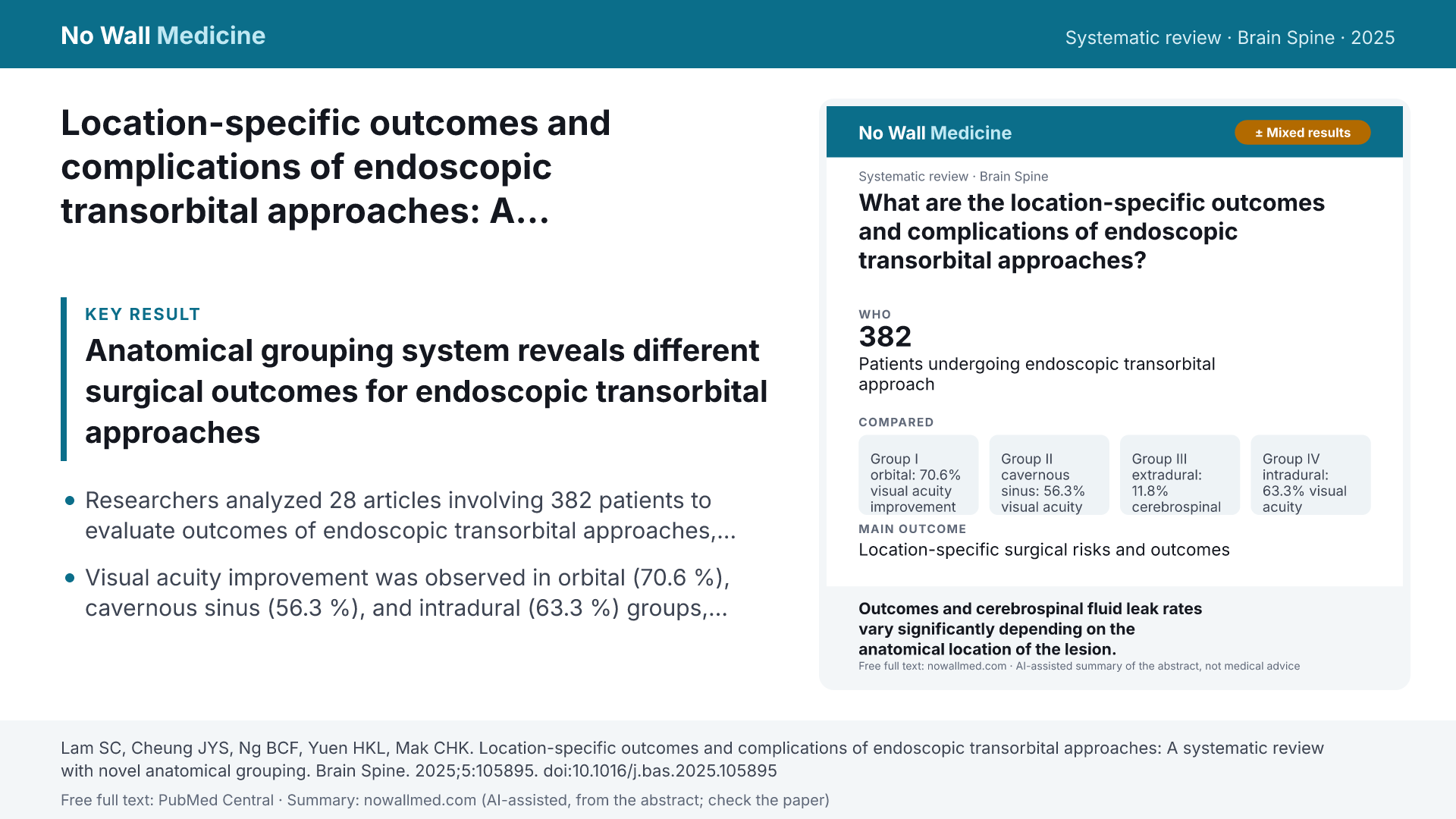
Anatomical grouping system reveals different surgical outcomes for endoscopic transorbital approaches
Location-specific outcomes and complications of endoscopic transorbital approaches: A systematic review with novel anatomical grouping
Systematic reviewMixed results
What are the location-specific outcomes and complications of endoscopic transorbital approaches?
Who
382
Patients undergoing endoscopic transorbital approach
Compared
Group I orbital: 70.6% visual acuity improvement
Group II cavernous sinus: 56.3% visual acuity improvement
Group III extradural: 11.8% cerebrospinal fluid leak
Group IV intradural: 63.3% visual acuity improvement
Main outcome
Location-specific surgical risks and outcomes
Bottom line: Outcomes and cerebrospinal fluid leak rates vary significantly depending on the anatomical location of the lesion.
Brain Spine · 2025-12-03Download image
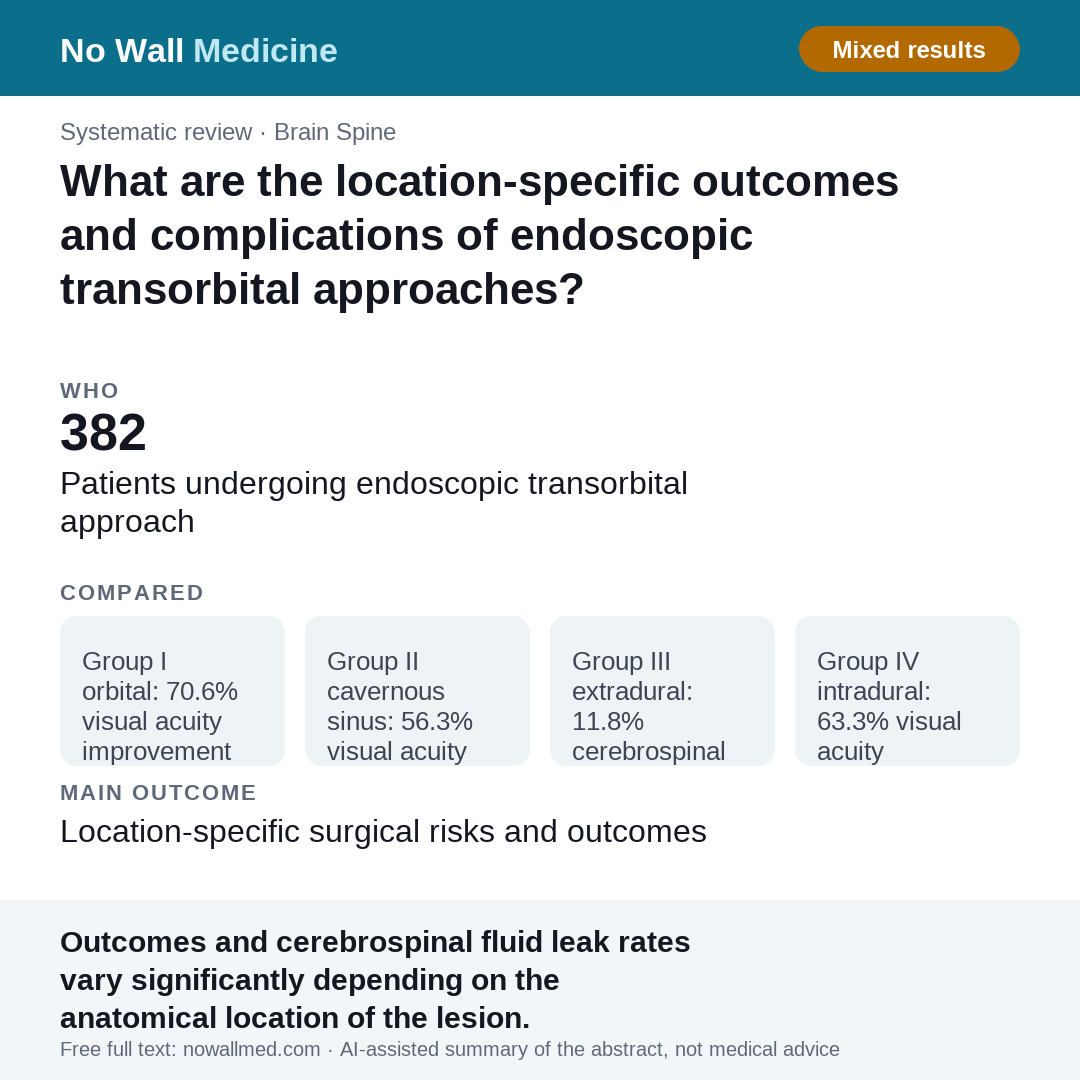
Clinical question: What are the location-specific outcomes and complications of endoscopic transorbital approaches?
Why it matters: There is no clear anatomical grouping system for lesions addressed by endoscopic transorbital approaches and location-specific complication rates are currently lacking.
Key points
- Researchers analyzed 28 articles involving 382 patients to evaluate outcomes of endoscopic transorbital approaches, a surgical method through the eye socket, across four anatomical locations.
- Visual acuity improvement was observed in orbital (70.6 %), cavernous sinus (56.3 %), and intradural (63.3 %) groups, while proptosis, or bulging of the eye, improved in all groups.
- The rate of cerebrospinal fluid leak, which is the leakage of the fluid surrounding the brain and spine, was 0 % in orbital and cavernous sinus groups compared to 11.8 % in extradural lesions.
Headline and key points written with AI from the paper’s abstract, with every number checked against it. Read the paper before relying on them.
Was this summary helpful?
Cite this article
Lam SC, Cheung JYS, Ng BCF, Yuen HKL, Mak CHK. Location-specific outcomes and complications of endoscopic transorbital approaches: A systematic review with novel anatomical grouping. Brain Spine. 2025. doi:10.1016/j.bas.2025.105895
Spotted a mistake? Suggest a correction