Location-specific outcomes and complications of endoscopic transorbital approaches: A systematic review with novel anatomical grouping
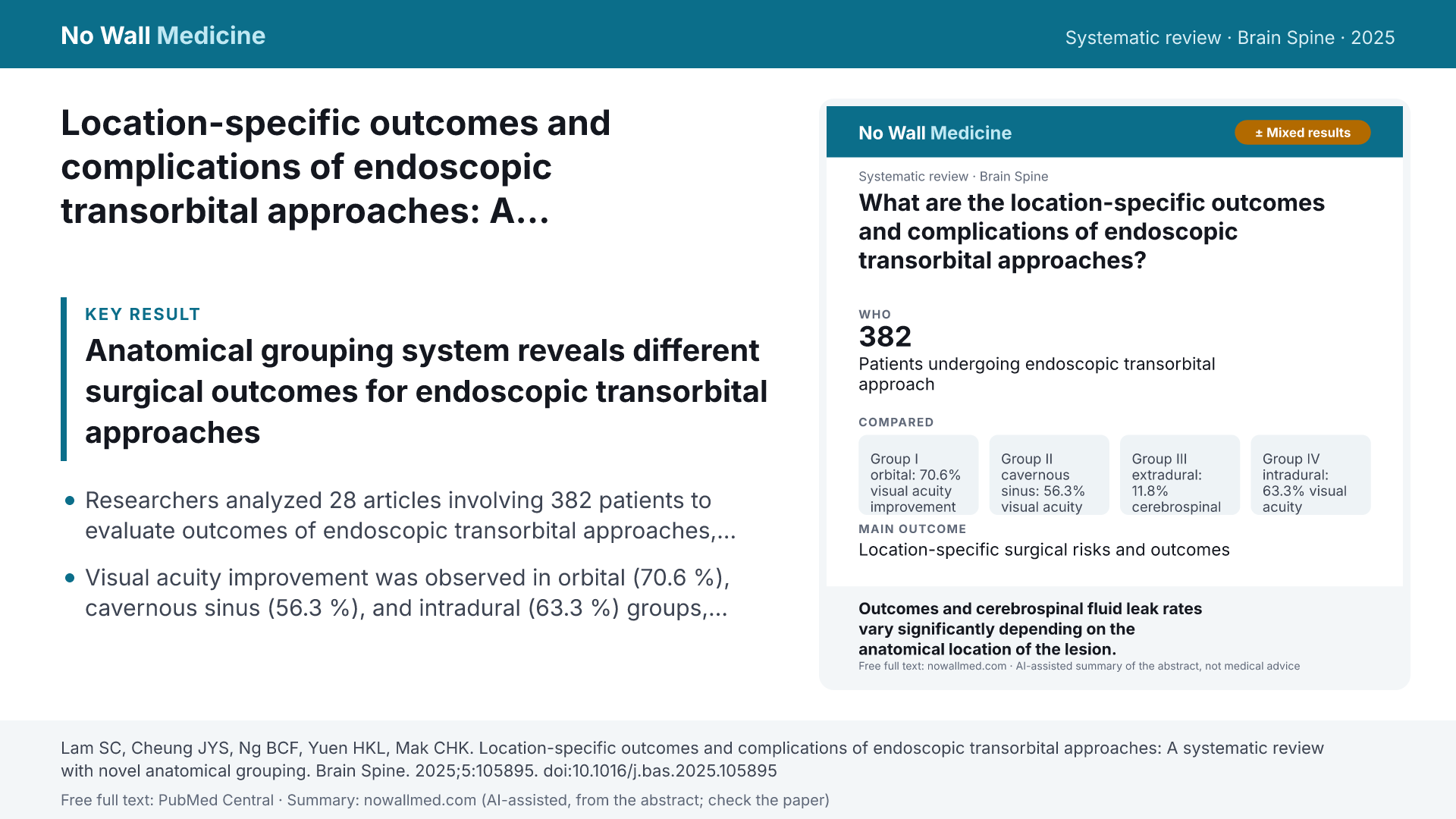
Key result: Anatomical grouping system reveals different surgical outcomes for endoscopic transorbital approaches
Systematic reviewMixed results
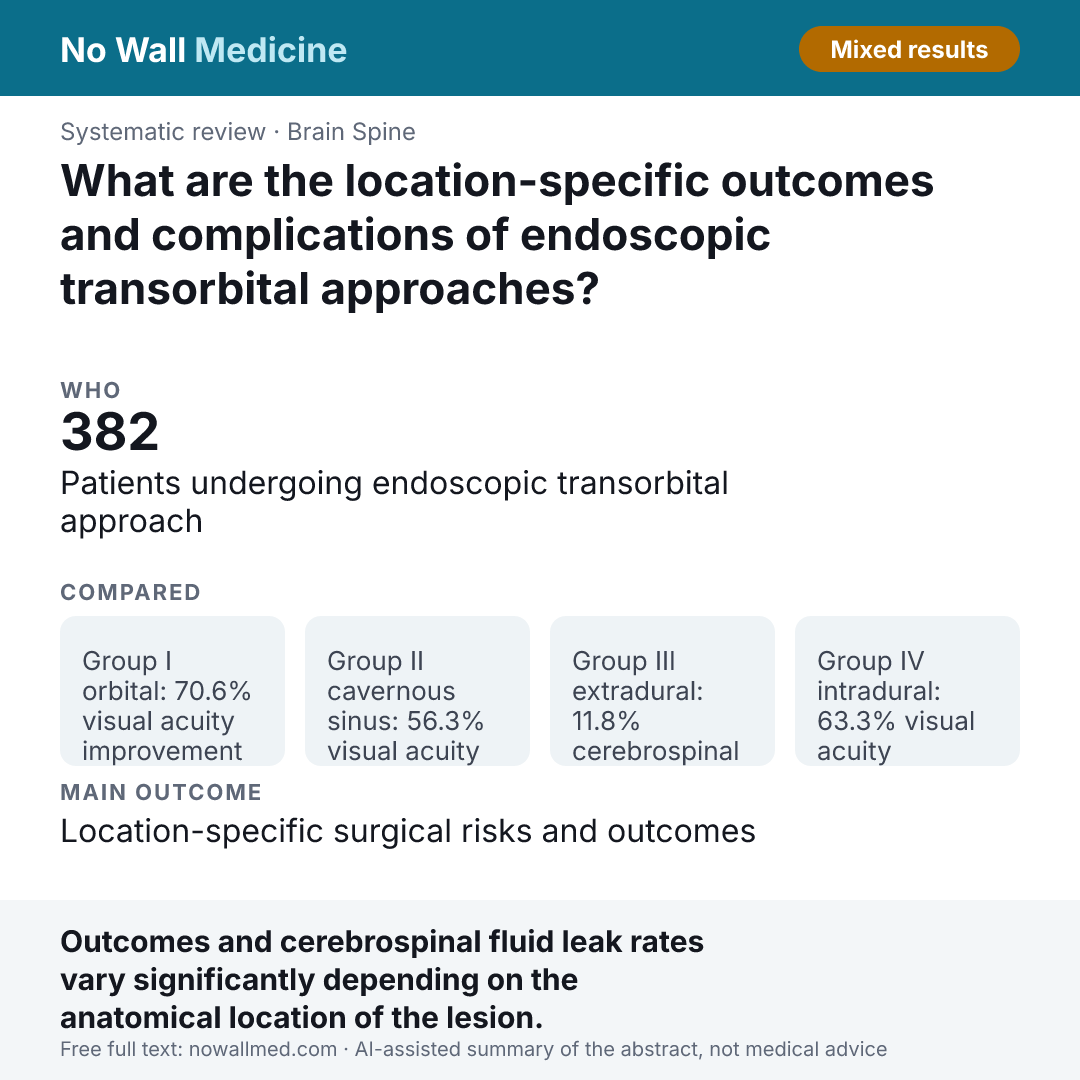
What are the location-specific outcomes and complications of endoscopic transorbital approaches?
Who
382
Patients undergoing endoscopic transorbital approach
Compared
Group I orbital: 70.6% visual acuity improvement
Group II cavernous sinus: 56.3% visual acuity improvement
Group III extradural: 11.8% cerebrospinal fluid leak
Group IV intradural: 63.3% visual acuity improvement
Main outcome
Location-specific surgical risks and outcomes
Bottom line: Outcomes and cerebrospinal fluid leak rates vary significantly depending on the anatomical location of the lesion.
Brain Spine · 2025-12-03 · Save PNG
Key points
- Researchers analyzed 28 articles involving 382 patients to evaluate outcomes of endoscopic transorbital approaches, a surgical method through the eye socket, across four anatomical locations.
- Visual acuity improvement was observed in orbital (70.6 %), cavernous sinus (56.3 %), and intradural (63.3 %) groups, while proptosis, or bulging of the eye, improved in all groups.
- The rate of cerebrospinal fluid leak, which is the leakage of the fluid surrounding the brain and spine, was 0 % in orbital and cavernous sinus groups compared to 11.8 % in extradural lesions.
Discussion prompts
- Would these patients look like yours? Who was left out?
- Is the main outcome one that matters to patients?
- Is the difference large enough to change what you do?
Cite: Lam SC, Cheung JYS, Ng BCF, Yuen HKL, Mak CHK. Location-specific outcomes and complications of endoscopic transorbital approaches: A systematic review with novel anatomical grouping. Brain Spine. 2025;5:105895. doi:10.1016/j.bas.2025.105895
Free full text: PubMed Central · Summary and visual abstract: nowallmed.com/a/location-specific-outcomes-and-complications-of-endoscopic-17xuitm/ (AI-assisted from the abstract; check the paper before relying on it).