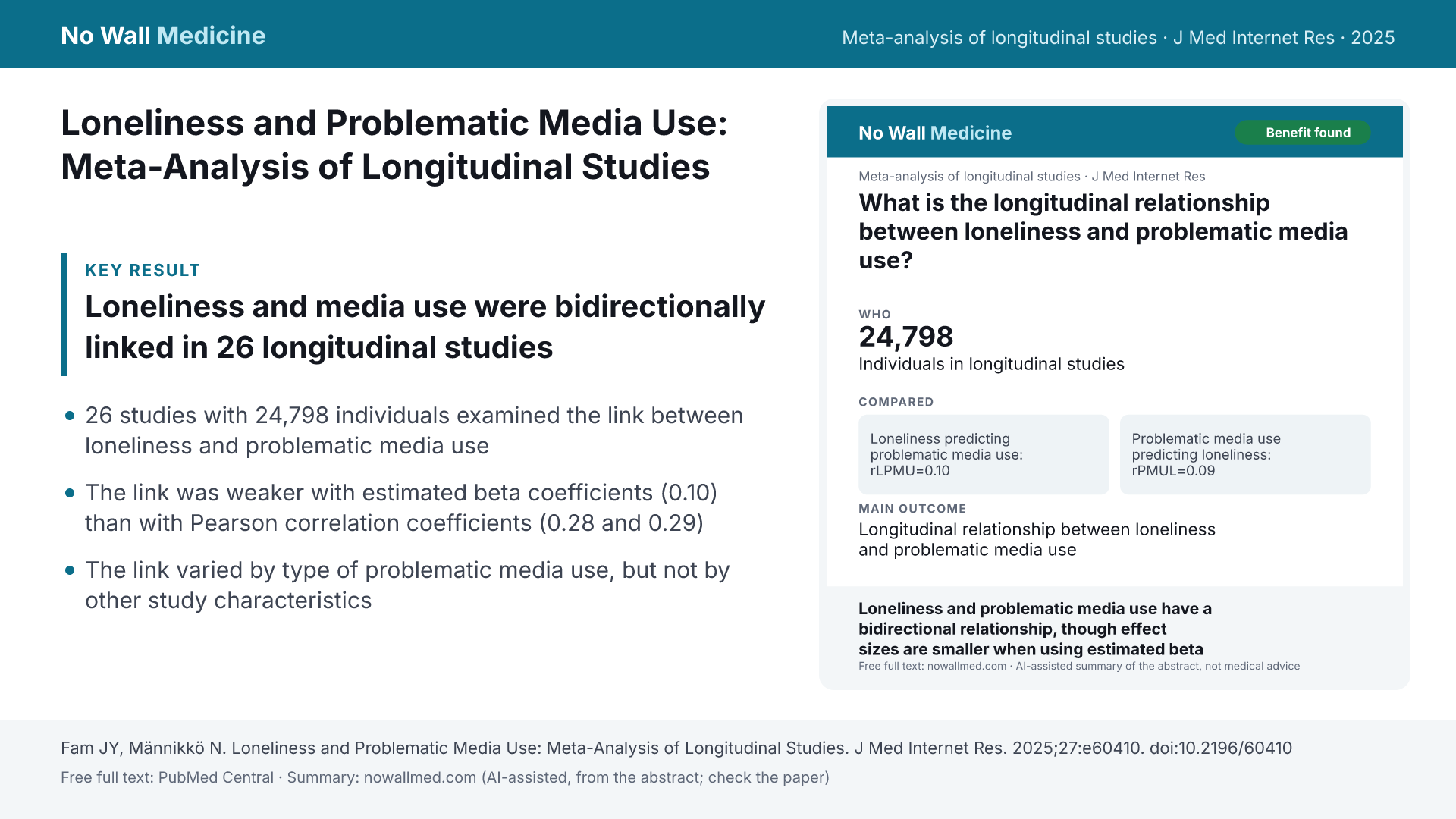
Loneliness and media use were bidirectionally linked in 26 longitudinal studies
Loneliness and Problematic Media Use: Meta-Analysis of Longitudinal Studies
Meta-analysis of longitudinal studiesBenefit found
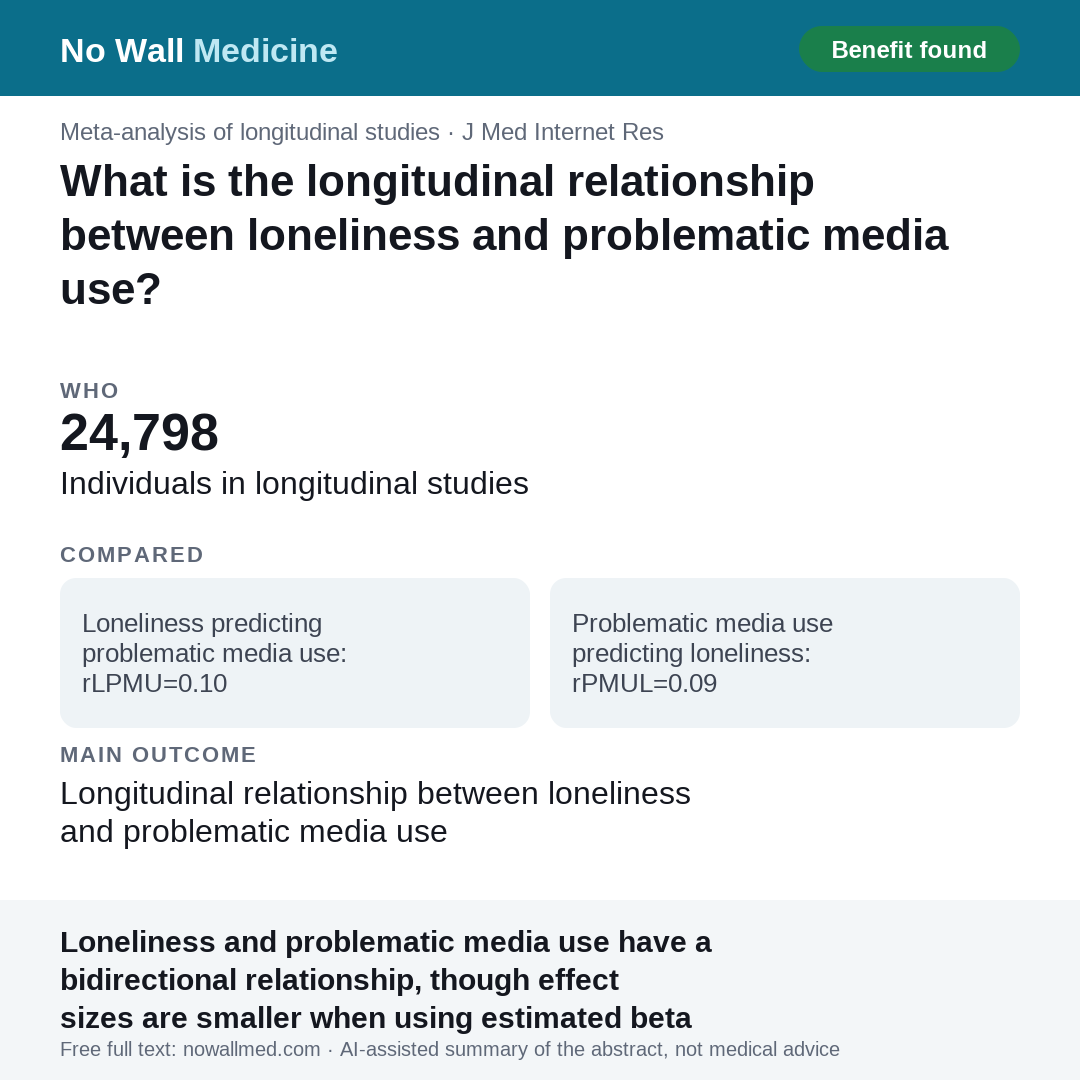
What is the longitudinal relationship between loneliness and problematic media use?
Who
24,798
Individuals in longitudinal studies
Compared
Loneliness predicting problematic media use: rLPMU=0.10
Problematic media use predicting loneliness: rPMUL=0.09
Main outcome
Longitudinal relationship between loneliness and problematic media use
Bottom line: Loneliness and problematic media use have a bidirectional relationship, though effect sizes are smaller when using estimated beta coefficients.
Limitation: Asymmetrical pattern in funnel plot and Egger regression test suggests need for more studies.
J Med Internet Res · 2025-08-14Download image
Clinical question: What is the longitudinal relationship between loneliness and problematic media use?
Why it matters: Previous meta-analyses relied heavily on Pearson correlation coefficients, which may not fully account for the complexities of this association
Key points
- 26 studies with 24,798 individuals examined the link between loneliness and problematic media use.
- The link was weaker with estimated beta coefficients (0.10) than with Pearson correlation coefficients (0.28 and 0.29).
- The link varied by type of problematic media use, but not by other study characteristics.
Limitation the authors note: The contour-enhanced funnel plot and Egger regression test revealed an asymmetrical pattern, indicating a need for more longitudinal studies
Headline and key points written with AI from the paper’s abstract, with every number checked against it. Read the paper before relying on them.
Was this summary helpful?
Subject terms
Cite this article
Fam JY, Männikkö N. Loneliness and Problematic Media Use: Meta-Analysis of Longitudinal Studies. J Med Internet Res. 2025. doi:10.2196/60410
Spotted a mistake? Suggest a correction