Long-acting factor XI inhibitor abelacimab was associated with low periprocedural bleeding rates in patients with atrial fibrillation
Long-Acting Factor XI Inhibition and Periprocedural Bleeding: An Analysis From AZALEA-TIMI 71
Multicenter, randomized, active-controlled studyNo clear difference
Does abelacimab affect periprocedural bleeding compared to rivaroxaban during invasive procedures?
Who
441
Patients with atrial fibrillation undergoing invasive procedures · Multicenter
Compared
1.2%Abelacimab
2.2%Rivaroxaban
Main outcome
Periprocedural major or clinically relevant nonmajor bleeding
Result: risk ratio 0.54 (95% CI 0.19-1.58)
Bottom line: Abelacimab showed low rates of periprocedural bleeding, suggesting routine anticoagulation interruption may not be necessary for all procedures.
JACC · 2025-06-12Download image
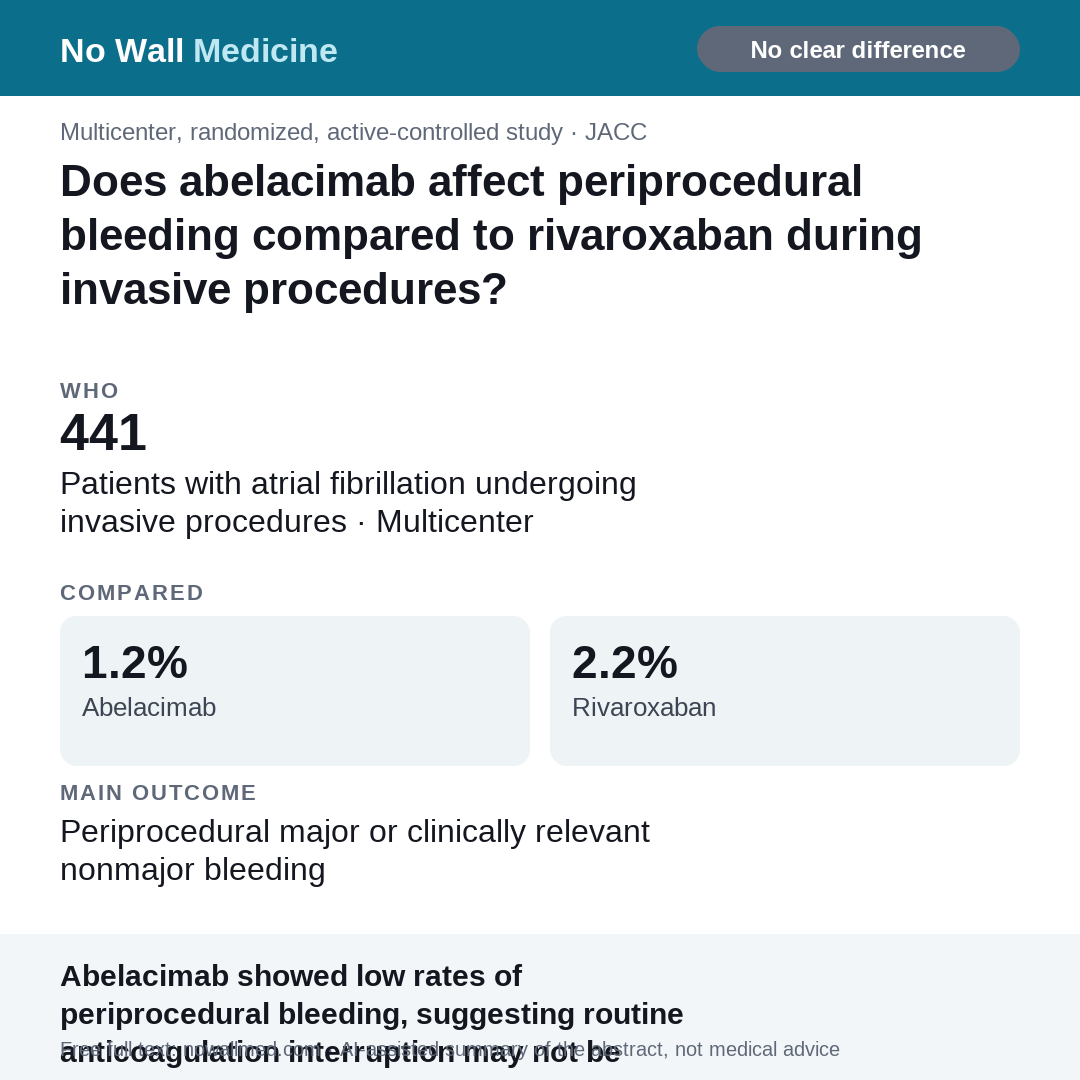
Clinical question: Does abelacimab affect periprocedural bleeding compared to rivaroxaban during invasive procedures?
Why it matters: It is unclear if routine interruption of anticoagulation is necessary for all invasive procedures when using long-acting factor XI inhibitors.
Key points
- Researchers analyzed 441 patients undergoing 920 invasive procedures to compare bleeding risks between abelacimab and rivaroxaban.
- Periprocedural major or clinically relevant nonmajor bleeding occurred in 1.2% of procedures in the abelacimab arms versus 2.2% in the rivaroxaban arm.
- For procedures occurring within 30 days of an abelacimab dose, major or clinically relevant nonmajor bleeding occurred in 0.9% of the 336 procedures.
Headline and key points written with AI from the paper’s abstract, with every number checked against it. Read the paper before relying on them.
Topics
Cite this article
Patel SM, Giugliano RP, Morrow DA, Parkar S, Shapiro H, Hug B. Long-Acting Factor XI Inhibition and Periprocedural Bleeding: An Analysis From AZALEA-TIMI 71. JACC. 2025. doi:10.1016/j.jacc.2025.04.018
Spotted a mistake? Suggest a correction
Top studies every Monday
The week’s key trials and guidelines in your specialties, plus any topics you follow. By email, free.
Get the weekly digest