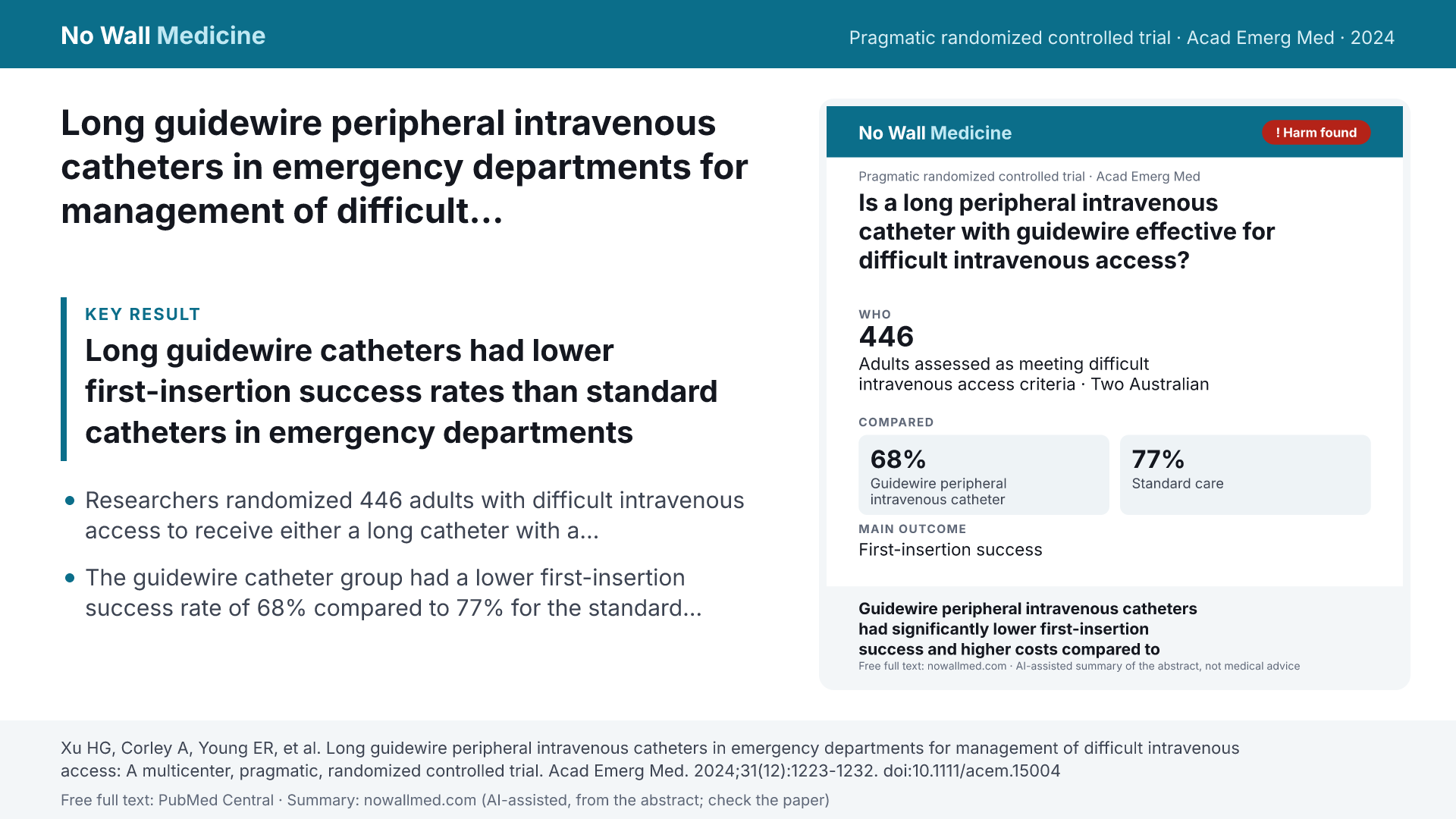
Long guidewire catheters had lower first-insertion success rates than standard catheters in emergency departments
Long guidewire peripheral intravenous catheters in emergency departments for management of difficult intravenous access: A multicenter, pragmatic, randomized controlled trial
Pragmatic randomized controlled trialHarm found
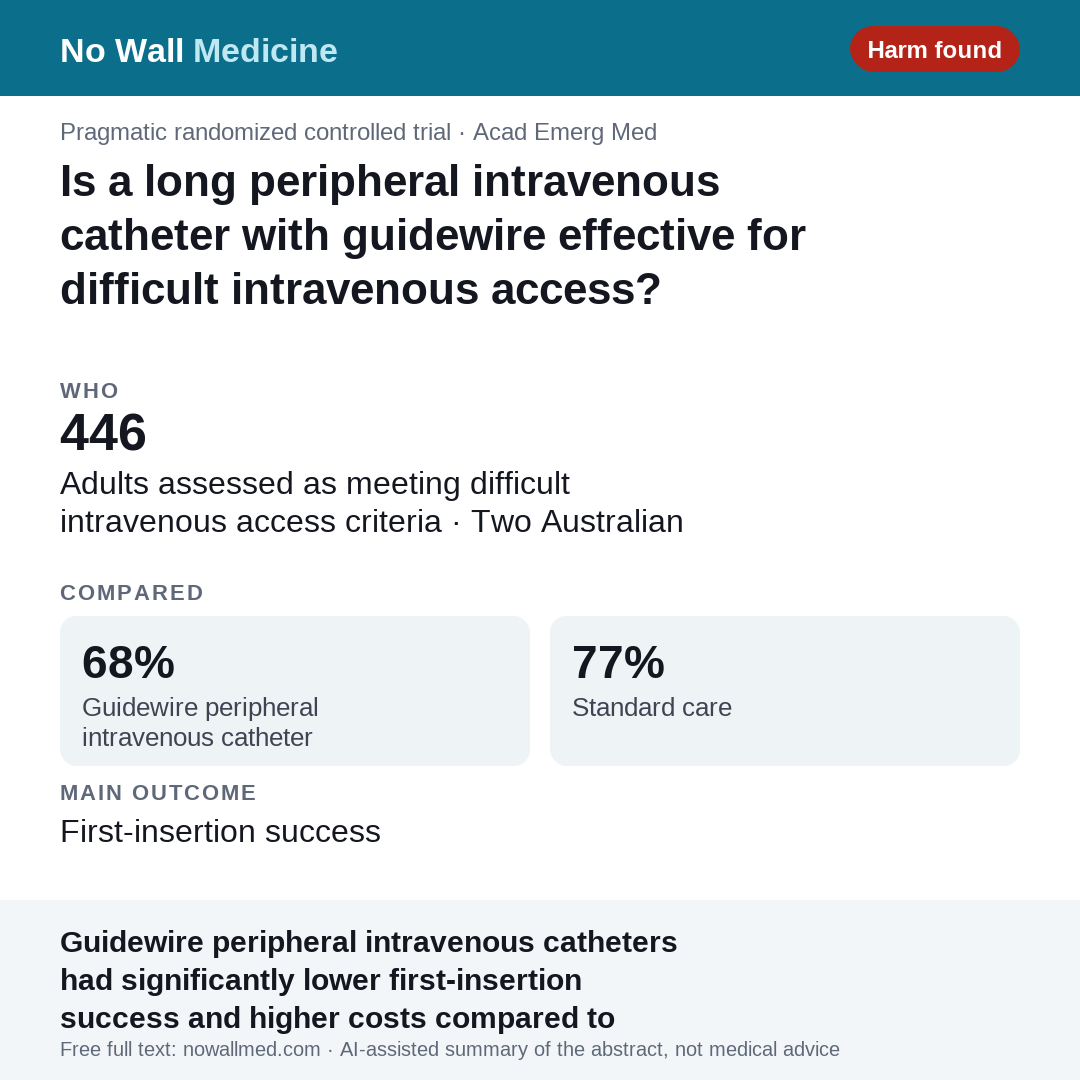
Is a long peripheral intravenous catheter with guidewire effective for difficult intravenous access?
Who
446
Adults assessed as meeting difficult intravenous access criteria · Two Australian emergency departments
Compared
68%Guidewire peripheral intravenous catheter
77%Standard care
Main outcome
First-insertion success
Result: odds ratio 0.65 (95% CI 0.43-0.99)
Bottom line: Guidewire peripheral intravenous catheters had significantly lower first-insertion success and higher costs compared to standard care.
Acad Emerg Med · 2024-09-09Download image
Clinical question: Is a long peripheral intravenous catheter with guidewire effective for difficult intravenous access?
Why it matters: It is unknown if a novel long catheter with a retractable coiled guidewire improves first-insertion success or cost-effectiveness for patients with difficult intravenous access.
In absolute numbers
Guidewire peripheral intravenous catheter: 68% · Standard care: 77% → a difference of 9 percentage points, so about 12 people would receive it for 1 more to be harmed (number needed to harm) over the trial’s follow-up.
Worked out by us from the two group results above, not reported by the authors. Check the paper for the exact outcome and timing.
Key points
- Researchers randomized 446 adults with difficult intravenous access to receive either a long catheter with a retractable coiled guidewire or standard care catheters.
- The guidewire catheter group had a lower first-insertion success rate of 68% compared to 77% for the standard care group.
- The cost per participant for guidewire catheter insertions was 2.46 times greater than standard catheter insertions at $AU80.24 versus $AU32.57.
Headline and key points written with AI from the paper’s abstract, with every number checked against it. Read the paper before relying on them.
Was this summary helpful?
Subject terms
Cite this article
Xu HG, Corley A, Young ER, Doubrovsky A, Ware RS, Afoakwah C. Long guidewire peripheral intravenous catheters in emergency departments for management of difficult intravenous access: A multicenter, pragmatic, randomized controlled trial. Acad Emerg Med. 2024. doi:10.1111/acem.15004
Spotted a mistake? Suggest a correction
Top studies every Monday
The week’s key trials and guidelines in your specialties, plus any topics you follow. By email, free.
Get the weekly digest