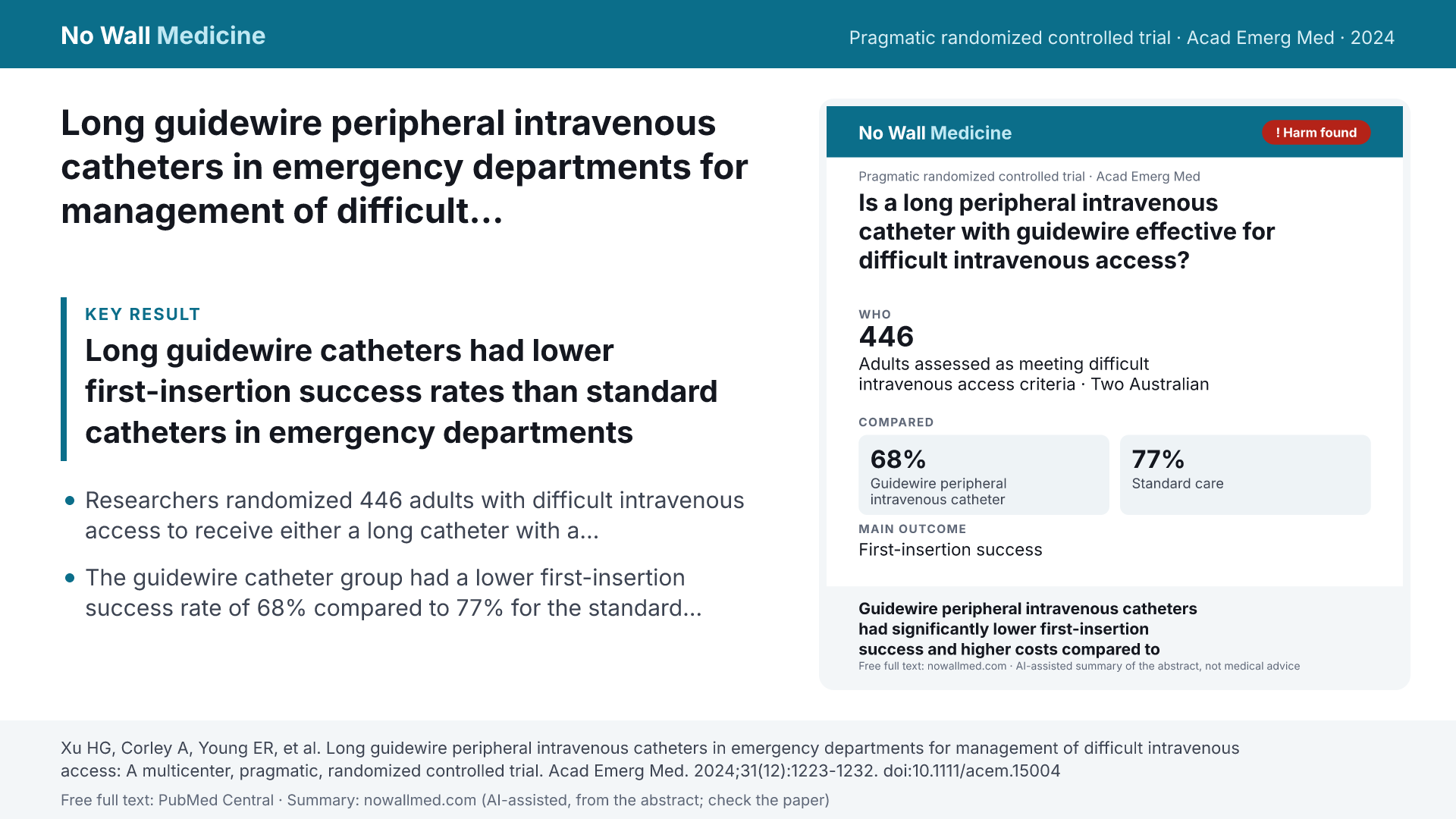
Long guidewire peripheral intravenous catheters in emergency departments for management of difficult intravenous access: A multicenter, pragmatic, randomized controlled trial
Key result: Long guidewire catheters had lower first-insertion success rates than standard catheters in emergency departments
Key points
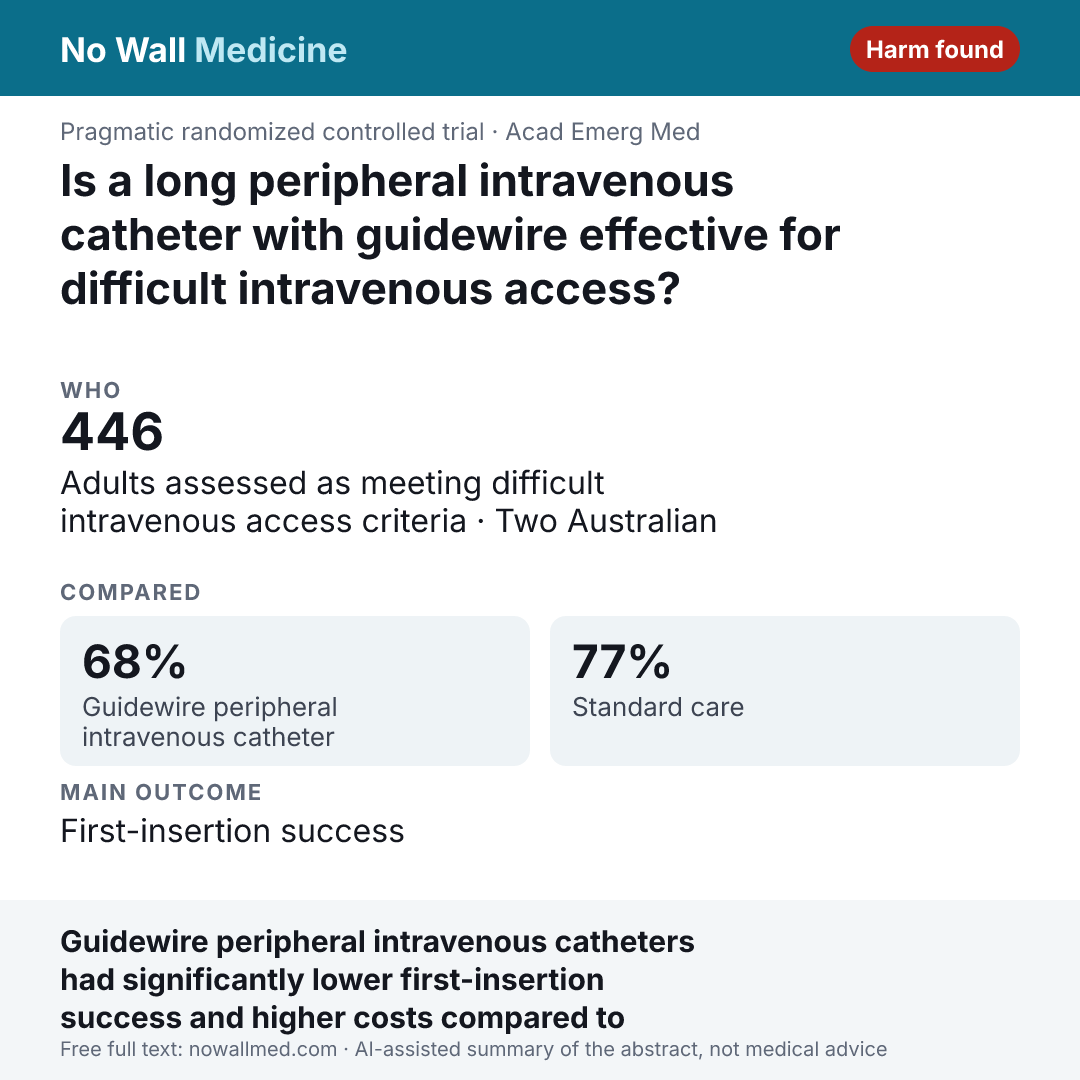
- Researchers randomized 446 adults with difficult intravenous access to receive either a long catheter with a retractable coiled guidewire or standard care catheters.
- The guidewire catheter group had a lower first-insertion success rate of 68% compared to 77% for the standard care group.
- The cost per participant for guidewire catheter insertions was 2.46 times greater than standard catheter insertions at $AU80.24 versus $AU32.57.
In absolute numbers: Guidewire peripheral intravenous catheter 68% vs Standard care 77%, a difference of 9 percentage points (about 12 people exposed for one more to be harmed).
Discussion prompts
- Would these patients look like yours? Who was left out?
- Is the main outcome one that matters to patients?
- Is the difference large enough to change what you do?
Cite: Xu HG, Corley A, Young ER, et al. Long guidewire peripheral intravenous catheters in emergency departments for management of difficult intravenous access: A multicenter, pragmatic, randomized controlled trial. Acad Emerg Med. 2024;31(12):1223-1232. doi:10.1111/acem.15004
Free full text: PubMed Central · Summary and visual abstract: nowallmed.com/a/long-guidewire-peripheral-intravenous-catheters-in-emergency-hpt4i1/ (AI-assisted from the abstract; check the paper before relying on it).