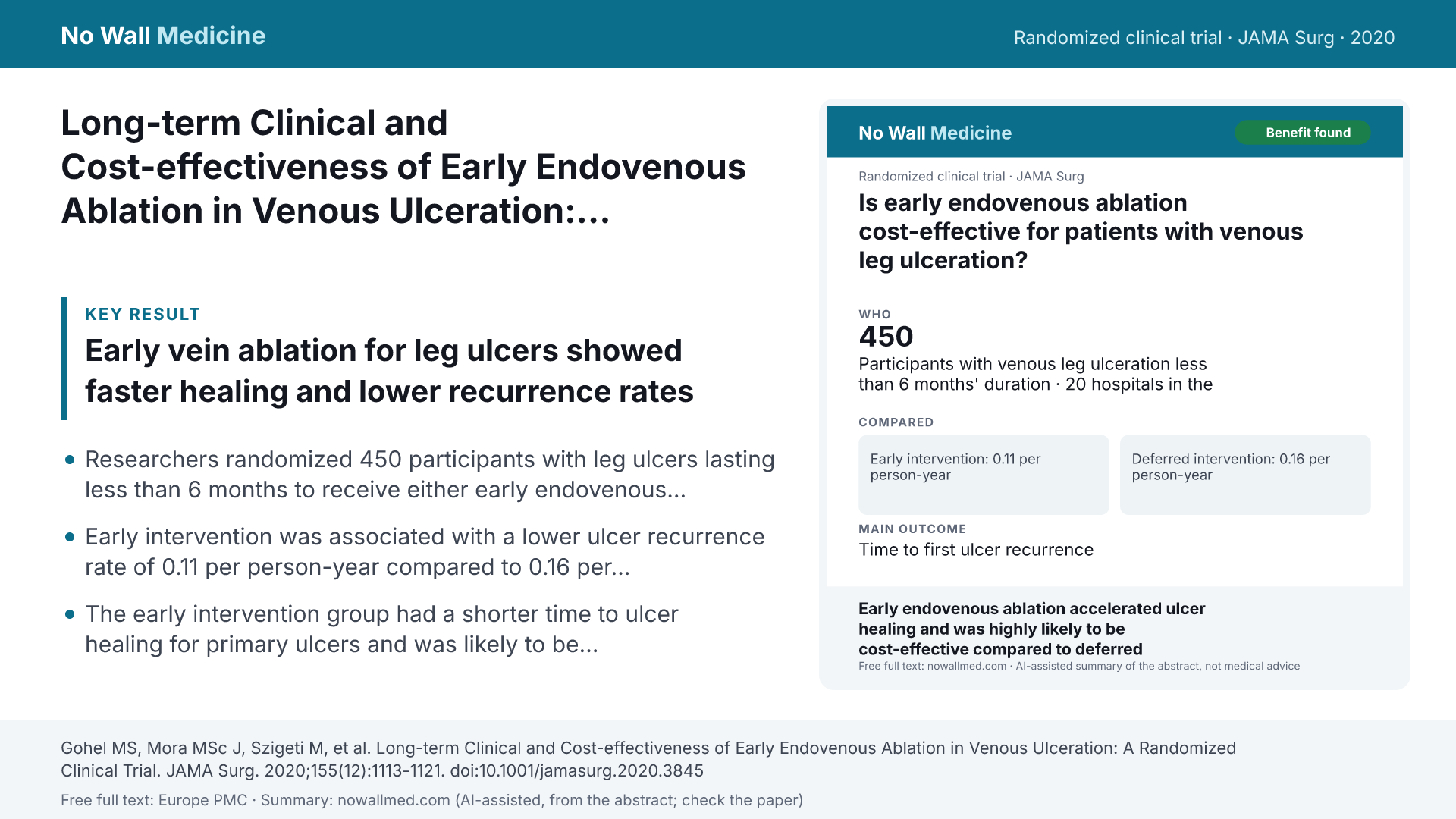
Early vein ablation for leg ulcers showed faster healing and lower recurrence rates
Long-term Clinical and Cost-effectiveness of Early Endovenous Ablation in Venous Ulceration: A Randomized Clinical Trial
Randomized clinical trialBenefit found
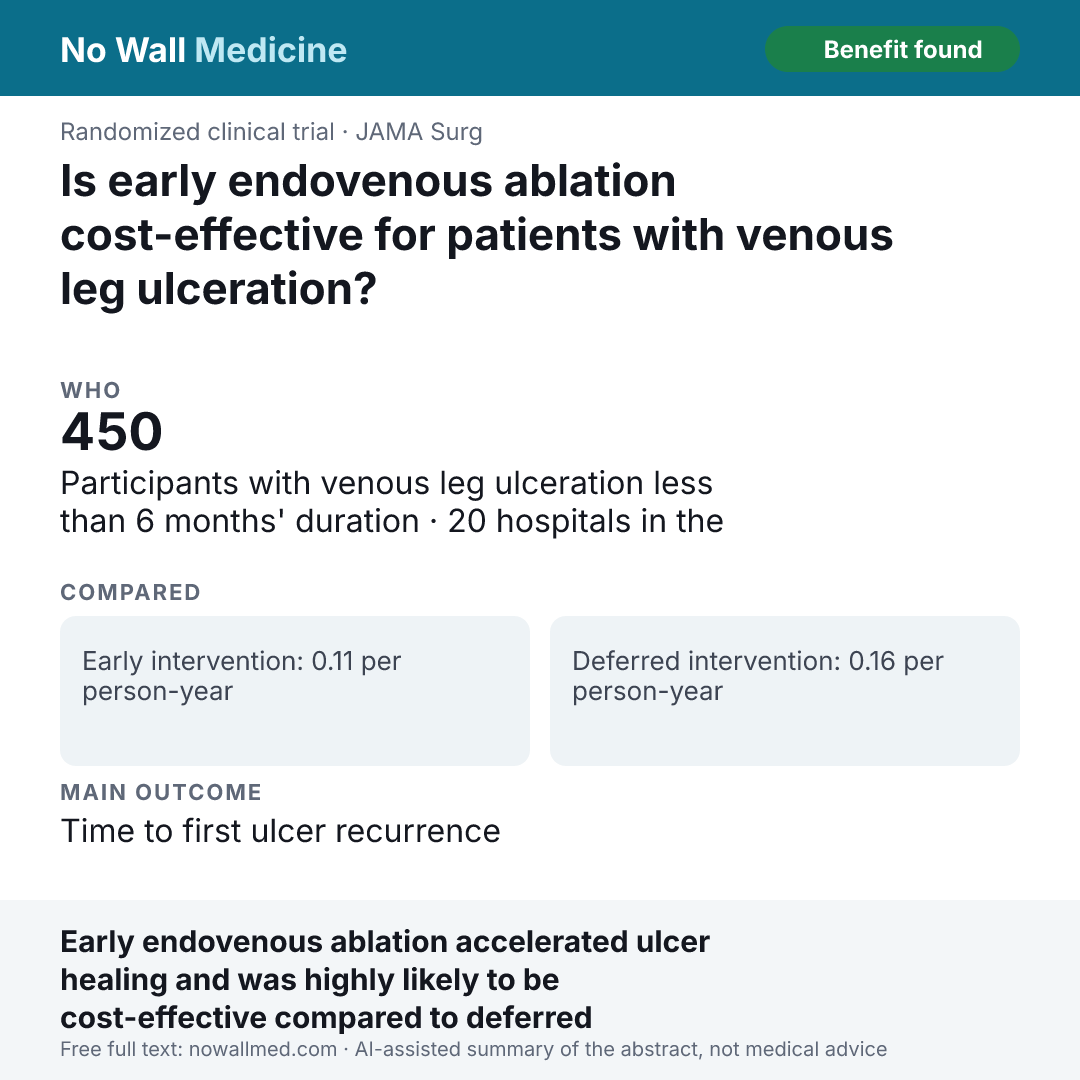
Is early endovenous ablation cost-effective for patients with venous leg ulceration?
Who
450
Participants with venous leg ulceration less than 6 months' duration · 20 hospitals in the United Kingdom
Compared
Early intervention: 0.11 per person-year
Deferred intervention: 0.16 per person-year
Main outcome
Time to first ulcer recurrence
Result: hazard ratio 0.82 (95% CI, 0.57-1.17)
Bottom line: Early endovenous ablation accelerated ulcer healing and was highly likely to be cost-effective compared to deferred intervention.
JAMA Surg · 2020-12-01 · ISRCTN02335796
Headline and visual abstract written with AI from the paper’s abstract, with every number checked against it. Read the paper before relying on them.
Was this summary helpful?
Abstract
Importance
One-year outcomes from the Early Venous Reflux Ablation (EVRA) randomized trial showed accelerated venous leg ulcer healing and greater ulcer-free time for participants who are treated with early endovenous ablation of lower extremity superficial reflux.Objective
To evaluate the clinical and cost-effectiveness of early endovenous ablation of superficial venous reflux in patients with venous leg ulceration.Design, setting, and participants
Between October 24, 2013, and September 27, 2016, the EVRA randomized clinical trial enrolled 450 participants (450 legs) with venous leg ulceration of less than 6 months' duration and superficial venous reflux. Initially, 6555 patients were assessed for eligibility, and 6105 were excluded for reasons including ulcer duration greater than 6 months, healed ulcer by the time of randomization, deep venous occlusive disease, and insufficient superficial venous reflux to warrant ablation therapy, among others. A total of 426 of 450 participants (94.7%) from the vascular surgery departments of 20 hospitals in the United Kingdom were included in the analysis for ulcer recurrence. Surgeons, participants, and follow-up assessors were not blinded to the treatment group. Data were analyzed from August 11 to November 4, 2019.Interventions
Patients were randomly assigned to receive compression therapy with early endovenous ablation within 2 weeks of randomization (early intervention, n = 224) or compression with deferred endovenous treatment of superficial venous reflux (deferred intervention, n = 226). Endovenous modality and strategy were left to the preference of the treating clinical team.Main outcomes and measures
The primary outcome for the extended phase was time to first ulcer recurrence. Secondary outcomes included ulcer recurrence rate and cost-effectiveness.Results
The early-intervention group consisted of 224 participants (mean [SD] age, 67.0 [15.5] years; 127 men [56.7%]; 206 White participants [92%]). The deferred-intervention group consisted of 226 participants (mean [SD] age, 68.9 [14.0] years; 120 men [53.1%]; 208 White participants [92%]). Of the 426 participants whose leg ulcer had healed, 121 (28.4%) experienced at least 1 recurrence during follow-up. There was no clear difference in time to first ulcer recurrence between the 2 groups (hazard ratio, 0.82; 95% CI, 0.57-1.17; P = .28). Ulcers recurred at a lower rate of 0.11 per person-year in the early-intervention group compared with 0.16 per person-year in the deferred-intervention group (incidence rate ratio, 0.658; 95% CI, 0.480-0.898; P = .003). Time to ulcer healing was shorter in the early-intervention group for primary ulcers (hazard ratio, 1.36; 95% CI, 1.12-1.64; P = .002). At 3 years, early intervention was 91.6% likely to be cost-effective at a willingness to pay of £20 000 ($26 283) per quality-adjusted life year and 90.8% likely at a threshold of £35 000 ($45 995) per quality-adjusted life year.Conclusions and relevance
Early endovenous ablation of superficial venous reflux was highly likely to be cost-effective over a 3-year horizon compared with deferred intervention. Early intervention accelerated the healing of venous leg ulcers and reduced the overall incidence of ulcer recurrence.Trial registration
ClinicalTrials.gov identifier: ISRCTN02335796.
Abstract reproduced under the article’s CC BY licence.
Subject terms
Cite this article
Gohel MS, Mora MSc J, Szigeti M, et al. Long-term Clinical and Cost-effectiveness of Early Endovenous Ablation in Venous Ulceration: A Randomized Clinical Trial. JAMA Surg. 2020;155(12):1113-1121. doi:10.1001/jamasurg.2020.3845
Spotted a mistake? Suggest a correction