Long-term complications of microtia reconstruction: A systematic review
Systematic reviewUnclear result
What are the long-term complications of autologous costal cartilage versus porous polyethylene implants?
Who
Patients with microtia undergoing auricular reconstruction
Compared
autologous costal cartilage: less than 10%
porous polyethylene implants: less than 15%
Main outcome
incidence of individual long-term complications
Bottom line: Long-term complication rates were less than 10% for autologous costal cartilage and less than 15% for porous polyethylene implants.
Limitation: Data synthesis was limited due to heterogeneity and poor study quality.
J Plast Reconstr Aesthet Surg · 2021-08-17Download image
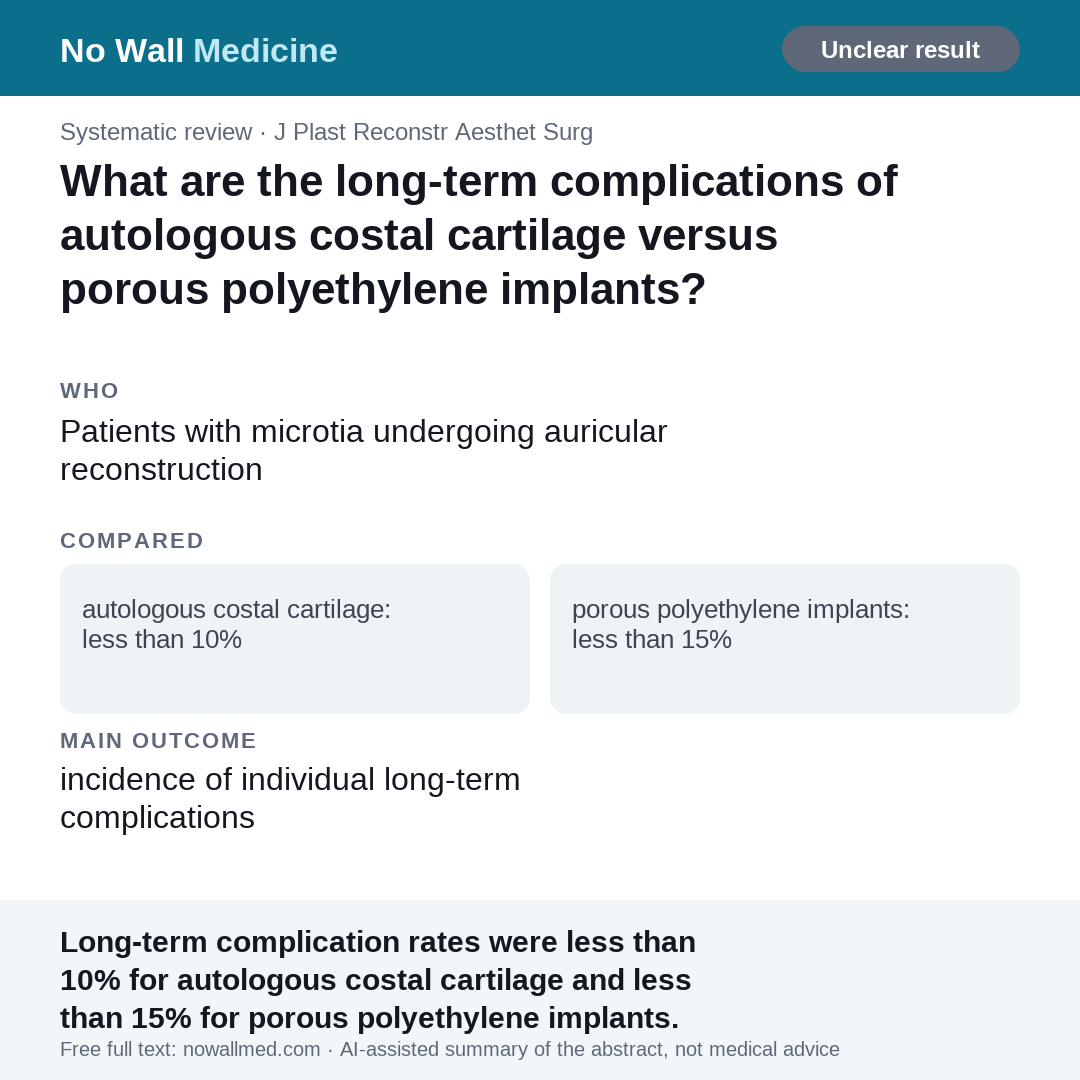
Clinical question: What are the long-term complications of autologous costal cartilage versus porous polyethylene implants?
Abstract
Background
Microtia is a rare disorder characterized by malformation or even complete absence of the auricle. Reconstruction is often performed using autologous costal cartilage (ACC) or porous polyethylene implants (PPE). However, the long-term outcomes of both methods are unclear. Objective
This systematic review aimed to analyze long-term complications and suggest minimal reporting criteria for future original data studies. Methods
A systematic literature search was conducted in MEDLINE, EMBASE and the Cochrane Central Register of Controlled Trials from inception through October 14, 2020. Articles on auricular reconstruction in patients with microtia using ACC or PPE were included provided that the follow-up period was at least one year. This publication focused on long-term complications reported in patients with a postoperative follow-up period of at least one year. Results
Twenty-nine publications reported on complications during long-term follow-up. Overall long-term complication rates were not reported. The incidence of individual complications during long-term follow-up was less than 10% after ACC reconstruction and less than 15% in PPE reconstruction. Framework resorption and wire exposure were reported even after an extended follow-up of more than five years after ACC reconstruction, while reports on the extended long-term results of PPE reconstruction are limited. Data synthesis was limited due to heterogeneity and poor study quality. Conclusions
Future studies should report on long-term complications including framework exposure or extrusion, graft loss, framework resorption, wire exposure and scalp and auricular scar complications. We recommend a surgical follow-up of at least five years.
Subject terms
Cite this article
Ronde EM, Esposito M, Lin Y, van Etten-Jamaludin FS, Bulstrode NW, Breugem CC. Long-term complications of microtia reconstruction: A systematic review. J Plast Reconstr Aesthet Surg. 2021. doi:10.1016/j.bjps.2021.08.001
Spotted a mistake? Suggest a correction
Top studies every Monday
The week’s key trials and guidelines in your specialties, plus any topics you follow. By email, free.
Get the weekly digest