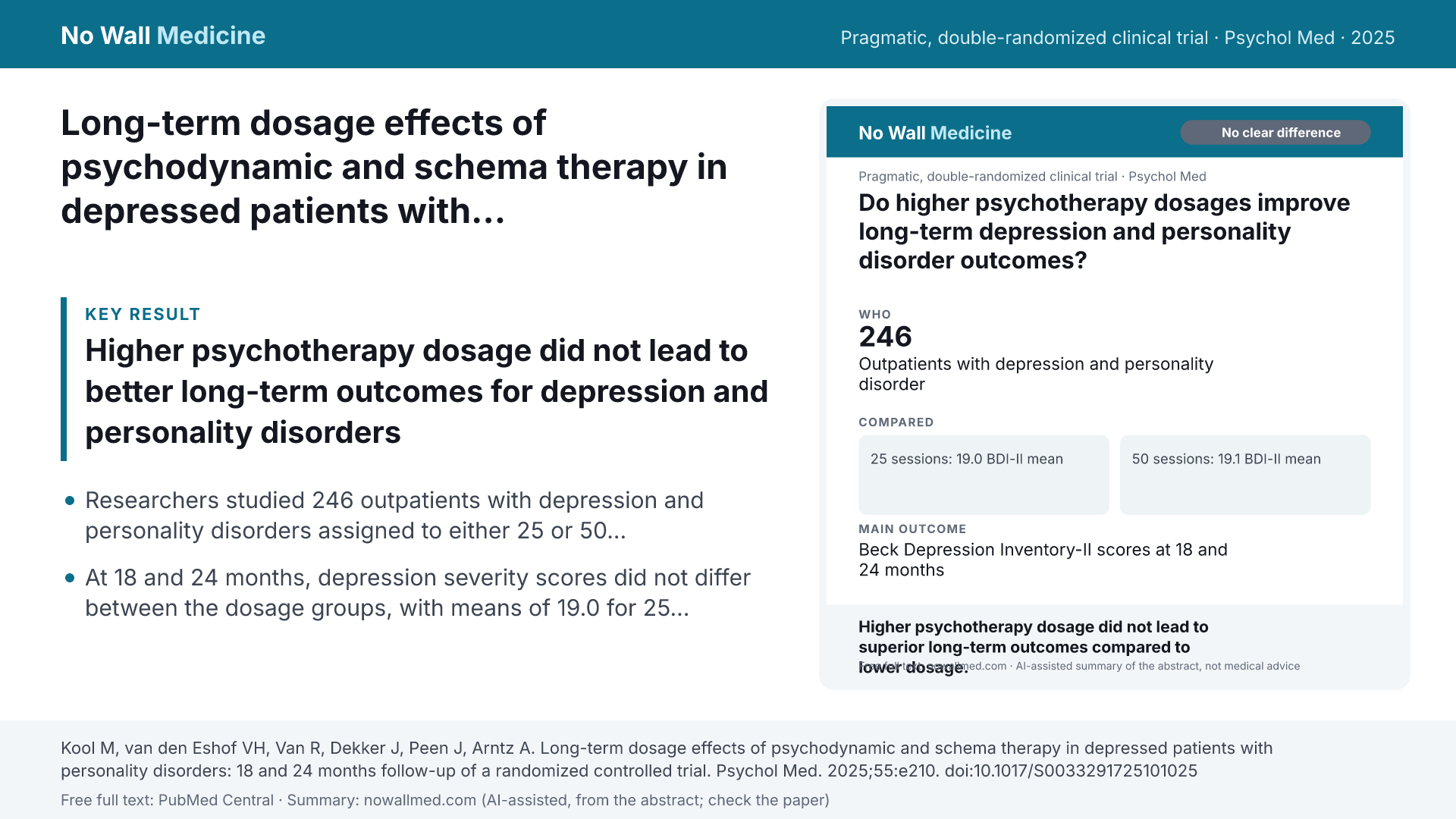
Higher psychotherapy dosage did not lead to better long-term outcomes for depression and personality disorders
Long-term dosage effects of psychodynamic and schema therapy in depressed patients with personality disorders: 18 and 24 months follow-up of a randomized controlled trial
Pragmatic, double-randomized clinical trialNo clear difference
Do higher psychotherapy dosages improve long-term depression and personality disorder outcomes?
Who
246
Outpatients with depression and personality disorder
Compared
25 sessions: 19.0 BDI-II mean
50 sessions: 19.1 BDI-II mean
Main outcome
Beck Depression Inventory-II scores at 18 and 24 months
Result: d = -0.01 (95% CI -0.35 to 0.37)
Bottom line: Higher psychotherapy dosage did not lead to superior long-term outcomes compared to lower dosage.
Limitation: Unregulated treatment during follow-up reduced the power to detect significant dosage effects.
Psychol Med · 2025-07-22 · Save PNG
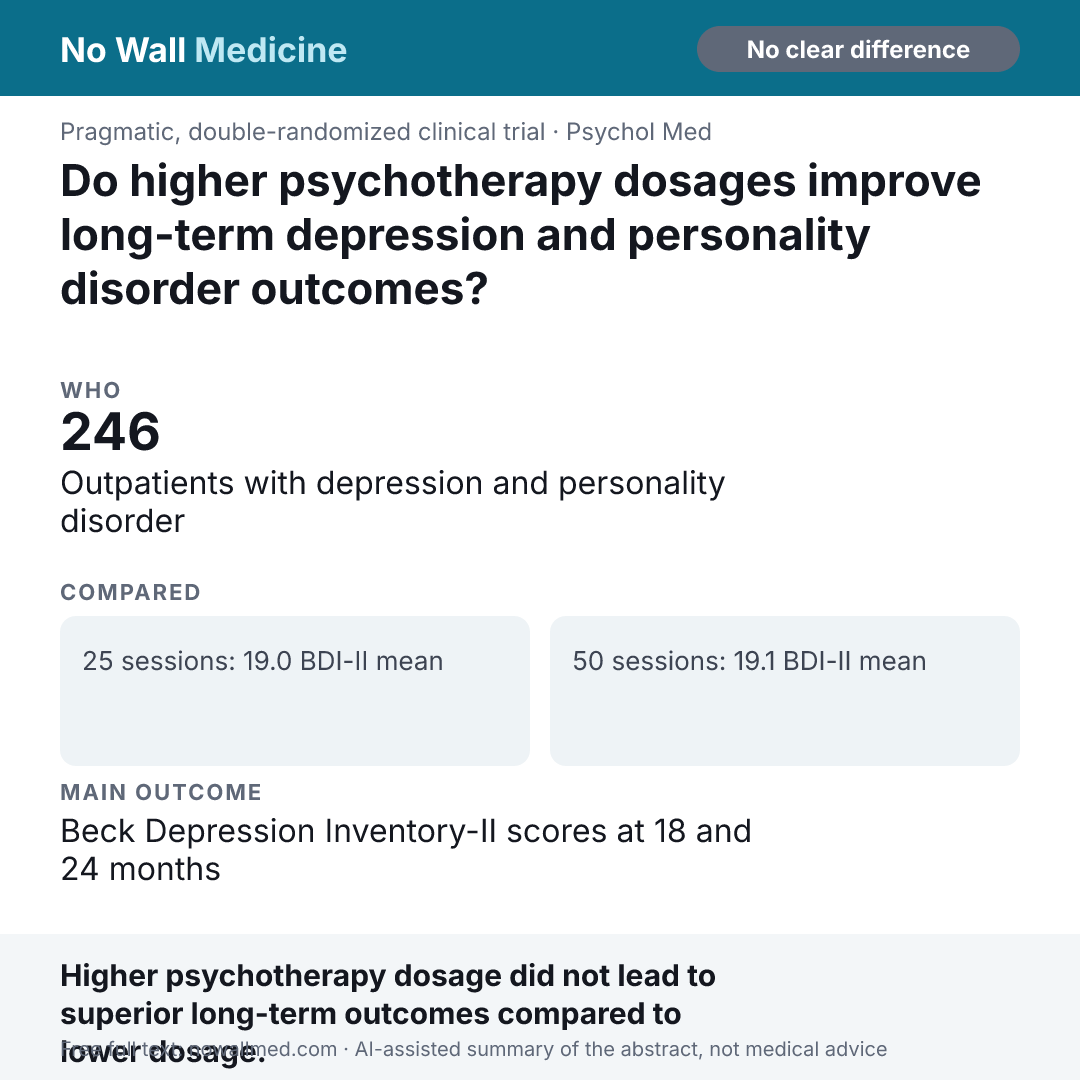
Clinical question: Do higher psychotherapy dosages improve long-term depression and personality disorder outcomes?
Key points
- Researchers studied 246 outpatients with depression and personality disorders assigned to either 25 or 50 therapy sessions using either psychodynamic supportive psychotherapy or schema therapy.
- At 18 and 24 months, depression severity scores did not differ between the dosage groups, with means of 19.0 for 25 sessions versus 19.1 for 50 sessions.
- At 24 months, remission rates were 66% for depression and 76% for personality disorders, with no differences found between the treatment types.
Limitation the authors note: Unregulated treatment during the follow-up period may have reduced the power to detect significant differences between dosage groups.
Headline and key points written with AI from the paper’s abstract, with every number checked against it. Read the paper before relying on them.
Was this summary helpful?
Subject terms
Headline, design, result, key points, caveat and citation as plain text.
Cite this article
Kool M, van den Eshof VH, Van R, Dekker J, Peen J, Arntz A. Long-term dosage effects of psychodynamic and schema therapy in depressed patients with personality disorders: 18 and 24 months follow-up of a randomized controlled trial. Psychol Med. 2025;55:e210. doi:10.1017/S0033291725101025
Spotted a mistake? Suggest a correction