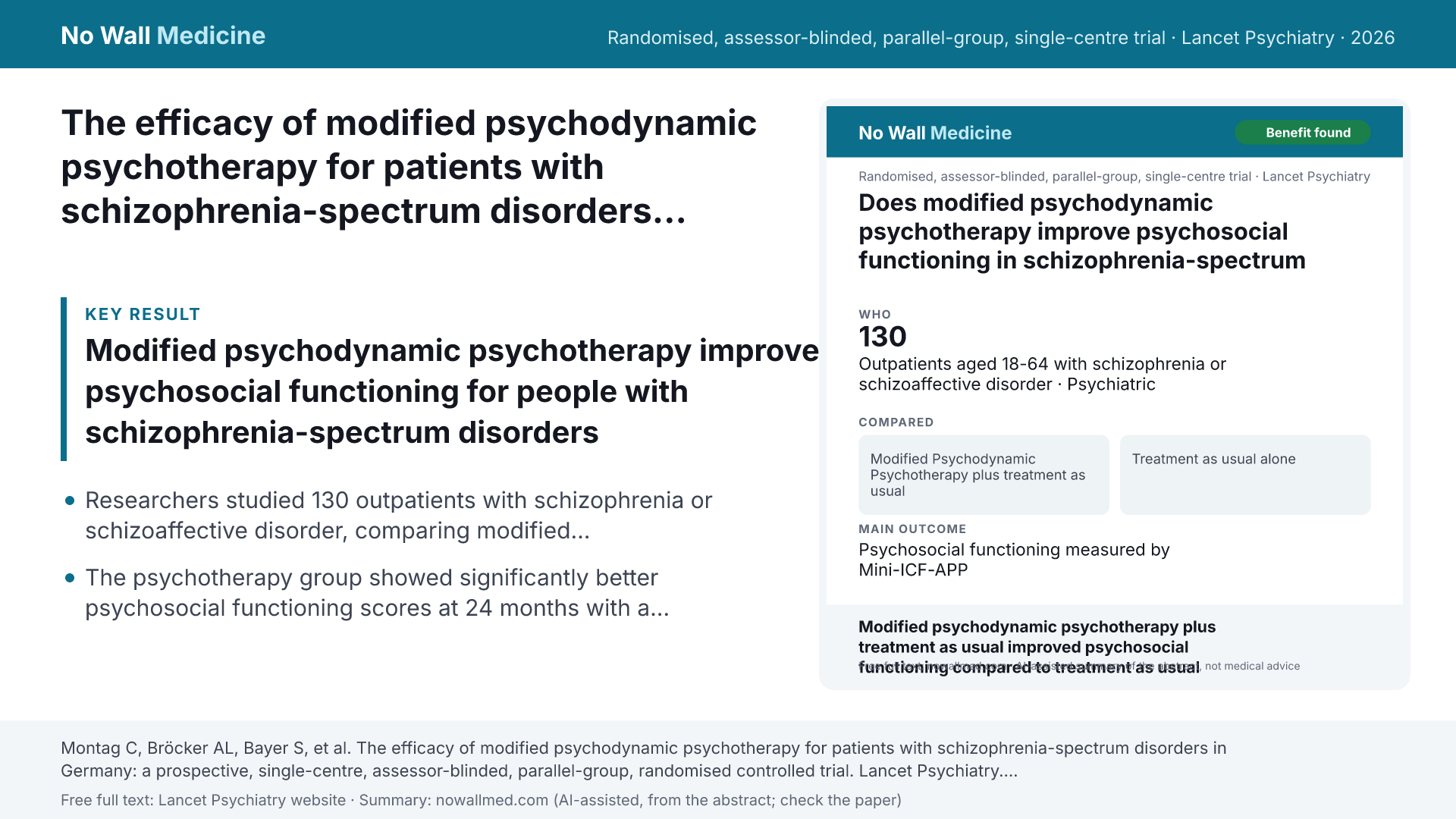
Modified psychodynamic psychotherapy improved psychosocial functioning for people with schizophrenia-spectrum disorders
The efficacy of modified psychodynamic psychotherapy for patients with schizophrenia-spectrum disorders in Germany: a prospective, single-centre, assessor-blinded, parallel-group, randomised controlled trial
Randomised, assessor-blinded, parallel-group, single-centre trialBenefit found
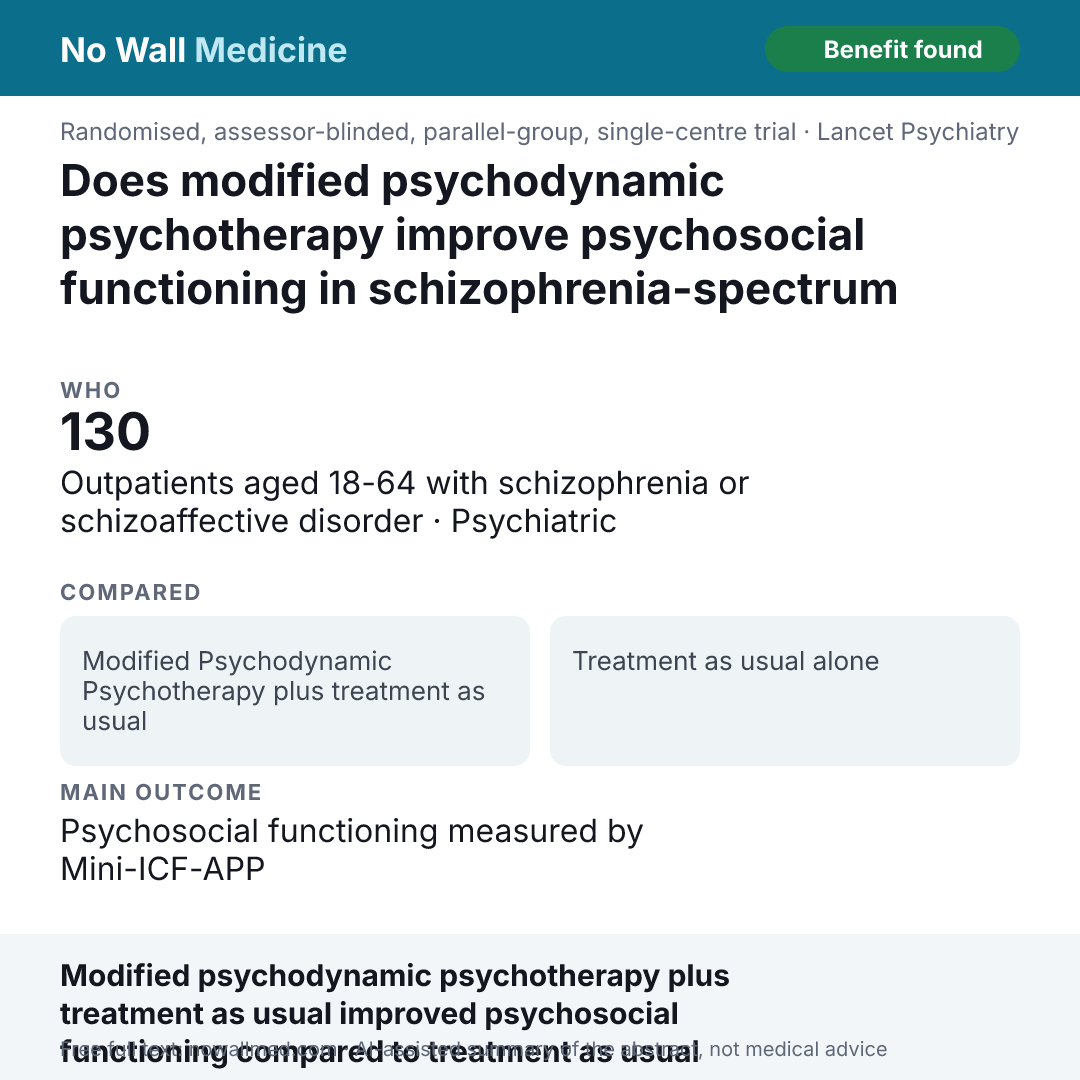
Does modified psychodynamic psychotherapy improve psychosocial functioning in schizophrenia-spectrum disorders?
Who
130
Outpatients aged 18-64 with schizophrenia or schizoaffective disorder · Psychiatric University Hospital in Berlin, Germany
Compared
Modified Psychodynamic Psychotherapy plus treatment as usual
Treatment as usual alone
Main outcome
Psychosocial functioning measured by Mini-ICF-APP
Result: adjusted between-group differences in Mini-ICF-APP scores of -3·45 (95% CI -5·51 to -1·40) at 24 months
Bottom line: Modified psychodynamic psychotherapy plus treatment as usual improved psychosocial functioning compared to treatment as usual alone.
Limitation: Participants and therapists were not masked to the treatment allocation.
Funded by: Berlin Institute of Health and others
Lancet Psychiatry · 2026-09-09 · Save PNG
Clinical question: Does modified psychodynamic psychotherapy improve psychosocial functioning in schizophrenia-spectrum disorders?
Why it matters: People with schizophrenia-spectrum disorders have interpersonal functioning difficulties that are not sufficiently addressed by standard care, and psychodynamic psychotherapy lacks empirical support for this population.
Key points
- Researchers studied 130 outpatients with schizophrenia or schizoaffective disorder, comparing modified psychodynamic psychotherapy plus standard care to standard care alone.
- The psychotherapy group showed significantly better psychosocial functioning scores at 24 months with a difference of -3.45 and at 36 months with a difference of -4.07.
- The frequency of adverse events was similar between the two groups, though three serious adverse events including two suicides occurred.
Limitation the authors note: This was a single-centre trial conducted at one psychiatric university hospital in Berlin, Germany.
Headline and key points written with AI from the paper’s abstract, with every number checked against it. Read the paper before relying on them.
Was this summary helpful?
Abstract
Background
People with schizophrenia-spectrum disorders have difficulties in interpersonal functioning that remain insufficiently addressed by standard care. Despite long-standing clinical use, psychodynamic psychotherapy has little empirical support compared with other psychosocial treatments for people with schizophrenia-spectrum disorders. We evaluated the efficacy of Modified Psychodynamic Psychotherapy for Schizophrenia (MPP-S), a manualised treatment tailored to the interpersonal vulnerability characteristic of this population, plus treatment as usual (TAU), compared with TAU alone. Methods
This prospective, single-centre, assessor-blinded, parallel-group, randomised controlled trial was conducted at the Psychiatric University Hospital of the Charité at St Hedwig Hospital in Berlin, Germany. Participants were outpatients aged 18-64 years who were diagnosed with schizophrenia or schizoaffective disorder and exclusion criteria included organic brain disorder, somatic illness affecting cerebral function, and current or past alcohol or illicit drug misuse requiring addiction-specific treatment. Participants were randomly assigned 1:1 in blocks of ten to MPP-S (minimum 30 sessions) plus TAU or TAU alone. Outcome assessors were masked, but participants and therapists were not. The primary outcome was psychosocial functioning, measured using the Mini International Classification of Functioning, Disability and Health Rating for Limitations of Activities and Participation in Psychological Disorders (Mini-ICF-APP) and evaluated at baseline and prespecified post-treatment (24 months) and follow-up (36 months) assessments. Analyses followed the intention-to-treat principle. Linear mixed models were used to analyse incomplete longitudinal data under a missing-at-random assumption. People with lived experience were not formally involved in the design, conduct, or reporting of this study. This trial was preregistered at ClinicalTrials.gov (NCT02576613) and is complete. Findings
From Oct 12, 2015, to Dec 7, 2021, 130 participants (57 [44%] female and 73 [56%] male) were randomly assigned to either MPP-S plus TAU (n=65) or TAU alone (n=64). One participant withdrew consent to data analysis. Regarding the primary outcome of psychosocial functioning, linear mixed models showed significant group-by-time interactions favouring the intervention: estimated marginal means indicated adjusted between-group differences in Mini-ICF-APP scores of -3·45 (95% CI -5·51 to -1·40; p=0·0011) at 24 months and -4·07 (-6·19 to -1·94; p=0·0002) at 36 months. The frequency of adverse events was similar between groups. There were three serious adverse events: two participants died by suicide (one in the MPP-S plus TAU group who did not start psychotherapy and one in the TAU alone group) and one participant in the MPP-S plus TAU group was admitted to a forensic hospital. Interpretation
MPP-S added to TAU could improve psychosocial functioning compared with TAU alone. Our findings suggest efficacy and possible long-term benefits of psychodynamic psychotherapy for schizophrenia-spectrum disorders and indicate its potential role alongside other psychotherapeutic and psychosocial treatments. Funding
Berlin Institute of Health, Deutsche Gesellschaft für Psychoanalyse, Psychotherapie, Psychosomatik und Tiefenpsychologie, International Psychoanalytic University Berlin, and Köhler-Stiftung.
Abstract reproduced under the article’s CC BY licence.
Subject terms
Headline, design, result, key points, caveat and citation as plain text.
Cite this article
Montag C, Bröcker AL, Bayer S, et al. The efficacy of modified psychodynamic psychotherapy for patients with schizophrenia-spectrum disorders in Germany: a prospective, single-centre, assessor-blinded, parallel-group, randomised controlled trial. Lancet Psychiatry. 2026;13(10):870-883. doi:10.1016/S2215-0366(26)00240-3
Spotted a mistake? Suggest a correction