Machine learning nudges increased serious illness conversations and decreased end-of-life therapy in cancer patients
Long-term Effect of Machine Learning-Triggered Behavioral Nudges on Serious Illness Conversations and End-of-Life Outcomes Among Patients With Cancer: A Randomized Clinical Trial
Stepped-wedge randomized clinical trialMixed results
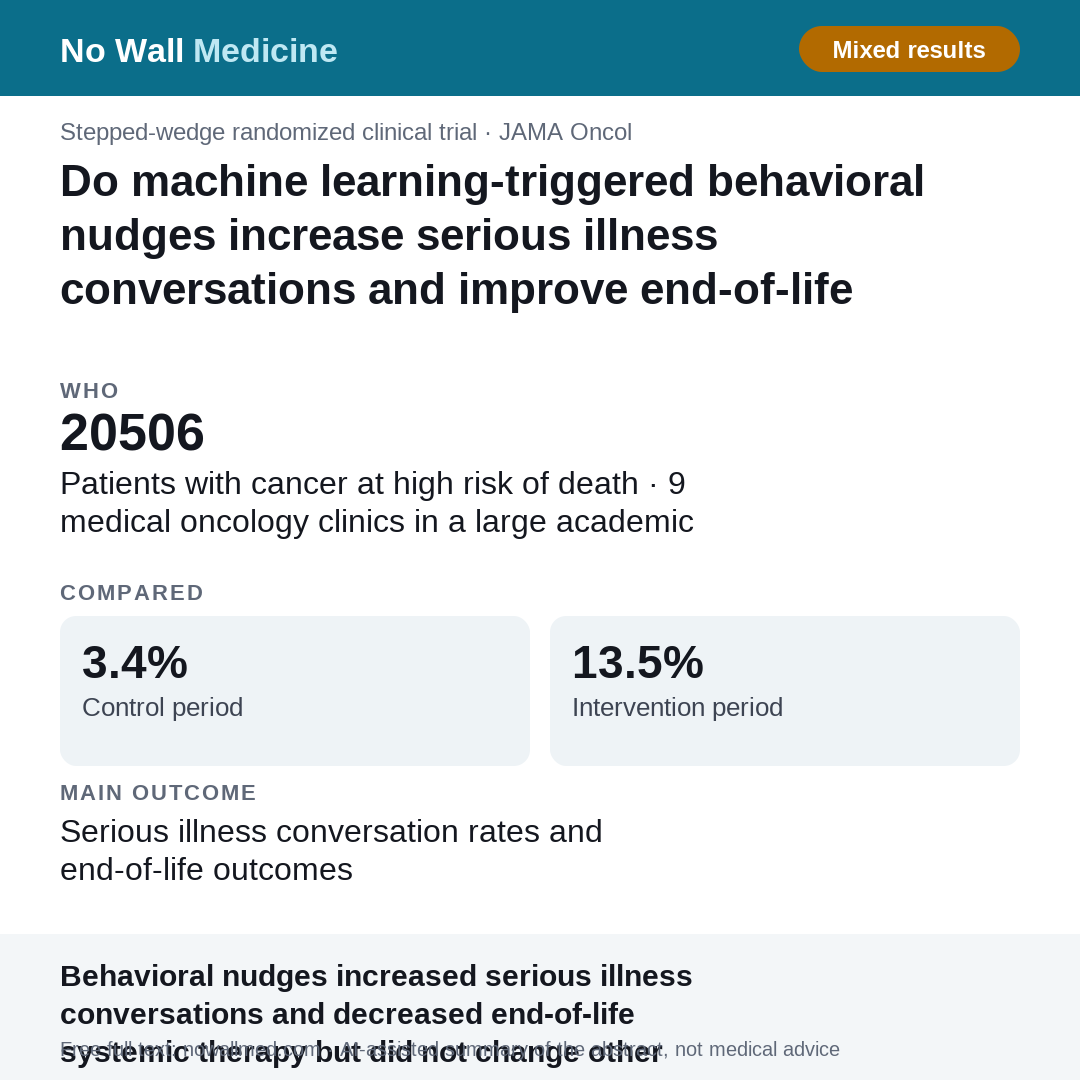
Do machine learning-triggered behavioral nudges increase serious illness conversations and improve end-of-life outcomes?
Who
20506
Patients with cancer at high risk of death · 9 medical oncology clinics in a large academic health system
Compared
3.4%Control period (59 of 1754 encounters)
13.5%Intervention period (510 of 3765 encounters)
Main outcome
Serious illness conversation rates and end-of-life outcomes
Result: adjusted odds ratio 2.09 (95% CI 1.53-2.87)
Bottom line: Behavioral nudges increased serious illness conversations and decreased end-of-life systemic therapy but did not change other end-of-life outcomes.
JAMA Oncol · 2023-01-13Download image
Clinical question: Do machine learning-triggered behavioral nudges increase serious illness conversations and improve end-of-life outcomes?
Why it matters: Most patients with cancer die without a documented serious illness conversation between their clinician and themselves.
Key points
- The study followed 20,506 cancer patients across 41,021 encounters at nine medical oncology clinics.
- Clinician nudges were associated with increased serious illness conversation rates and decreased end-of-life systemic therapy (7.5% vs 10.4%).
- The intervention was not associated with changes in hospice enrollment, length of stay, inpatient death, or intensive care unit use.
Headline and key points written with AI from the paper’s abstract, with every number checked against it. Read the paper before relying on them.
Was this summary helpful?
Subject terms
Cite this article
Manz CR, Zhang Y, Chen K, Long Q, Small DS, Evans CN. Long-term Effect of Machine Learning-Triggered Behavioral Nudges on Serious Illness Conversations and End-of-Life Outcomes Among Patients With Cancer: A Randomized Clinical Trial. JAMA Oncol. 2023. doi:10.1001/jamaoncol.2022.6303
Spotted a mistake? Suggest a correction
Top studies every Monday
The week’s key trials and guidelines in your specialties, plus any topics you follow. By email, free.
Get the weekly digest