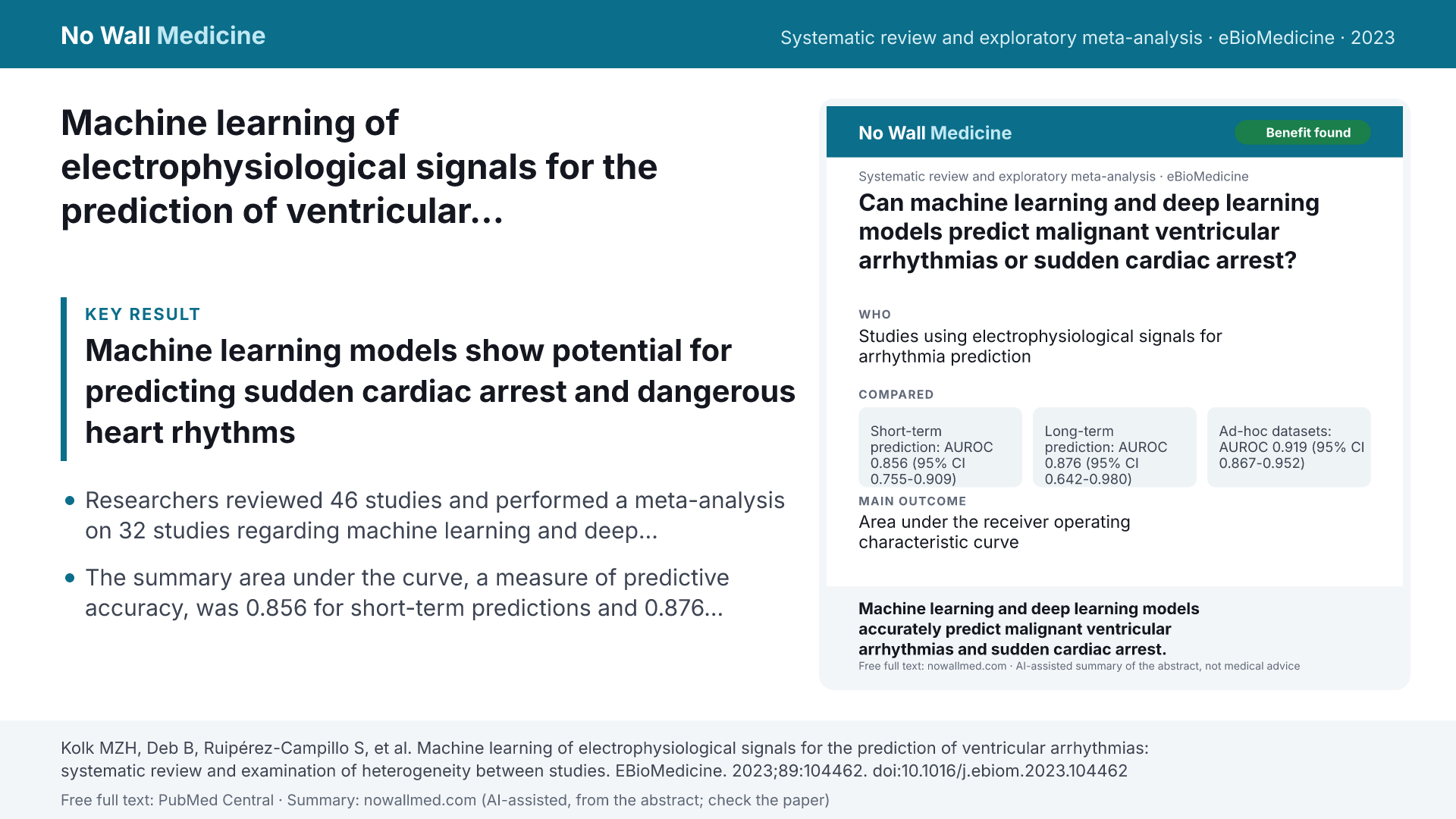
Machine learning models show potential for predicting sudden cardiac arrest and dangerous heart rhythms
Machine learning of electrophysiological signals for the prediction of ventricular arrhythmias: systematic review and examination of heterogeneity between studies
Systematic review and exploratory meta-analysisBenefit found
Can machine learning and deep learning models predict malignant ventricular arrhythmias or sudden cardiac arrest?
Who
Studies using electrophysiological signals for arrhythmia prediction
Compared
Short-term prediction: AUROC 0.856 (95% CI 0.755-0.909)
Long-term prediction: AUROC 0.876 (95% CI 0.642-0.980)
Ad-hoc datasets: AUROC 0.919 (95% CI 0.867-0.952)
Main outcome
Area under the receiver operating characteristic curve
Result: summary AUROC 0.856 (95% CI 0.755-0.909) for short-term prediction
Bottom line: Machine learning and deep learning models accurately predict malignant ventricular arrhythmias and sudden cardiac arrest.
Limitation: Wide heterogeneity and high risk of bias in models using small ad-hoc datasets.
Funded by: Dutch Research Council and Amsterdam Cardiovascular Sciences
eBioMedicine · 2023-02-09Download image
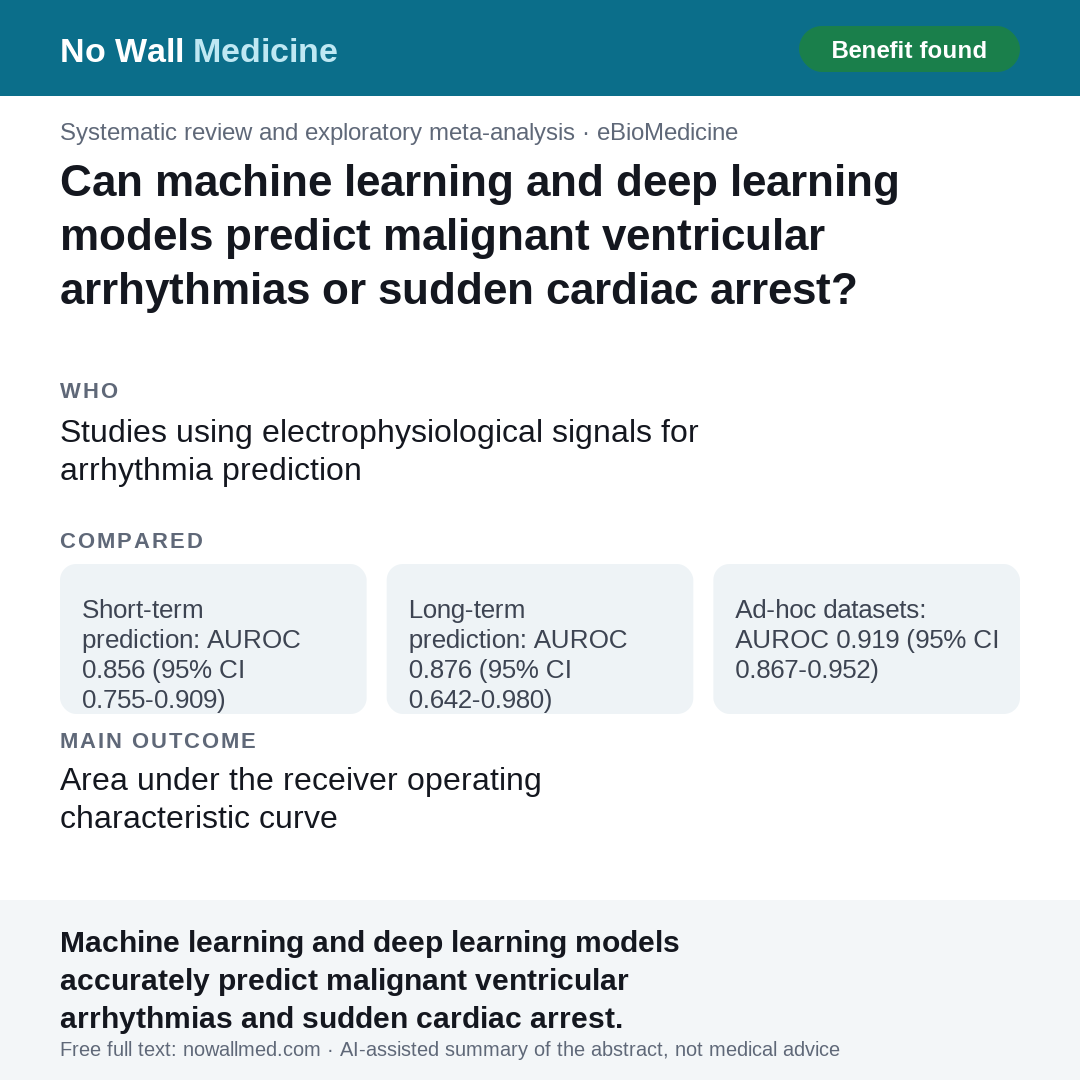
Clinical question: Can machine learning and deep learning models predict malignant ventricular arrhythmias or sudden cardiac arrest?
Why it matters: It is unknown how accurately machine learning and deep learning models can predict malignant ventricular arrhythmias or sudden cardiac arrest using electrophysiological signals.
Key points
- Researchers reviewed 46 studies and performed a meta-analysis on 32 studies regarding machine learning and deep learning models for predicting malignant ventricular arrhythmias.
- The summary area under the curve, a measure of predictive accuracy, was 0.856 for short-term predictions and 0.876 for long-term predictions.
- Models using ad-hoc datasets had a higher pooled performance of 0.919 but carried a high risk of bias due to small datasets and lack of external validation.
Limitation the authors note: Wide heterogeneity between studies, caused by small ad-hoc datasets and different model choices, may reduce the ability to generalize results.
Headline and key points written with AI from the paper’s abstract, with every number checked against it. Read the paper before relying on them.
Was this summary helpful?
Subject terms
Cite this article
Kolk MZH, Deb B, Ruipérez-Campillo S, et al. Machine learning of electrophysiological signals for the prediction of ventricular arrhythmias: systematic review and examination of heterogeneity between studies. eBioMedicine. 2023. doi:10.1016/j.ebiom.2023.104462
Spotted a mistake? Suggest a correction