Peer-led asthma self-management programs improved quality of life and control in urban adolescents
Long-term Effectiveness of a Peer-Led Asthma Self-management Program on Asthma Outcomes in Adolescents Living in Urban Areas: A Randomized Clinical Trial
Parallel-group, randomized clinical trialBenefit found
Does a peer-led asthma self-management program improve long-term asthma outcomes in urban adolescents?
Who
320
Adolescents aged 12 to 17 years with persistent asthma · 3 metropolitan cities in the US
Compared
0.75Peer-led asthma self-management program
0.37Adult-led asthma self-management program
Main outcome
Pediatric Asthma Quality of Life Questionnaire score
Result: between-group adjusted mean difference 0.38 (95% CI 0.07 to 0.63)
Bottom line: A peer-led asthma self-management program was more effective than adult-led programs for improving quality of life and asthma control.
JAMA Netw Open · 2021-12-01Download image
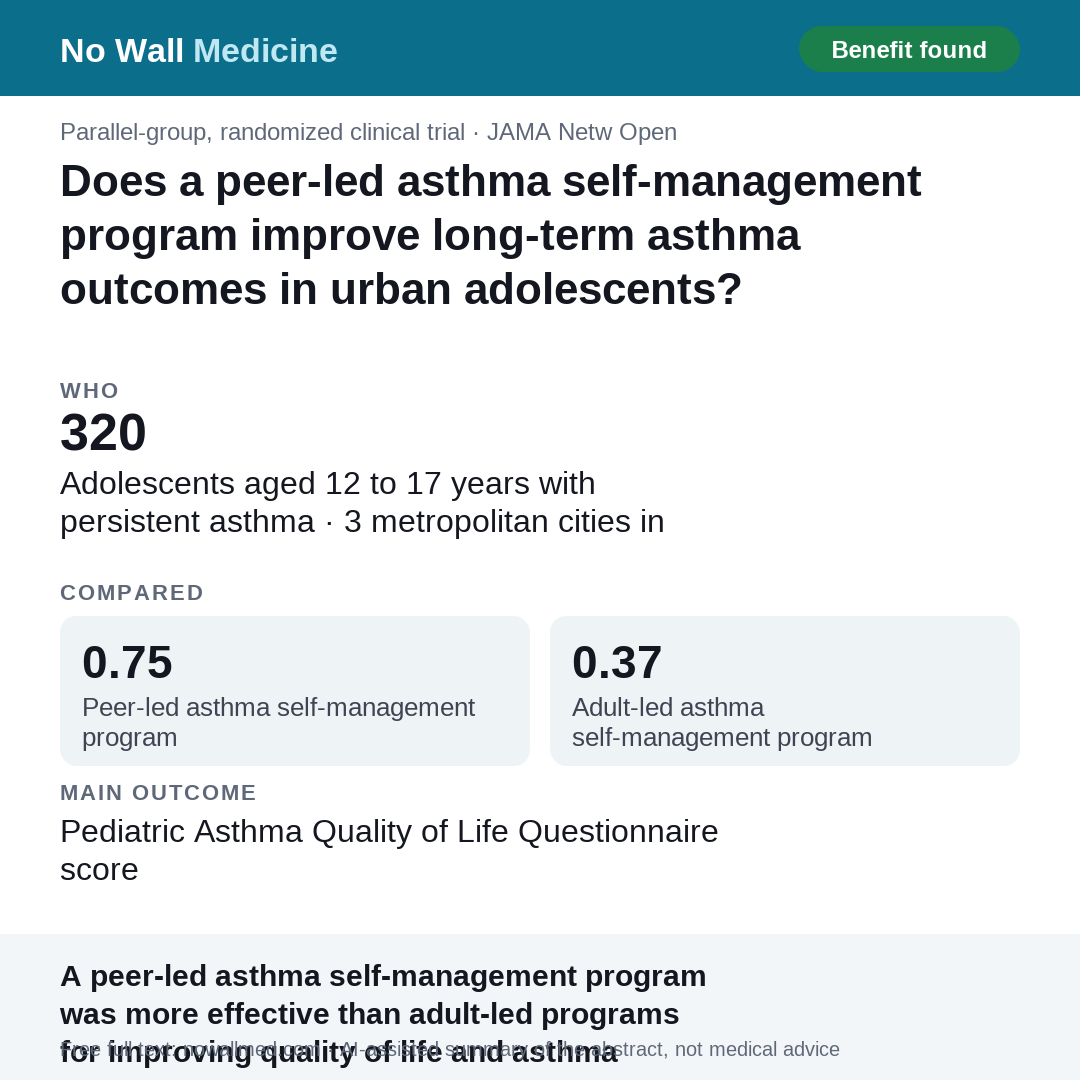
Clinical question: Does a peer-led asthma self-management program improve long-term asthma outcomes in urban adolescents?
Why it matters: The long-term effectiveness of peer-led asthma self-management programs for urban adolescents, particularly those from racial and ethnic minority backgrounds, has not been established.
Key points
- Researchers conducted a randomized clinical trial with 303 adolescents aged 12 to 17 years living in three metropolitan cities in the US.
- The peer-led group showed greater improvements in quality of life with an adjusted mean difference of 0.75 compared to 0.37 in the adult-led group.
- Asthma control also showed greater improvement in the peer-led group with an adjusted mean difference of -0.59 compared to -0.31 in the adult-led group.
Headline and key points written with AI from the paper’s abstract, with every number checked against it. Read the paper before relying on them.
Was this summary helpful?
Subject terms
Cite this article
Rhee H, Love T, Wicks MN, Tumiel-Berhalter L, Sloand E, Harrington D. Long-term Effectiveness of a Peer-Led Asthma Self-management Program on Asthma Outcomes in Adolescents Living in Urban Areas: A Randomized Clinical Trial. JAMA Netw Open. 2021. doi:10.1001/jamanetworkopen.2021.37492
Spotted a mistake? Suggest a correction
Top studies every Monday
The week’s key trials and guidelines in your specialties, plus any topics you follow. By email, free.
Get the weekly digest