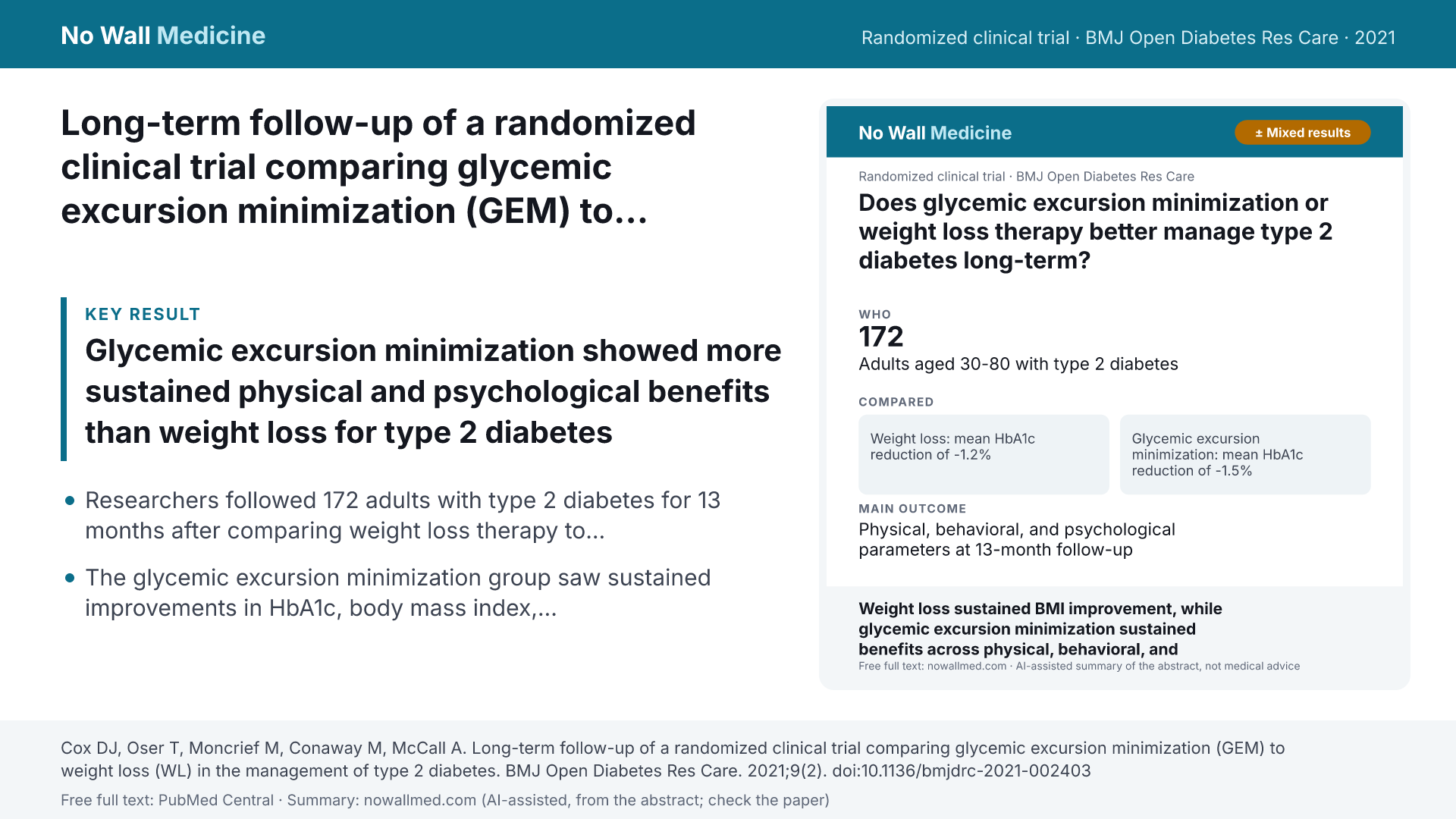
Glycemic excursion minimization showed more sustained physical and psychological benefits than weight loss for type 2 diabetes
Long-term follow-up of a randomized clinical trial comparing glycemic excursion minimization (GEM) to weight loss (WL) in the management of type 2 diabetes
Randomized clinical trialMixed results
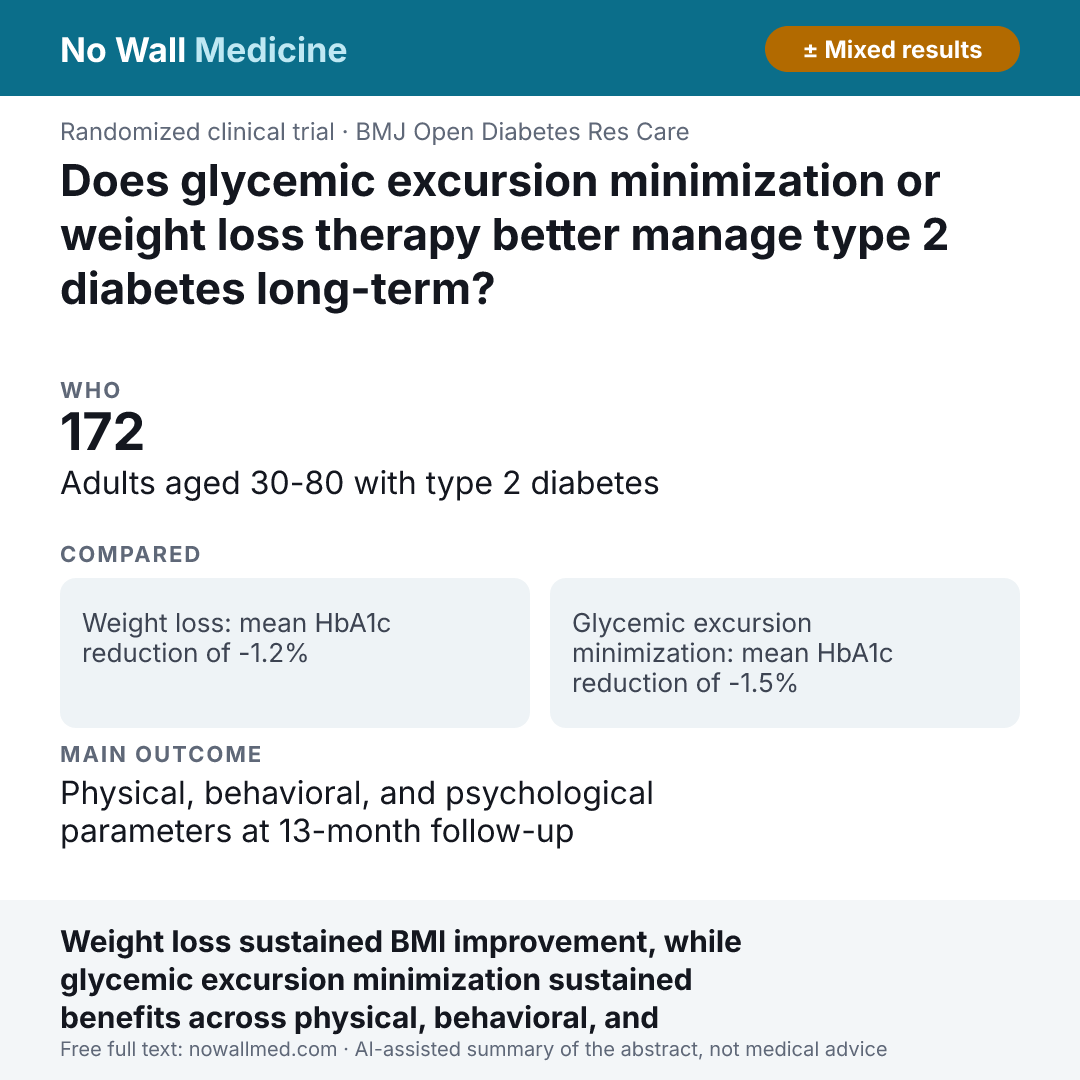
Does glycemic excursion minimization or weight loss therapy better manage type 2 diabetes long-term?
Who
172
Adults aged 30-80 with type 2 diabetes
Compared
Weight loss: mean HbA1c reduction of -1.2%
Glycemic excursion minimization: mean HbA1c reduction of -1.5%
Main outcome
Physical, behavioral, and psychological parameters at 13-month follow-up
Bottom line: Weight loss sustained BMI improvement, while glycemic excursion minimization sustained benefits across physical, behavioral, and psychological parameters.
BMJ Open Diabetes Res Care · 2021-11-30 · Save PNG
Same trial (NCT03196895)
Papers we list that report this registered trial, oldest first. Read a secondary analysis alongside the main results.
- Main results Benefit found
Lifestyle intervention focusing on blood glucose spikes showed similar results to conventional weight loss therapy BMJ Open Diabetes Res Care 2020-12 - Longer follow-up Mixed results
This paper BMJ Open Diabetes Res Care 2021-11
Clinical question: Does glycemic excursion minimization or weight loss therapy better manage type 2 diabetes long-term?
Key points
- Researchers followed 172 adults with type 2 diabetes for 13 months after comparing weight loss therapy to glycemic excursion minimization, which focuses on reducing blood sugar spikes.
- The glycemic excursion minimization group saw sustained improvements in HbA1c, body mass index, high-density lipoprotein, carbohydrate intake, diabetes knowledge, and diabetes empowerment.
- Weight loss participants sustained improvement in body mass index of -0.9±1.4, while 52% of the glycemic excursion minimization group were responders with a mean HbA1c reduction of -1.5%.
Headline and key points written with AI from the paper’s abstract, with every number checked against it. Read the paper before relying on them.
Was this summary helpful?
Abstract
Introduction
We previously reported the physical, psychological and behavioral 3-month post-treatment results of a randomized controlled trial comparing glycemic excursion minimization (GEM) versus conventional weight loss (WL) therapy in the management of type 2 diabetes (T2D). GEM is a paradigm shift in the lifestyle management of T2D that focuses on reducing postnutrient glucose excursions, rather than reducing weight. We now present the 13-month follow-up results. Research design and methods
The initial study sample of 172 were 30-80 years old, had T2D for ≤10 years, an HbA1c ≥6.8% (51 mmol/mol), and were not using insulin. Participants were randomized to 6 hours of group treatment, either to WL or one of three versions of GEM. GEM groups differed in degree of blood glucose (BG) feedback provided during treatment: no recommended feedback, systematic capillary BG feedback before and after nutrient intake and physical activity, or continuous glucose monitoring. Since these GEM groups did not differ in pre-post improvement they were combined for initial and current analyses. Of those who completed the 3-month postassessment, 100% and 96% of the WL and GEM participants completed the 13-month follow-up assessment. Results
Pre to follow-up within-group comparisons indicated WL participants sustained improvement in body mass index (BMI) (-0.9±1.4, p=0.001). GEM participants continued to benefit in their HbA1c (-0.5±1.4, p<0.001), BMI (-1±1, p<0.001), high-density lipoprotein (p<0.001), reduction of carbohydrate ingestion (p<0.001), self-monitoring of blood glucose satisfaction (p<0.001) and frequency (p<0.001), diabetes knowledge (p<0.001), diabetes empowerment (p<0.001), and both diabetes distress emotional (p=0.009) and regimen (p=0.001) subscales. Forty-two percent and 52% of WL and GEM participants, respectively, were classified as responders (individuals whose A1c dropped by at least -0.5%), with a mean HbA1c reduction of -1.2% and -1.5%. Neither WL nor GEM responders differed from non-responders in baseline demographics, psychological or disease severity variables. While WL responders could not be predicted, 73% of GEM responders were predicted by post minus pretreatment reductions of HbA1c, diabetes medication and BMI. Conclusions
While WL sustained improvement in BMI, GEM sustained benefits across a broad range of physical, behavioral and psychological parameters, beneficial for clinicians and adults with T2D. This may be especially relevant for primary care physicians who manage about 90% of patients with T2D. Trial registration number
NCT03196895.
Abstract reproduced under the article’s CC BY NC licence.
Subject terms
Headline, design, result, key points, caveat and citation as plain text.
Cite this article
Cox DJ, Oser T, Moncrief M, Conaway M, McCall A. Long-term follow-up of a randomized clinical trial comparing glycemic excursion minimization (GEM) to weight loss (WL) in the management of type 2 diabetes. BMJ Open Diabetes Res Care. 2021;9(2). doi:10.1136/bmjdrc-2021-002403
Spotted a mistake? Suggest a correction