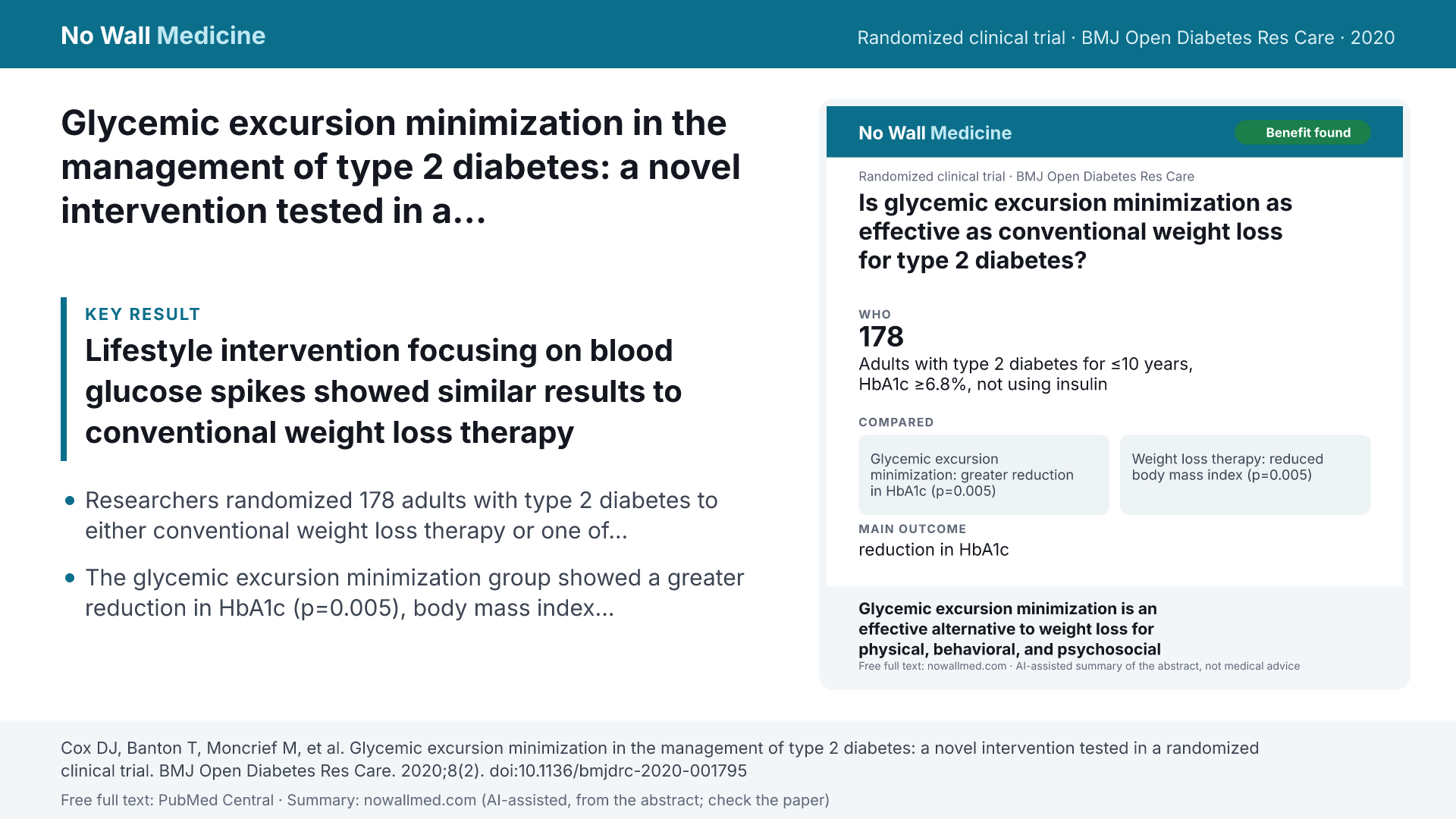
Lifestyle intervention focusing on blood glucose spikes showed similar results to conventional weight loss therapy
Glycemic excursion minimization in the management of type 2 diabetes: a novel intervention tested in a randomized clinical trial
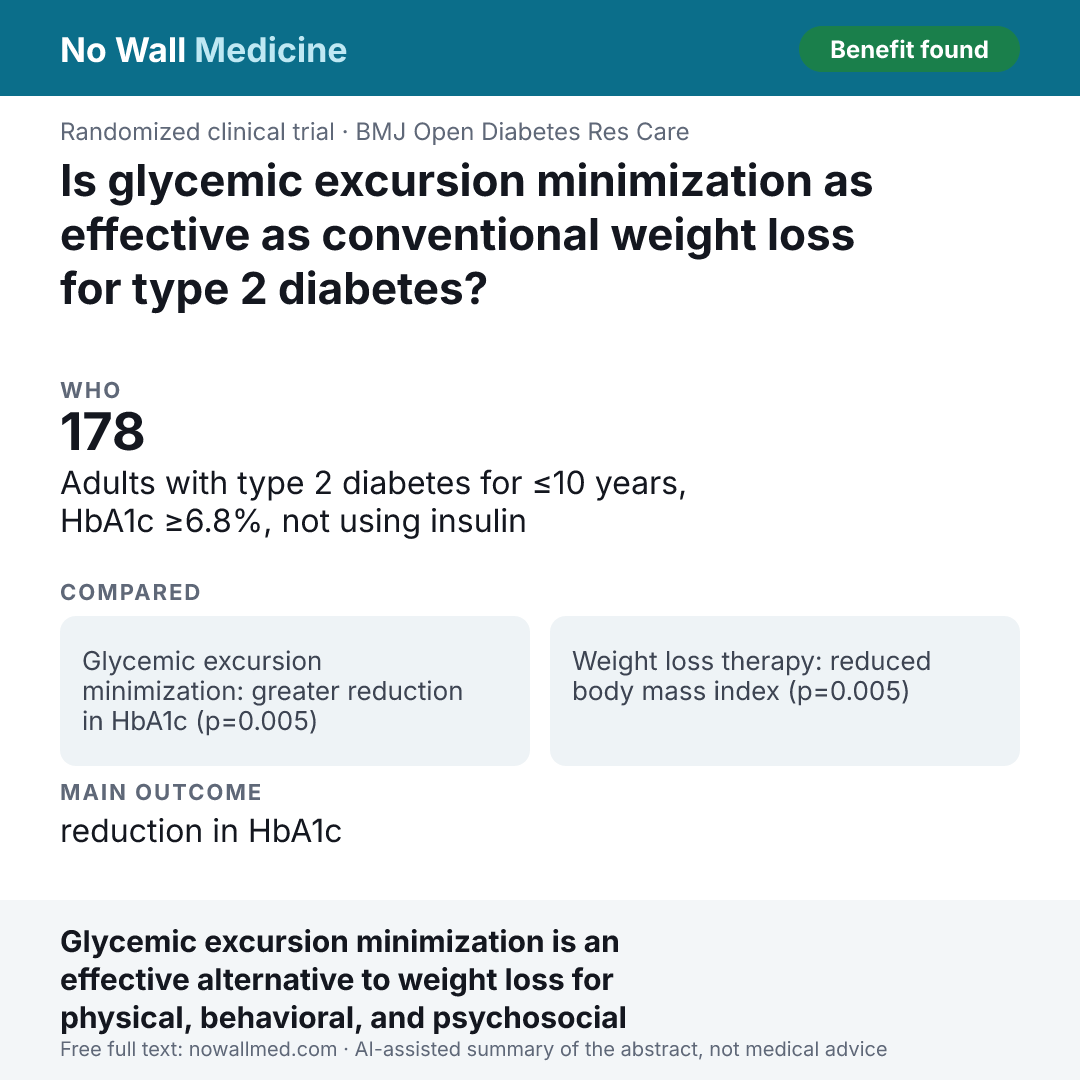
Randomized clinical trialBenefit found
Is glycemic excursion minimization as effective as conventional weight loss for type 2 diabetes?
Who
178
Adults with type 2 diabetes for ≤10 years, HbA1c ≥6.8%, not using insulin
Compared
Glycemic excursion minimization: greater reduction in HbA1c (p=0.005)
Weight loss therapy: reduced body mass index (p=0.005)
Main outcome
reduction in HbA1c
Bottom line: Glycemic excursion minimization is an effective alternative to weight loss for physical, behavioral, and psychosocial outcomes.
BMJ Open Diabetes Res Care · 2020-12-17 · Save PNG
Same trial (NCT03196895)
Papers we list that report this registered trial, oldest first. Read a secondary analysis alongside the main results.
- Main results Benefit found
This paper BMJ Open Diabetes Res Care 2020-12 - Longer follow-up Mixed results
Glycemic excursion minimization showed more sustained physical and psychological benefits than weight loss for type 2 diabetes BMJ Open Diabetes Res Care 2021-11
Clinical question: Is glycemic excursion minimization as effective as conventional weight loss for type 2 diabetes?
Key points
- Researchers randomized 178 adults with type 2 diabetes to either conventional weight loss therapy or one of three glycemic excursion minimization versions.
- The glycemic excursion minimization group showed a greater reduction in HbA1c (p=0.005), body mass index (p=0.013), carbohydrate intake (p=0.001), and cardiovascular risk (p=0.003).
- Only the glycemic excursion minimization group significantly improved diabetes empowerment, diabetes distress, depressive symptoms, steps per day, and active hours.
Headline and key points written with AI from the paper’s abstract, with every number checked against it. Read the paper before relying on them.
Was this summary helpful?
Abstract
Introduction
This study of adults with type 2 diabetes employed a non-inferiority hypothesis to investigate whether an innovative lifestyle focused on minimizing postnutrient blood glucose (BG) excursions (glycemic excursion minimization (GEM)) would be equivalent or superior to conventional weight loss (WL) therapy in regard to reducing HbA1c, and superior to WL when investigating physical, behavioral and psychological secondary outcomes. The impact of BG feedback on GEM efficacy was also investigated. Research design and methods
178 adults with type 2 diabetes for ≤10 years, HbA1c ≥6.8%, and not using insulin were randomized to WL (n=40) or one of three versions of GEM. Didactic (GEM-D, n=39) taught participants to choose low-glycemic load foods, reduce sedentary time and increase moderate routine physical activity. GEM-S (n=51) received GEM-D and systematically measured BG before and after meals and physical activity to educate and motivate food and activity choices. GEM-C (n=48) received GEM-D with continuous glucose monitoring feedback. All participants received 6 hours of group training and BG and activity monitors. Before and 3 months after treatment, participants were assessed for HbA1c, lipids, weight, routine physical activity, nutrition, depression, diabetes empowerment and distress. Results
GEM versions did not differ in primary or secondary outcomes, so they were combined for analyses. While WL reduced body mass index (BMI) (p=0.005), GEM demonstrated a greater reduction in HbA1c (p=0.005), BMI (p=0.013), carbohydrate intake (p=0.001), BG response to a glucose challenge (p=0.02), and cardiovascular risk (p=0.003). Only GEM participants significantly improved diabetes empowerment, diabetes distress, depressive symptoms, steps/day, and active hours and reduced calories/day. Neither intervention had negative side effects. Conclusions
GEM is an effective alternative to WL with respect to physical, behavioral and psychosocial outcomes. Trial registration number
NCT03196895.
Abstract reproduced under the article’s CC BY NC licence.
Subject terms
Headline, design, result, key points, caveat and citation as plain text.
Cite this article
Cox DJ, Banton T, Moncrief M, et al. Glycemic excursion minimization in the management of type 2 diabetes: a novel intervention tested in a randomized clinical trial. BMJ Open Diabetes Res Care. 2020;8(2). doi:10.1136/bmjdrc-2020-001795
Spotted a mistake? Suggest a correction