Long-term implications of elective evar that is non-compliant with clinical practice guideline diameter thresholds
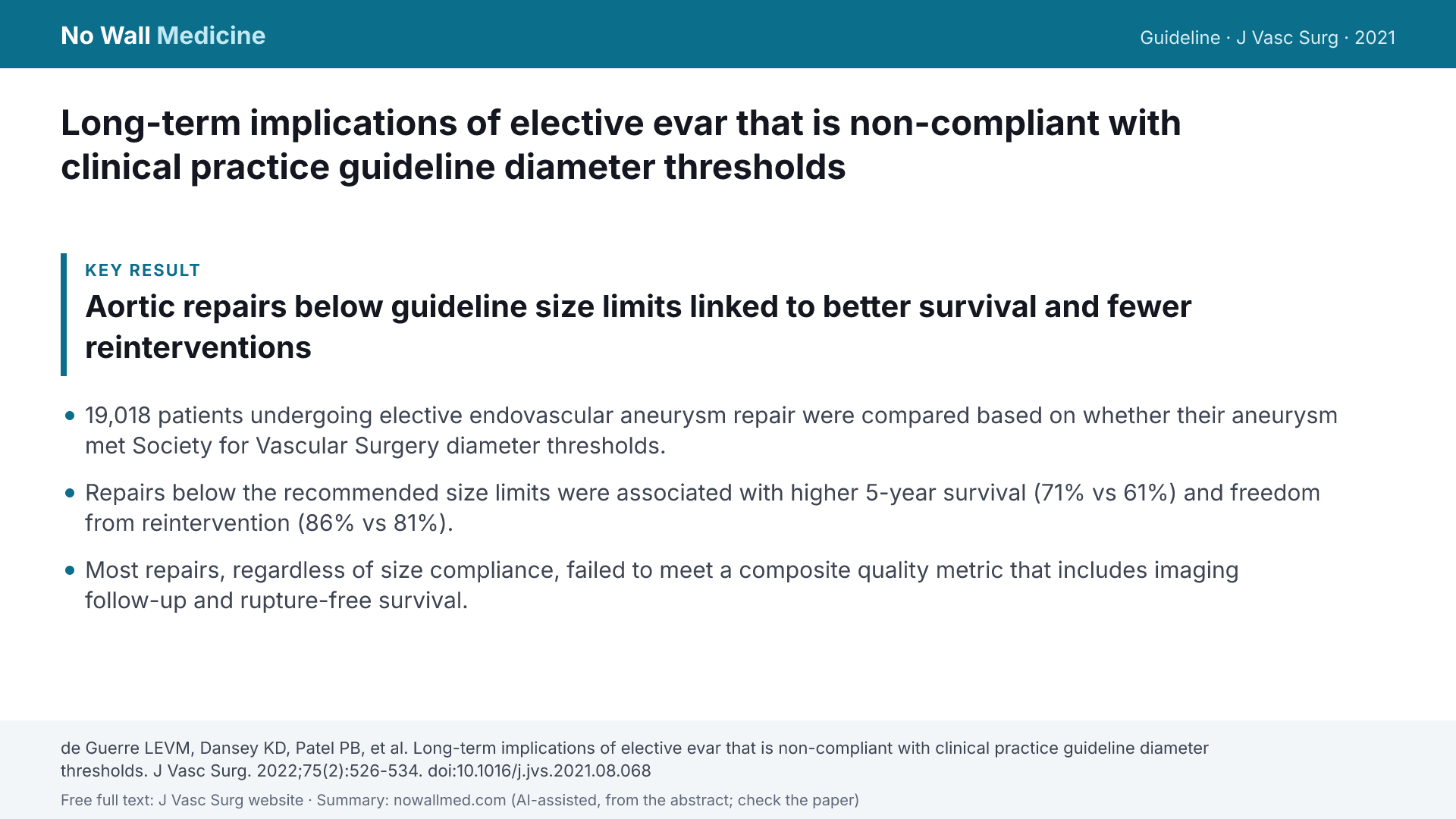
Key result: Aortic repairs below guideline size limits linked to better survival and fewer reinterventions
Key points
- 19,018 patients undergoing elective endovascular aneurysm repair were compared based on whether their aneurysm met Society for Vascular Surgery diameter thresholds.
- Repairs below the recommended size limits were associated with higher 5-year survival (71% vs 61%) and freedom from reintervention (86% vs 81%).
- Most repairs, regardless of size compliance, failed to meet a composite quality metric that includes imaging follow-up and rupture-free survival.
Discussion prompts
- Would these patients look like yours? Who was left out?
- Is the main outcome one that matters to patients?
- Is the difference large enough to change what you do?
Cite: de Guerre LEVM, Dansey KD, Patel PB, et al. Long-term implications of elective evar that is non-compliant with clinical practice guideline diameter thresholds. J Vasc Surg. 2022;75(2):526-534. doi:10.1016/j.jvs.2021.08.068
Free full text: J Vasc Surg website · Summary and visual abstract: nowallmed.com/a/long-term-implications-of-elective-evar-that-is-non-compliant-with-zk6u9r/ (AI-assisted from the abstract; check the paper before relying on it).