Pegvaliase drug clearance declines over time as the body develops tolerance in phenylketonuria patients
Long-term management strategies for pegvaliase use in phenylketonuria: Lessons learned from the phase-3 PRISM open-label extension study
Medical Genetics & GenomicsAdult and pediatric
Pharmacokinetic/pharmacodynamic model analysisBenefit found
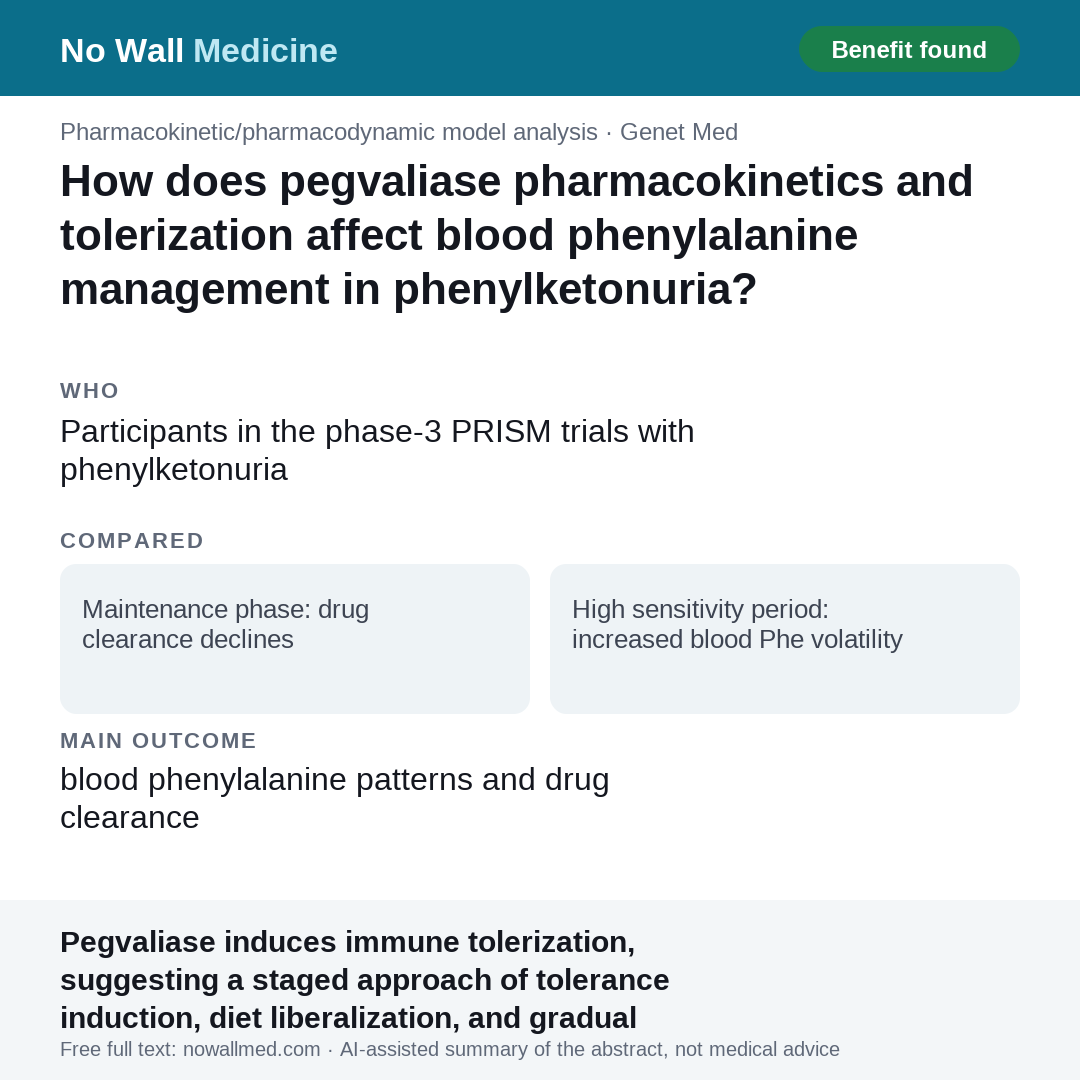
How does pegvaliase pharmacokinetics and tolerization affect blood phenylalanine management in phenylketonuria?
Who
Participants in the phase-3 PRISM trials with phenylketonuria
Compared
Maintenance phase: drug clearance declines
High sensitivity period: increased blood Phe volatility
Main outcome
blood phenylalanine patterns and drug clearance
Bottom line: Pegvaliase induces immune tolerization, suggesting a staged approach of tolerance induction, diet liberalization, and gradual dose adjustment.
Genet Med · 2025-05-20Download image
Clinical question: How does pegvaliase pharmacokinetics and tolerization affect blood phenylalanine management in phenylketonuria?
Why it matters: Individual differences in how the body processes pegvaliase lead to varying times for patients to reach target blood phenylalanine levels.
Key points
- Researchers used participant-level data from the phase-3 PRISM trials to model how pegvaliase, an enzyme substitution therapy, affects blood phenylalanine levels.
- The model showed that drug clearance declines as immune tolerization occurs, creating a period of high blood phenylalanine volatility at approximately 120 to 200 μmol/L.
- Reducing the drug dose or increasing dietary phenylalanine intake during this period of volatility was associated with marked increases in blood phenylalanine levels.
Headline and key points written with AI from the paper’s abstract, with every number checked against it. Read the paper before relying on them.
Was this summary helpful?
Subject terms
Cite this article
Harding CO, Whitehall KB, Lilienstein J, Sazova O, Lindstrom K, Levy DG. Long-term management strategies for pegvaliase use in phenylketonuria: Lessons learned from the phase-3 PRISM open-label extension study. Genet Med. 2025. doi:10.1016/j.gim.2025.101459
Spotted a mistake? Suggest a correction
Top studies every Monday
The week’s key trials and guidelines in your specialties, plus any topics you follow. By email, free.
Get the weekly digest