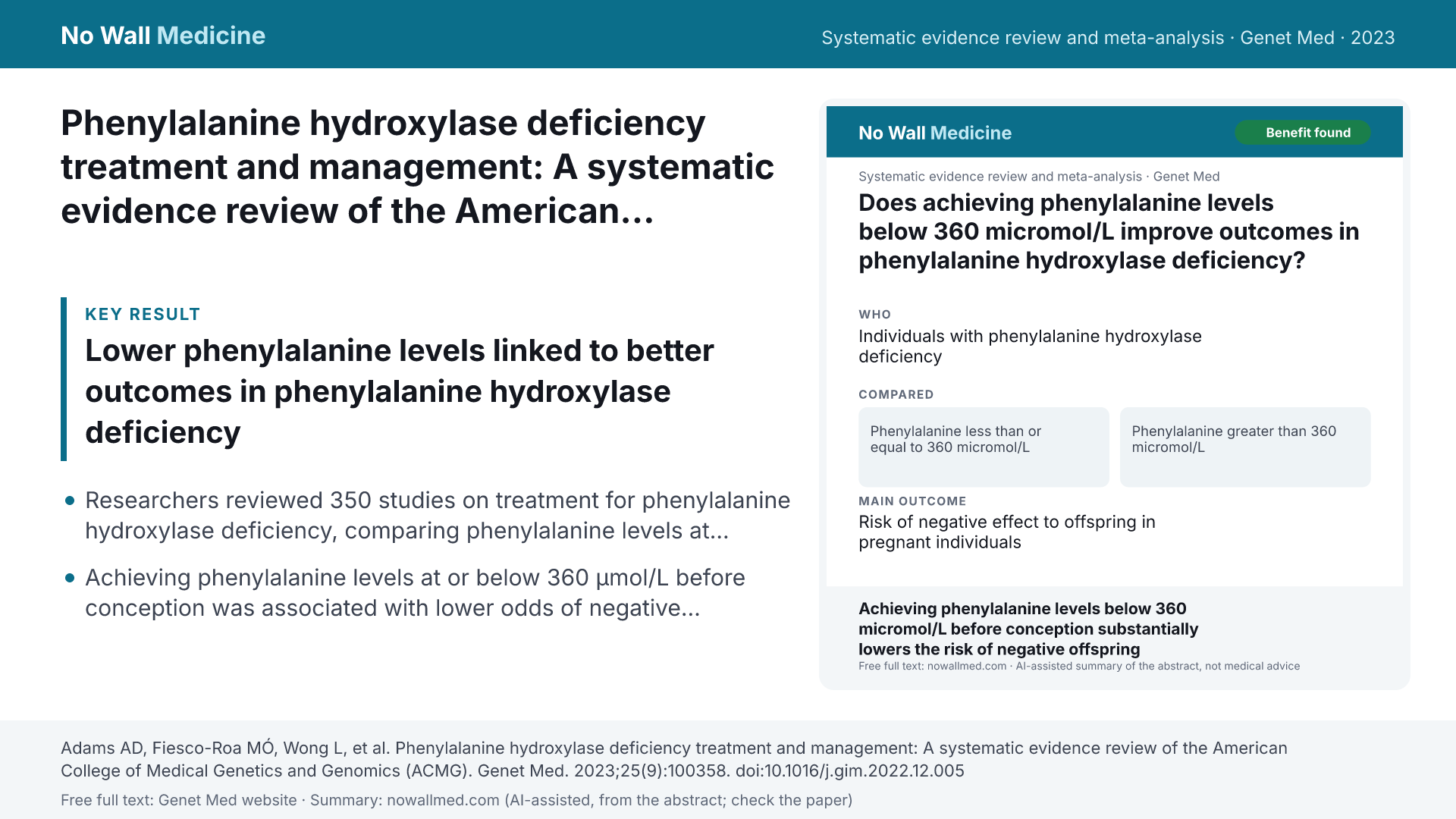
Lower phenylalanine levels linked to better outcomes in phenylalanine hydroxylase deficiency
Phenylalanine hydroxylase deficiency treatment and management: A systematic evidence review of the American College of Medical Genetics and Genomics (ACMG)
Systematic evidence review and meta-analysisBenefit found
Does achieving phenylalanine levels below 360 micromol/L improve outcomes in phenylalanine hydroxylase deficiency?
Who
Individuals with phenylalanine hydroxylase deficiency
Compared
Phenylalanine less than or equal to 360 micromol/L
Phenylalanine greater than 360 micromol/L
Main outcome
Risk of negative effect to offspring in pregnant individuals
Result: odds ratio 0.07 (95% CI 0.04-0.14)
Bottom line: Achieving phenylalanine levels below 360 micromol/L before conception substantially lowers the risk of negative offspring outcomes.
Limitation: Risk of bias was moderate.
Genet Med · 2023-07-20Download image
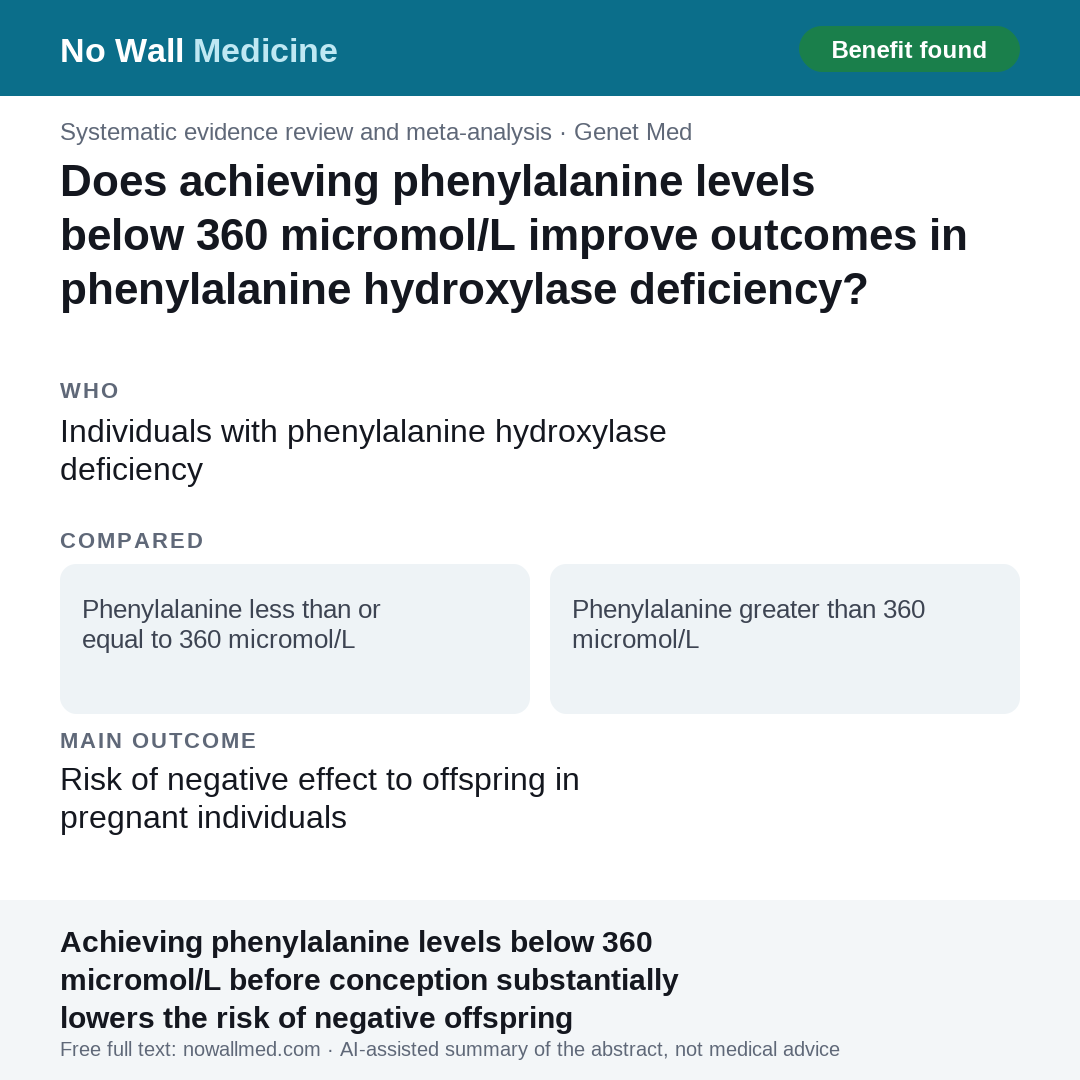
Clinical question: Does achieving phenylalanine levels below 360 micromol/L improve outcomes in phenylalanine hydroxylase deficiency?
Why it matters: Applies to individuals with phenylalanine hydroxylase deficiency; supports targeting phenylalanine levels at or below 360 μmol/L through diet or medication.
Key points
- Researchers reviewed 350 studies on treatment for phenylalanine hydroxylase deficiency, comparing phenylalanine levels at or below 360 μmol/L with higher levels.
- Achieving phenylalanine levels at or below 360 μmol/L before conception was associated with lower odds of negative effects in offspring (odds ratio 0.07, 95% CI 0.04-0.14).
- Pharmacologic treatments commonly caused adverse events but reduced phenylalanine levels, which allowed patients to liberalize their diets.
Limitation the authors note: The authors noted that the risk of bias in the included studies was moderate.
Headline and key points written with AI from the paper’s abstract, with every number checked against it. Read the paper before relying on them.
Was this summary helpful?
Subject terms
Headline, design, result, key points, caveat and citation as plain text.
Cite this article
Adams AD, Fiesco-Roa MÓ, Wong L, et al. Phenylalanine hydroxylase deficiency treatment and management: A systematic evidence review of the American College of Medical Genetics and Genomics (ACMG). Genet Med. 2023. doi:10.1016/j.gim.2022.12.005
Spotted a mistake? Suggest a correction