Wildfire emissions linked to rising fine particle pollution and premature deaths in western USA
Long-term mortality burden trends attributed to black carbon and PM2·5 from wildfire emissions across the continental USA from 2000 to 2020: a deep learning modelling study
Deep learning modelling studyMixed results
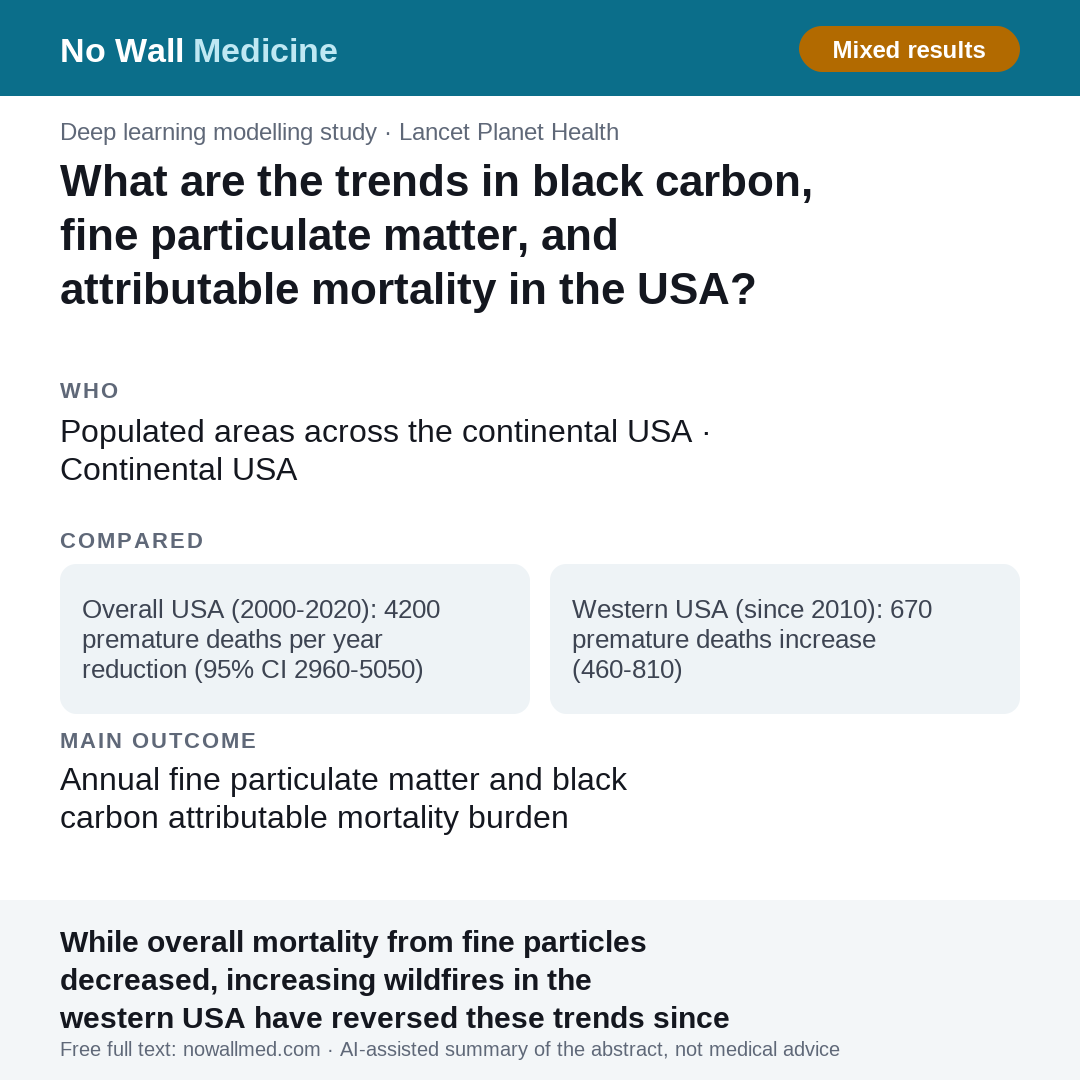
What are the trends in black carbon, fine particulate matter, and attributable mortality in the USA?
Who
Populated areas across the continental USA · Continental USA
Compared
Overall USA (2000-2020): 4200 premature deaths per year reduction (95% CI 2960-5050)
Western USA (since 2010): 670 premature deaths increase (460-810)
Main outcome
Annual fine particulate matter and black carbon attributable mortality burden
Bottom line: While overall mortality from fine particles decreased, increasing wildfires in the western USA have reversed these trends since 2010.
Funded by: NASA and NOAA
Lancet Planet Health · 2023-12-07Download image
Clinical question: What are the trends in black carbon, fine particulate matter, and attributable mortality in the USA?
Why it matters: It was unknown how increasing wildfire emissions might offset improvements in air quality and impact mortality trends across different regions of the United States.
Key points
- Researchers used deep learning to estimate fine particulate matter (PM2.5) and black carbon concentrations and mortality across the continental USA from 2000 to 2020.
- While overall US PM2.5 decreased by 22% and black carbon by 11%, the western USA saw a 55% increase in PM2.5 and an 86% increase in black carbon since 2010.
- The increase in the western USA was associated with 670 additional premature deaths and large fluctuations linked to increasing wildfire incidence.
Headline and key points written with AI from the paper’s abstract, with every number checked against it. Read the paper before relying on them.
Was this summary helpful?
Abstract
Background
Long-term improvements in air quality and public health in the continental USA were disrupted over the past decade by increased fire emissions that potentially offset the decrease in anthropogenic emissions. This study aims to estimate trends in black carbon and PM2·5 concentrations and their attributable mortality burden across the USA. Methods
In this study, we derived daily concentrations of PM2·5 and its highly toxic black carbon component at a 1-km resolution in the USA from 2000 to 2020 via deep learning that integrated big data from satellites, models, and surface observations. We estimated the annual PM2·5-attributable and black carbon-attributable mortality burden at each 1-km2 grid using concentration-response functions collected from a national cohort study and a meta-analysis study, respectively. We investigated the spatiotemporal linear-regressed trends in PM2·5 and black carbon pollution and their associated premature deaths from 2000 to 2020, and the impact of wildfires on air quality and public health. Findings
Our results showed that PM2·5 and black carbon estimates are reliable, with sample-based cross-validated coefficients of determination of 0·82 and 0·80, respectively, for daily estimates (0·97 and 0·95 for monthly estimates). Both PM2·5 and black carbon in the USA showed significantly decreasing trends overall during 2000 to 2020 (22% decrease for PM2·5 and 11% decrease for black carbon), leading to a reduction of around 4200 premature deaths per year (95% CI 2960-5050). However, since 2010, the decreasing trends of fine particles and premature deaths have reversed to increase in the western USA (55% increase in PM2·5, 86% increase in black carbon, and increase of 670 premature deaths [460-810]), while remaining mostly unchanged in the eastern USA. The western USA showed large interannual fluctuations that were attributable to the increasing incidence of wildfires. Furthermore, the black carbon-to-PM2·5 mass ratio increased annually by 2·4% across the USA, mainly due to increasing wildfire emissions in the western USA and more rapid reductions of other components in the eastern USA, suggesting a potential increase in the relative toxicity of PM2·5. 100% of populated areas in the USA have experienced at least one day of PM2·5 pollution exceeding the daily air quality guideline level of 15 μg/m3 during 2000-2020, with 99% experiencing at least 7 days and 85% experiencing at least 30 days. The recent widespread wildfires have greatly increased the daily exposure risks in the western USA, and have also impacted the midwestern USA due to the long-range transport of smoke. Interpretation
Wildfires have become increasingly intensive and frequent in the western USA, resulting in a significant increase in smoke-related emissions in populated areas. This increase is likely to have contributed to a decline in air quality and an increase in attributable mortality. Reducing fire risk via effective policies besides mitigation of climate warming, such as wildfire prevention and management, forest restoration, and new revenue generation, could substantially improve air quality and public health in the coming decades. Funding
National Aeronautics and Space Administration (NASA) Applied Science programme, NASA MODIS maintenance programme, NASA MAIA satellite mission programme, NASA GMAO core fund, National Oceanic and Atmospheric Administration (NOAA) GEO-XO project, NOAA Atmospheric Chemistry, Carbon Cycle, and Climate (AC4) programme, and NOAA Educational Partnership Program with Minority Serving Institutions.
Abstract reproduced under the article’s CC BY licence.
Subject terms
Cite this article
Wei J, Wang J, Li Z, Kondragunta S, Anenberg S, Wang Y. Long-term mortality burden trends attributed to black carbon and PM2·5 from wildfire emissions across the continental USA from 2000 to 2020: a deep learning modelling study. Lancet Planet Health. 2023. doi:10.1016/S2542-5196(23)00235-8
Spotted a mistake? Suggest a correction
Top studies every Monday
The week’s key trials and guidelines in your specialties, plus any topics you follow. By email, free.
Get the weekly digest