Wildfire pollution linked to 0.62% of all cause deaths globally
Mortality risk attributable to wildfire-related PM2·5 pollution: a global time series study in 749 locations
Global time series study and meta-analysisHarm found
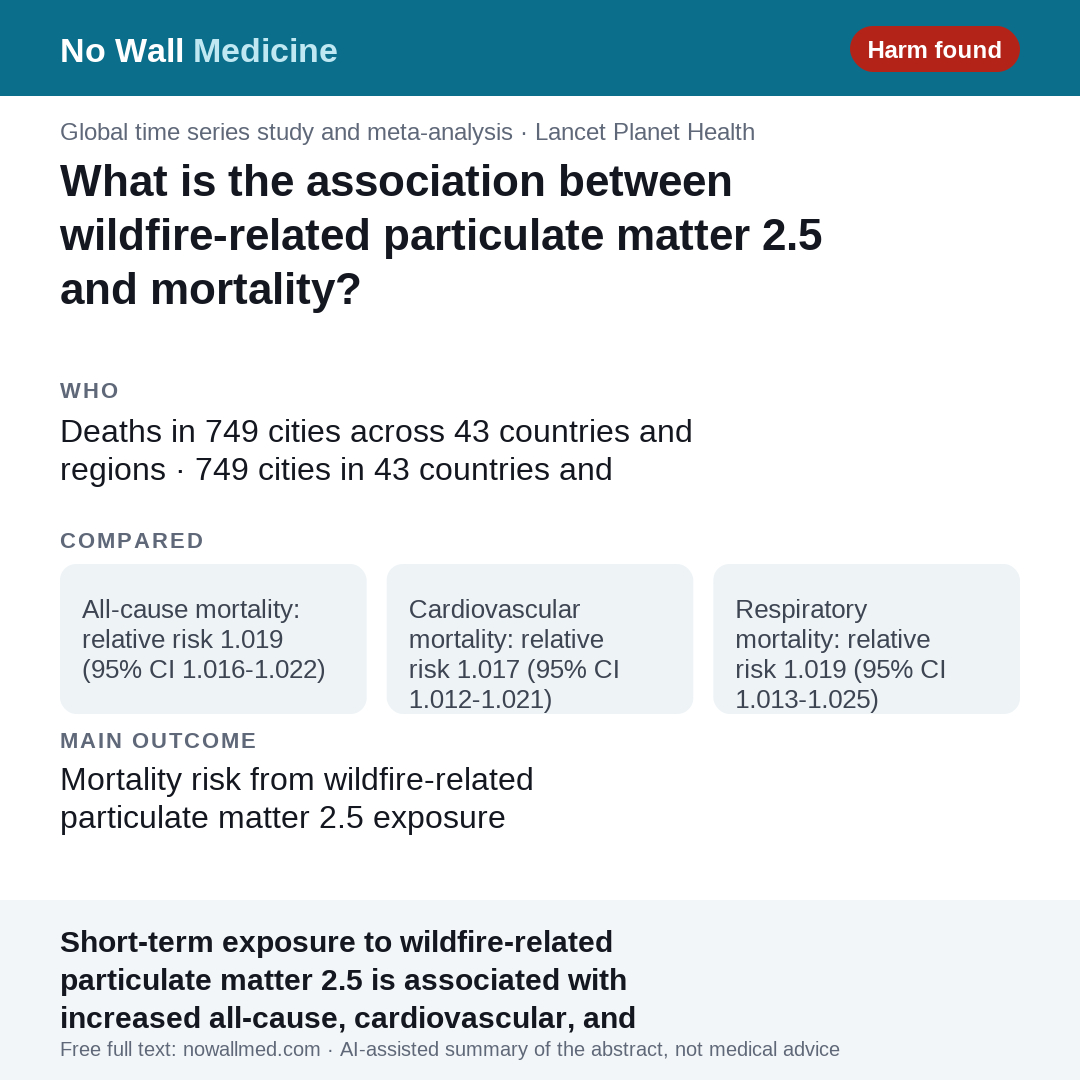
What is the association between wildfire-related particulate matter 2.5 and mortality?
Who
Deaths in 749 cities across 43 countries and regions · 749 cities in 43 countries and regions
Compared
All-cause mortality: relative risk 1.019 (95% CI 1.016-1.022)
Cardiovascular mortality: relative risk 1.017 (95% CI 1.012-1.021)
Respiratory mortality: relative risk 1.019 (95% CI 1.013-1.025)
Main outcome
Mortality risk from wildfire-related particulate matter 2.5 exposure
Result: relative risk 1.019 (95% CI 1.016-1.022) for all-cause mortality
Bottom line: Short-term exposure to wildfire-related particulate matter 2.5 is associated with increased all-cause, cardiovascular, and respiratory mortality.
Funded by: Australian Research Council, Australian National Health & Medical Research Council
Lancet Planet Health · 2021-09-12Download image
Clinical question: What is the association between wildfire-related particulate matter 2.5 and mortality?
Why it matters: The association between wildfire-related PM2·5 and mortality was not well characterised
Key points
- 749 cities in 43 countries were studied for wildfire-related PM2·5 exposure and mortality.
- Each 10 μg/m3 increase in wildfire-related PM2·5 was associated with a 1.019 relative risk of all-cause mortality.
- 0.62% of all-cause deaths were annually attributable to wildfire-related PM2·5 exposure.
Limitation the authors note: None stated in the abstract
Headline and key points written with AI from the paper’s abstract, with every number checked against it. Read the paper before relying on them.
Was this summary helpful?
Abstract
Background
Many regions of the world are now facing more frequent and unprecedentedly large wildfires. However, the association between wildfire-related PM2·5 and mortality has not been well characterised. We aimed to comprehensively assess the association between short-term exposure to wildfire-related PM2·5 and mortality across various regions of the world. Methods
For this time series study, data on daily counts of deaths for all causes, cardiovascular causes, and respiratory causes were collected from 749 cities in 43 countries and regions during 2000-16. Daily concentrations of wildfire-related PM2·5 were estimated using the three-dimensional chemical transport model GEOS-Chem at a 0·25° × 0·25° resolution. The association between wildfire-related PM2·5 exposure and mortality was examined using a quasi-Poisson time series model in each city considering both the current-day and lag effects, and the effect estimates were then pooled using a random-effects meta-analysis. Based on these pooled effect estimates, the population attributable fraction and relative risk (RR) of annual mortality due to acute wildfire-related PM2·5 exposure was calculated. Findings
65·6 million all-cause deaths, 15·1 million cardiovascular deaths, and 6·8 million respiratory deaths were included in our analyses. The pooled RRs of mortality associated with each 10 μg/m3 increase in the 3-day moving average (lag 0-2 days) of wildfire-related PM2·5 exposure were 1·019 (95% CI 1·016-1·022) for all-cause mortality, 1·017 (1·012-1·021) for cardiovascular mortality, and 1·019 (1·013-1·025) for respiratory mortality. Overall, 0·62% (95% CI 0·48-0·75) of all-cause deaths, 0·55% (0·43-0·67) of cardiovascular deaths, and 0·64% (0·50-0·78) of respiratory deaths were annually attributable to the acute impacts of wildfire-related PM2·5 exposure during the study period. Interpretation
Short-term exposure to wildfire-related PM2·5 was associated with increased risk of mortality. Urgent action is needed to reduce health risks from the increasing wildfires. Funding
Australian Research Council, Australian National Health & Medical Research Council.
Abstract reproduced under the article’s CC BY NC ND licence.
Subject terms
Cite this article
Chen G, Guo Y, Yue X, Tong S, Gasparrini A, Bell ML. Mortality risk attributable to wildfire-related PM2·5 pollution: a global time series study in 749 locations. Lancet Planet Health. 2021. doi:10.1016/S2542-5196(21)00200-X
Spotted a mistake? Suggest a correction
Top studies every Monday
The week’s key trials and guidelines in your specialties, plus any topics you follow. By email, free.
Get the weekly digest