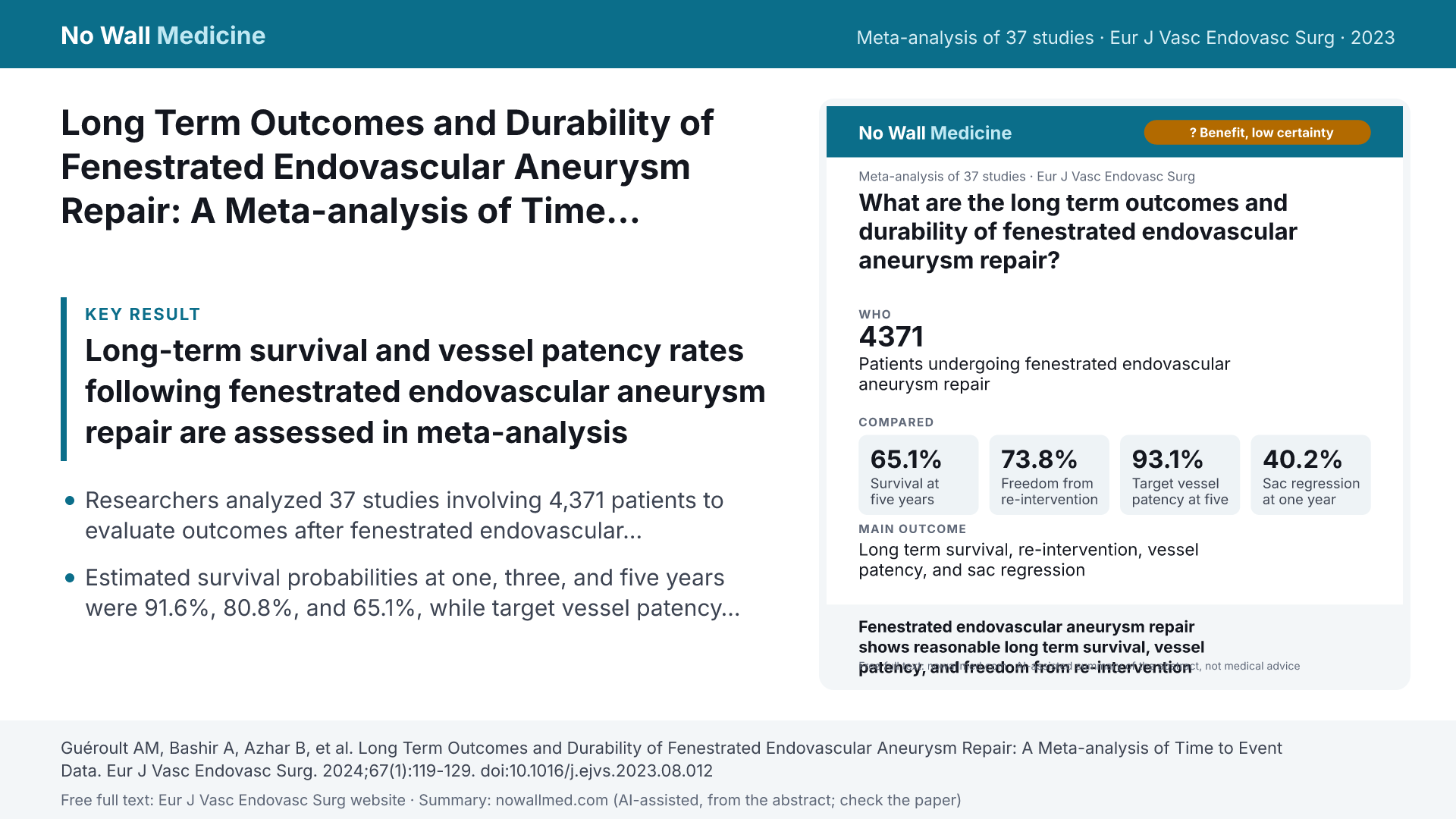
Long-term survival and vessel patency rates following fenestrated endovascular aneurysm repair are assessed in meta-analysis
Long Term Outcomes and Durability of Fenestrated Endovascular Aneurysm Repair: A Meta-analysis of Time to Event Data
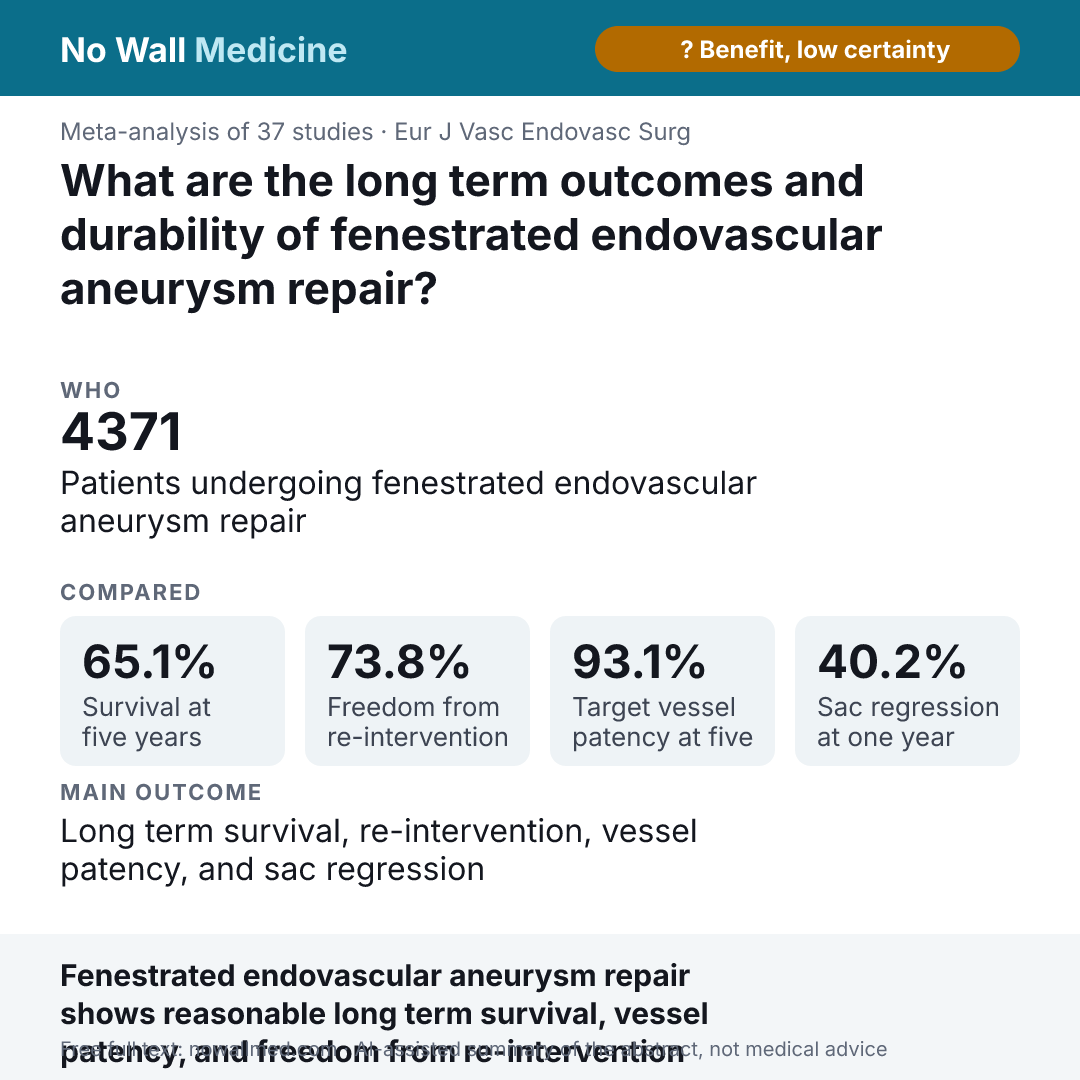
Meta-analysis of 37 studiesBenefit, low certainty
What are the long term outcomes and durability of fenestrated endovascular aneurysm repair?
Who
4371
Patients undergoing fenestrated endovascular aneurysm repair
Compared
65.1%Survival at five years (95% CI 60.9 - 69.1)
73.8%Freedom from re-intervention at five years (95% CI 67.1 - 79.6)
93.1%Target vessel patency at five years (95% CI 89.3 - 96.0)
40.2%Sac regression at one year (95% CI 28.9 - 52.7)
Main outcome
Long term survival, re-intervention, vessel patency, and sac regression
Bottom line: Fenestrated endovascular aneurysm repair shows reasonable long term survival, vessel patency, and freedom from re-intervention outcomes.
Limitation: Beyond five years there is a lack of data in the literature.
Eur J Vasc Endovasc Surg · 2023-08-10 · PROSPERO CRD42023401468
Why it matters: Long-term outcomes for fenestrated endovascular aneurysm repair remain uncertain despite the widespread use of this procedure.
Headline and visual abstract written with AI from the paper’s abstract, with every number checked against it. Read the paper before relying on them.
Was this summary helpful?
Subject terms
Cite this article
Guéroult AM, Bashir A, Azhar B, et al. Long Term Outcomes and Durability of Fenestrated Endovascular Aneurysm Repair: A Meta-analysis of Time to Event Data. Eur J Vasc Endovasc Surg. 2024;67(1):119-129. doi:10.1016/j.ejvs.2023.08.012
Spotted a mistake? Suggest a correction