Ovarian suppression during chemotherapy showed no difference in long-term survival for early breast cancer patients
Long-Term Outcomes With Pharmacological Ovarian Suppression During Chemotherapy in Premenopausal Early Breast Cancer Patients
Randomized, open-label, phase III superiority trialNo clear difference
Does triptorelin during chemotherapy affect long-term outcomes in premenopausal early breast cancer patients?
Who
281
Premenopausal early breast cancer patients · 16 Italian centers
Compared
Chemotherapy plus triptorelin: 65.7% [95% CI = 57.0% to 73.1%]
Chemotherapy alone: 69.2% [95% CI = 60.3% to 76.5%]
Main outcome
12-year disease-free survival
Result: hazard ratio 1.16 (95% CI 0.76 to 1.77)
Bottom line: Triptorelin during chemotherapy shows no difference in long-term disease-free or overall survival for premenopausal early breast cancer patients.
J Natl Cancer Inst · 2021-12-02Download image
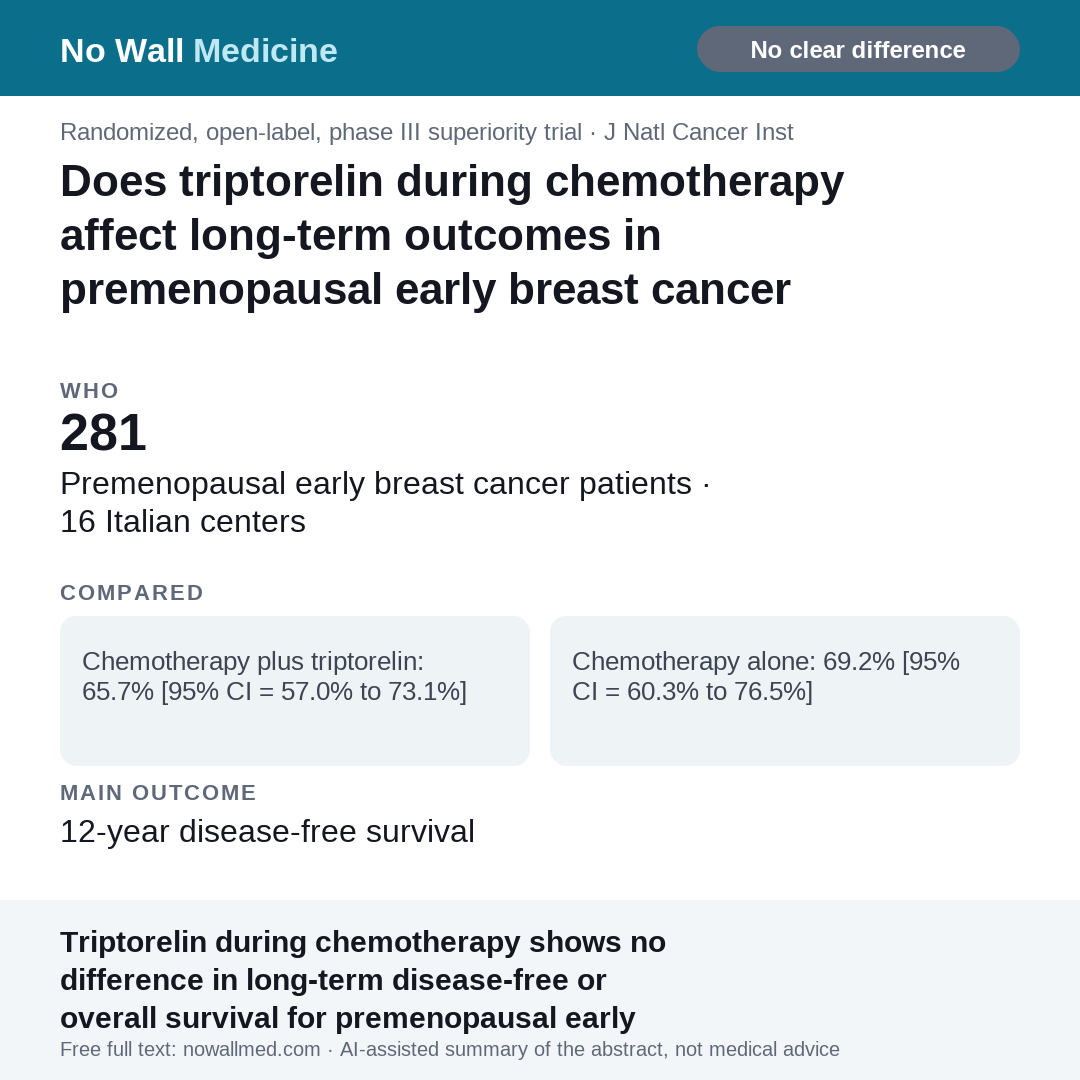
Clinical question: Does triptorelin during chemotherapy affect long-term outcomes in premenopausal early breast cancer patients?
Why it matters: Long-term safety data are unavailable regarding the use of ovarian suppression during chemotherapy, specifically concerning potential risks for women with hormone receptor-positive breast cancer.
Key points
- Researchers studied 281 premenopausal patients randomly assigned to receive chemotherapy alone or chemotherapy combined with triptorelin, a gonadotropin-releasing hormone agonist used to protect ovarian function.
- At a median follow-up of 12.4 years, there were no differences in 12-year disease-free survival (65.7% in the triptorelin arm vs 69.2% in the control arm) or 12-year overall survival (81.2% vs 81.3%).
- In patients with hormone receptor-positive disease, the hazard ratios for disease-free survival and overall survival showed no significant difference between the two groups.
Headline and key points written with AI from the paper’s abstract, with every number checked against it. Read the paper before relying on them.
Was this summary helpful?
Subject terms
Cite this article
Lambertini M, Boni L, Michelotti A, Magnolfi E, Cogoni AA, Mosconi AM. Long-Term Outcomes With Pharmacological Ovarian Suppression During Chemotherapy in Premenopausal Early Breast Cancer Patients. J Natl Cancer Inst. 2021. doi:10.1093/jnci/djab213
Spotted a mistake? Suggest a correction
Top studies every Monday
The week’s key trials and guidelines in your specialties, plus any topics you follow. By email, free.
Get the weekly digest