Biomarker-guided blood clot prevention improved survival at 6 and 12 months in cancer patients
Long-term survival outcomes after biomarker-guided thromboprophylaxis in cancer: extended follow-up of the TARGET-TP randomised trial
Randomized trialMixed results
Does biomarker-guided thromboprophylaxis improve long-term survival in high-risk cancer patients?
Who
High-risk patients with lung or gastrointestinal cancers
Compared
Thromboprophylaxis
No thromboprophylaxis
Main outcome
Overall survival and progression-free survival to 36 months
Bottom line: Thromboprophylaxis improved overall survival at 6 and 12 months, but no progression-free survival differences were observed.
J Natl Cancer Inst · 2026-03-07Download image
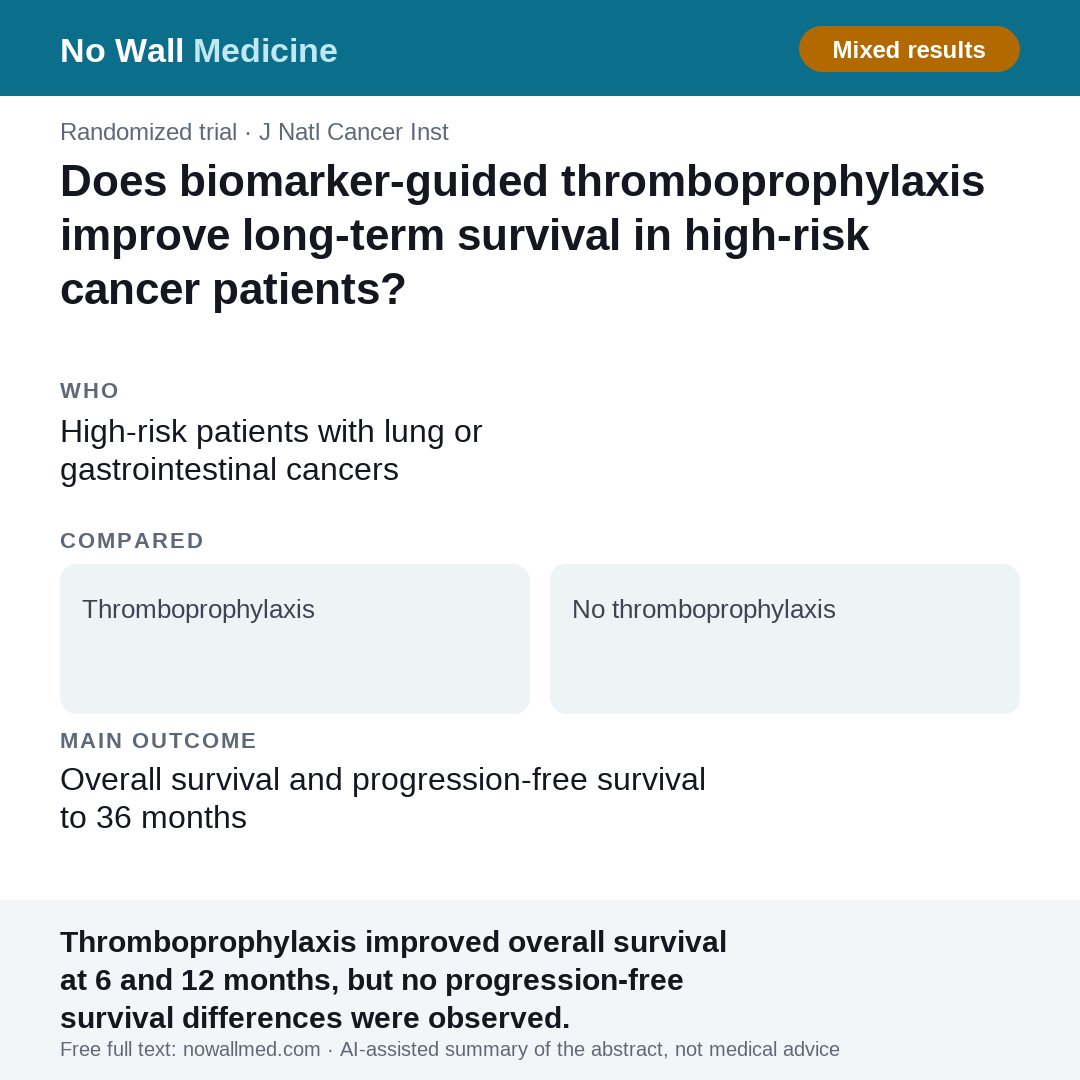
Clinical question: Does biomarker-guided thromboprophylaxis improve long-term survival in high-risk cancer patients?
Why it matters: Thromboembolism, or blood clots, is a major cause of early death in patients with cancer.
Key points
- High-risk patients with lung or gastrointestinal cancers were randomized to receive enoxaparin, a blood thinner, or no thromboprophylaxis, which is blood clot prevention.
- Among high-risk patients, blood clot prevention improved overall survival at 6 and 12 months, though survival rates converged after that time.
- No differences were observed in progression-free survival, which measures the length of time during and after treatment that a disease does not get worse.
Headline and key points written with AI from the paper’s abstract, with every number checked against it. Read the paper before relying on them.
Cite this article
Rogers J, Michael M, Tie J, Solomon BJ, Harris S, Underhill C. Long-term survival outcomes after biomarker-guided thromboprophylaxis in cancer: extended follow-up of the TARGET-TP randomised trial. J Natl Cancer Inst. 2026. doi:10.1093/jnci/djag065
Spotted a mistake? Suggest a correction