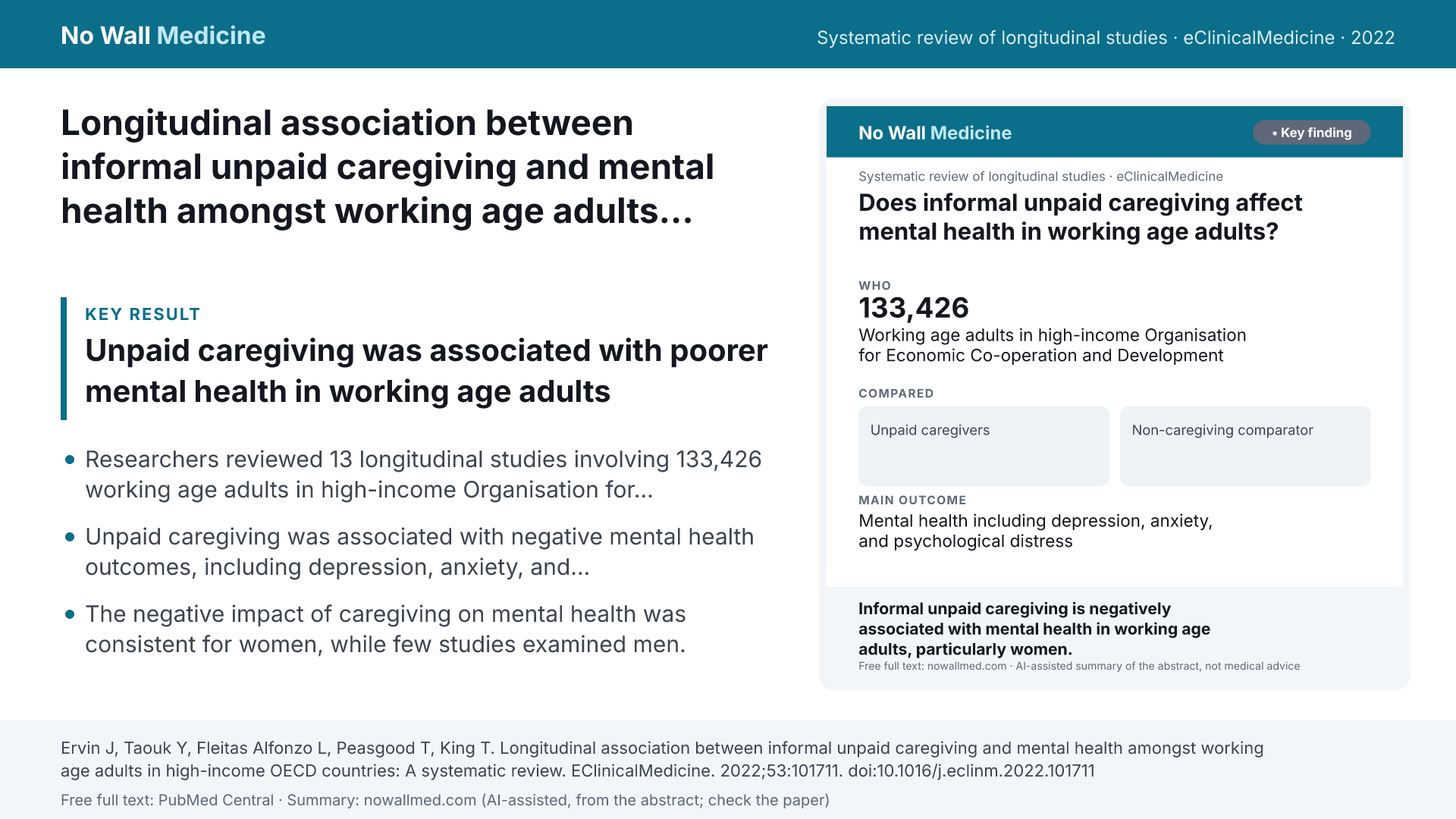
Unpaid caregiving was associated with poorer mental health in working age adults
Longitudinal association between informal unpaid caregiving and mental health amongst working age adults in high-income OECD countries: A systematic review
Systematic review of longitudinal studiesHarm found
Does informal unpaid caregiving affect mental health in working age adults?
Who
133,426
Working age adults in high-income Organisation for Economic Co-operation and Development countries · High-income Organisation for Economic Co-operation and Development countries
Compared
Unpaid caregivers
Non-caregiving comparator
Main outcome
Mental health including depression, anxiety, and psychological distress
Bottom line: Informal unpaid caregiving is negatively associated with mental health in working age adults, particularly women.
Funded by: Melbourne School of Population and Global Health
eClinicalMedicine · 2022-11-01Download image
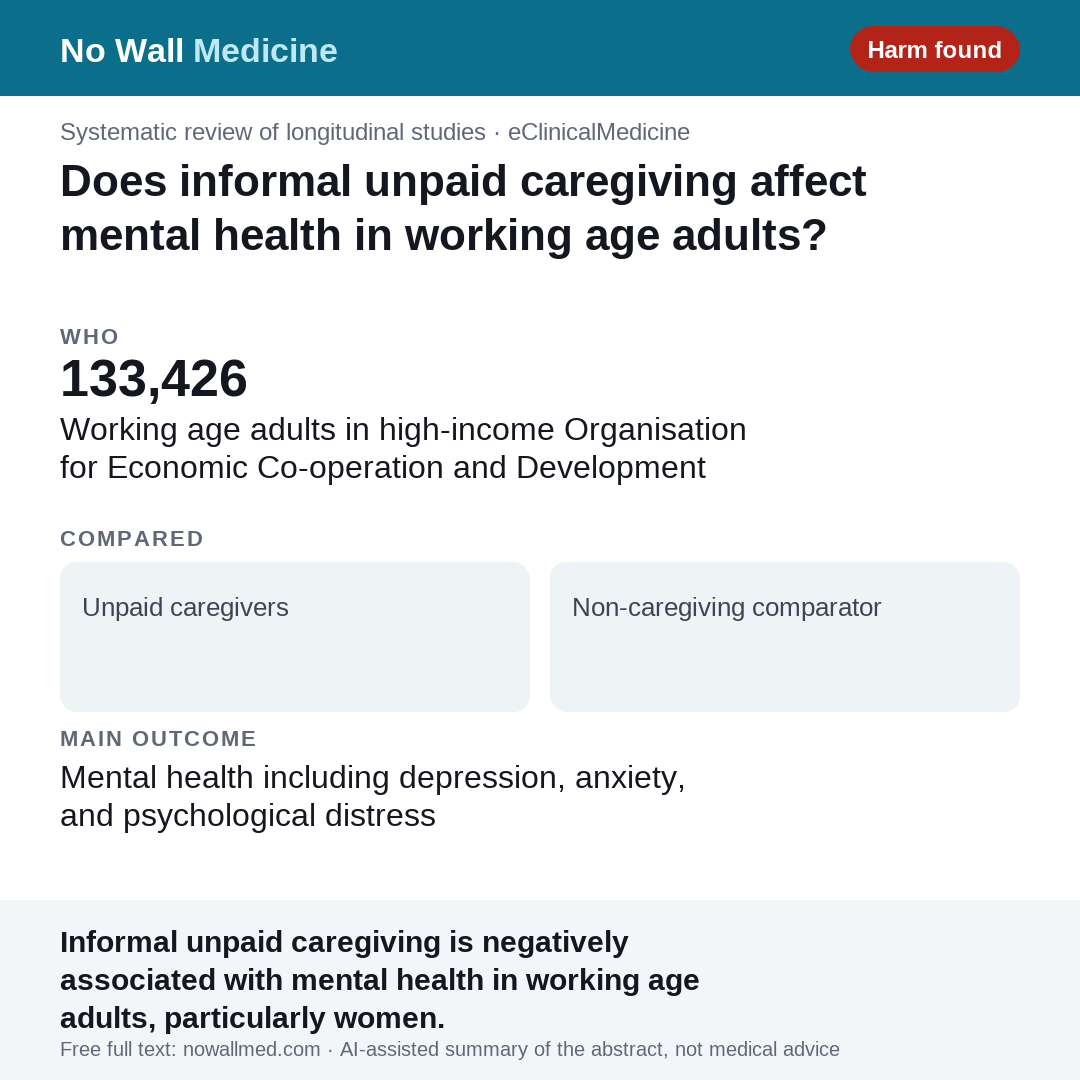
Clinical question: Does informal unpaid caregiving affect mental health in working age adults?
Why it matters: Longitudinal evidence was needed to assess the association between unpaid caregiving and mental health among working age adults in high-income countries.
Key points
- Researchers reviewed 13 longitudinal studies involving 133,426 working age adults in high-income Organisation for Economic Co-operation and Development countries.
- Unpaid caregiving was associated with negative mental health outcomes, including depression, anxiety, and psychological distress.
- The negative impact of caregiving on mental health was consistent for women, while few studies examined men.
Limitation the authors note: Significant between-study heterogeneity precluded meta-analysis.
Headline and key points written with AI from the paper’s abstract, with every number checked against it. Read the paper before relying on them.
Was this summary helpful?
Cite this article
Ervin J, Taouk Y, Fleitas Alfonzo L, Peasgood T, King T. Longitudinal association between informal unpaid caregiving and mental health amongst working age adults in high-income OECD countries: A systematic review. eClinicalMedicine. 2022. doi:10.1016/j.eclinm.2022.101711
Spotted a mistake? Suggest a correction