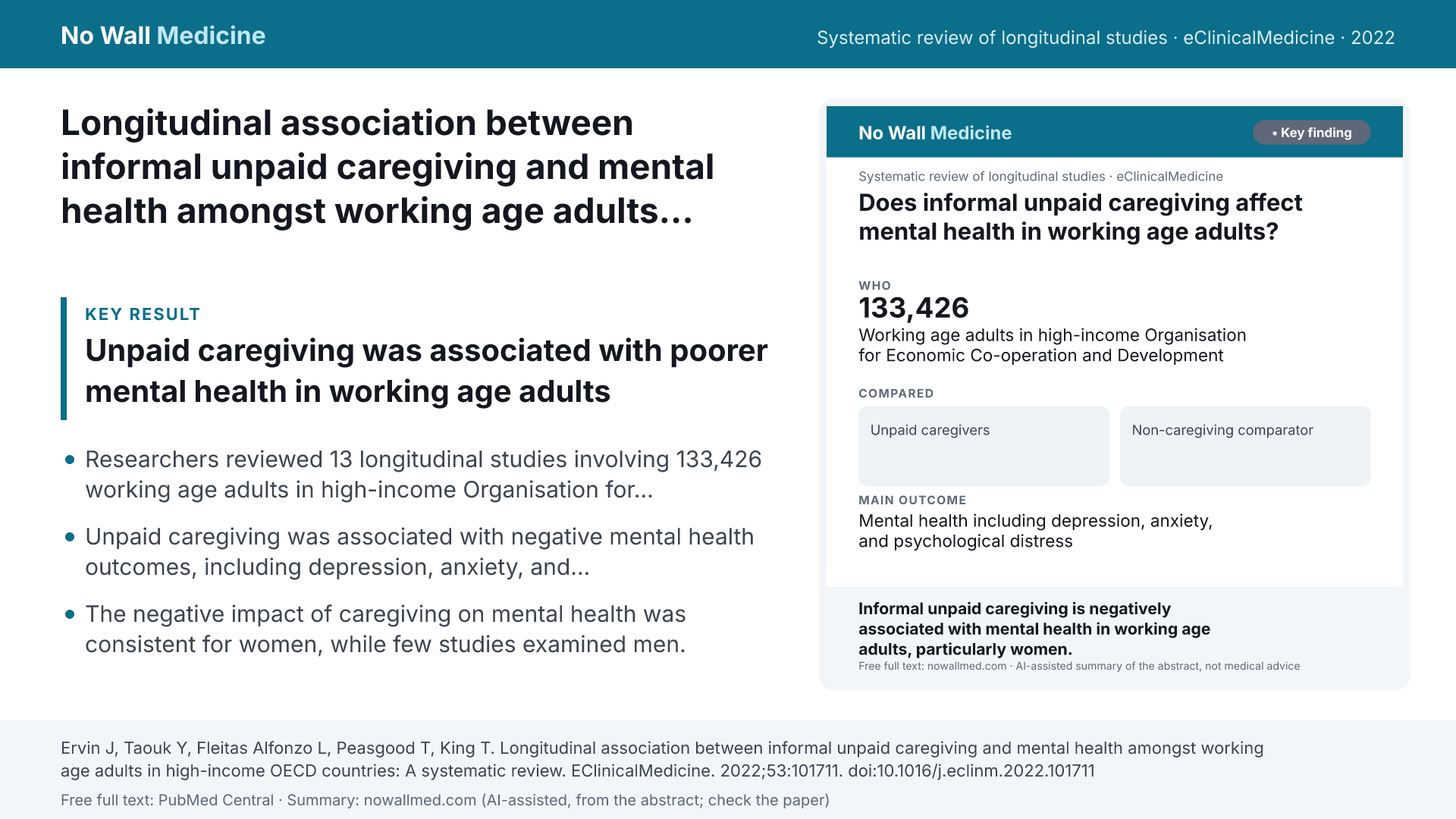
Longitudinal association between informal unpaid caregiving and mental health amongst working age adults in high-income OECD countries: A systematic review
Key result: Unpaid caregiving was associated with poorer mental health in working age adults
Key points
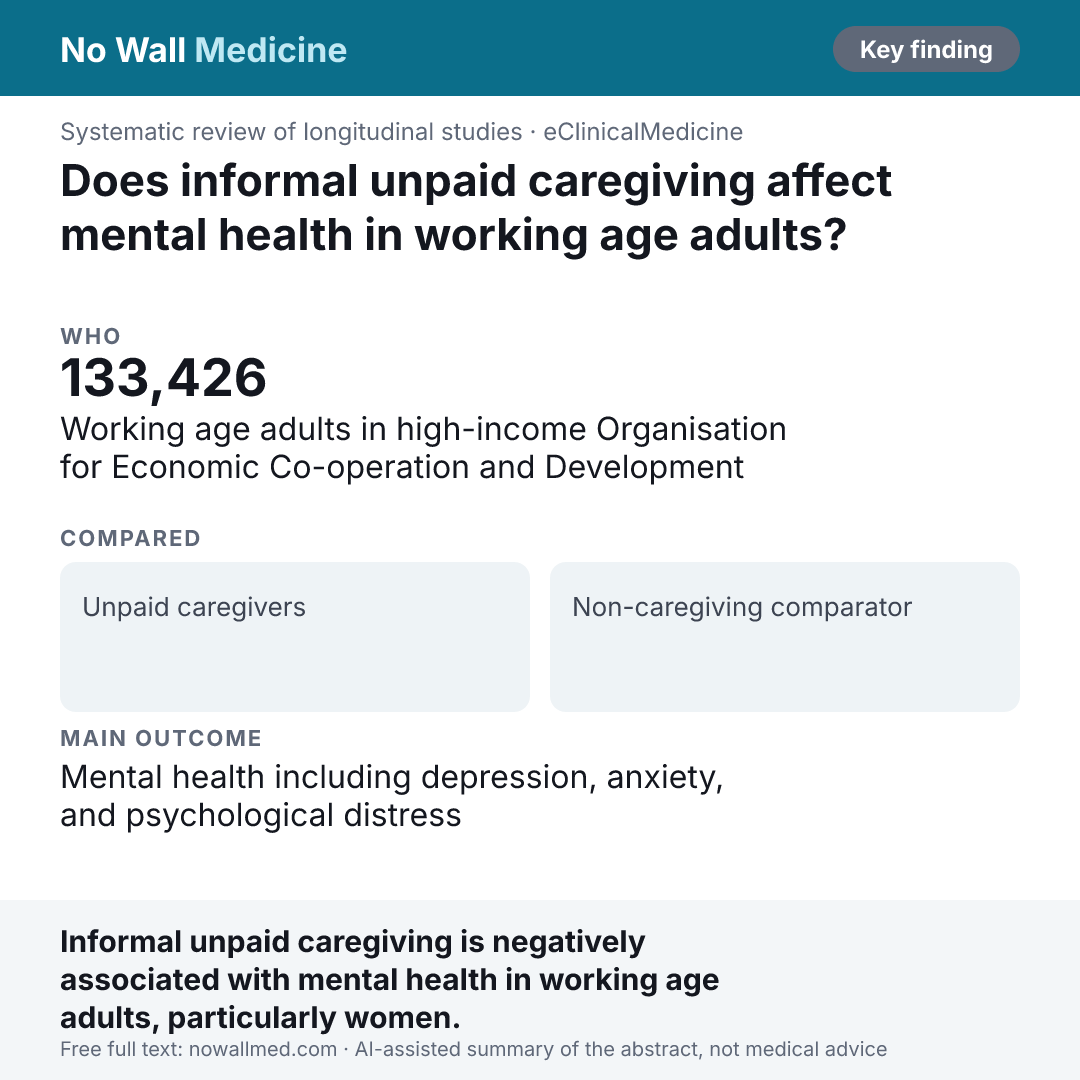
- Researchers reviewed 13 longitudinal studies involving 133,426 working age adults in high-income Organisation for Economic Co-operation and Development countries.
- Unpaid caregiving was associated with negative mental health outcomes, including depression, anxiety, and psychological distress.
- The negative impact of caregiving on mental health was consistent for women, while few studies examined men.
Why it matters: Longitudinal evidence was needed to assess the association between unpaid caregiving and mental health among working age adults in high-income countries.
Limitation the authors note: Significant between-study heterogeneity precluded meta-analysis.
Discussion prompts
- Would these patients look like yours? Who was left out?
- Is the main outcome one that matters to patients?
- Is the difference large enough to change what you do?
Cite: Ervin J, Taouk Y, Fleitas Alfonzo L, Peasgood T, King T. Longitudinal association between informal unpaid caregiving and mental health amongst working age adults in high-income OECD countries: A systematic review. EClinicalMedicine. 2022;53:101711. doi:10.1016/j.eclinm.2022.101711
Free full text: PubMed Central · Summary and visual abstract: nowallmed.com/a/longitudinal-association-between-informal-unpaid-caregiving-and-k9oljm/ (AI-assisted from the abstract; check the paper before relying on it).