Red-light therapy was associated with thicker choroid layers and better myopia control in children
Longitudinal Changes and Predictive Value of Choroidal Thickness for Myopia Control after Repeated Low-Level Red-Light Therapy
Secondary analysis of a randomized controlled trialBenefit found
How does repeated low-level red-light therapy affect macular choroidal thickness and myopia control?
Who
120
Myopic children aged 8-13 years · Multicenter, 2 of 5 sites
Compared
Repeated low-level red-light therapy: 9.089 μm at 12 months
Single-vision spectacle: -10.407 μm at 12 months
Main outcome
Changes in macular choroidal thickness and myopia control
Bottom line: Repeated low-level red-light therapy induced sustained choroidal thickening and 3-month thickness changes predict 12-month myopia control.
Ophthalmology · 2022-10-11Download image
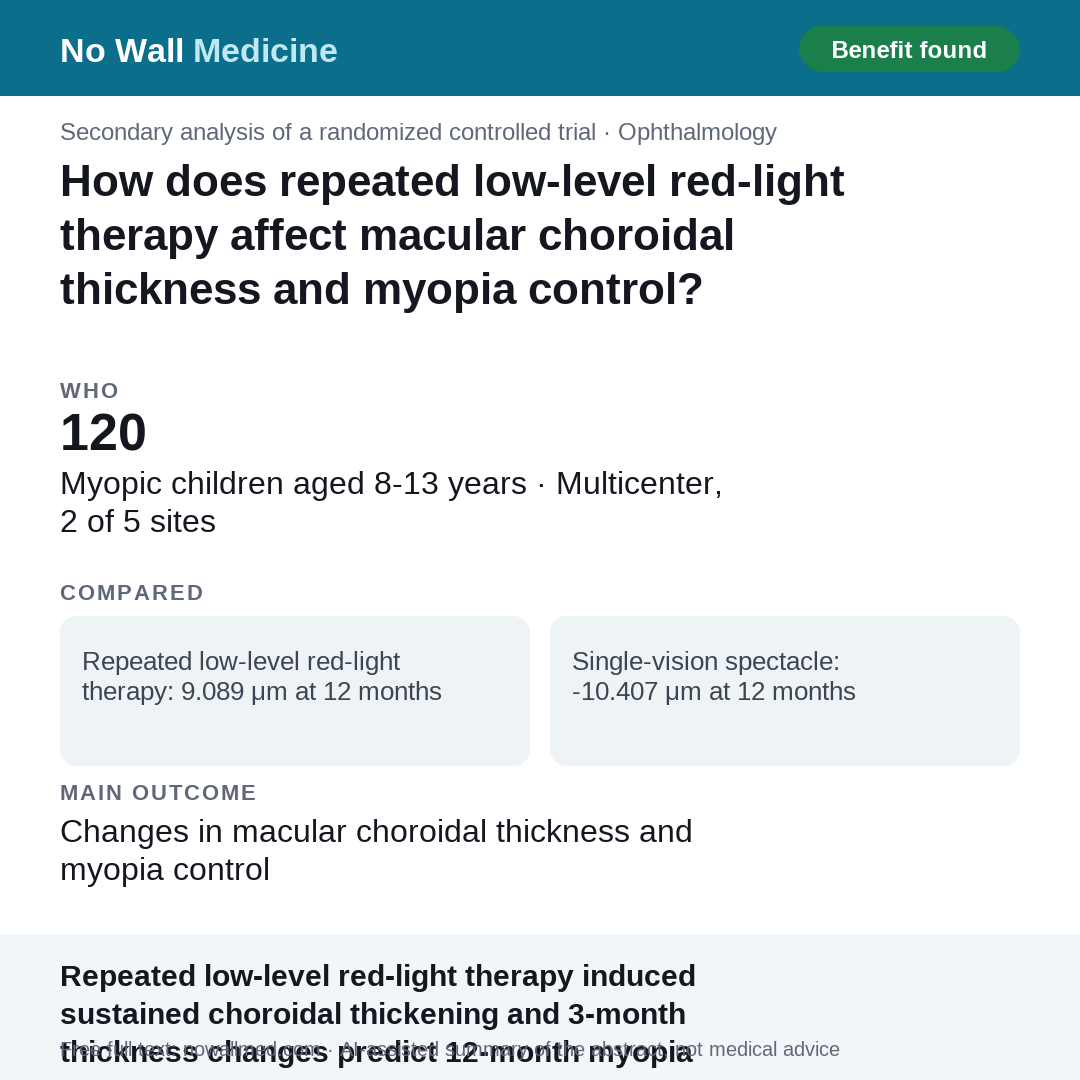
Clinical question: How does repeated low-level red-light therapy affect macular choroidal thickness and myopia control?
Why it matters: It was unknown if changes in the thickness of the choroid, the vascular layer of the eye, could predict how well red-light therapy controls myopia.
Key points
- Researchers analyzed 120 myopic children aged 8-13 years receiving either repeated low-level red-light therapy or single-vision spectacles.
- The red-light group showed a maximal macular choroidal thickness increase of 14.755 μm at 1 month, while the spectacle group showed thinning reaching -10.407 μm at 12 months.
- Changes in macular choroidal thickness at 3 months alone were associated with predicting 12-month myopia control efficacy with areas under the curve of 0.710-0.786.
Headline and key points written with AI from the paper’s abstract, with every number checked against it. Read the paper before relying on them.
Was this summary helpful?
Subject terms
Cite this article
Xiong R, Zhu Z, Jiang Y, Wang W, Zhang J, Chen Y. Longitudinal Changes and Predictive Value of Choroidal Thickness for Myopia Control after Repeated Low-Level Red-Light Therapy. Ophthalmology. 2022. doi:10.1016/j.ophtha.2022.10.002
Spotted a mistake? Suggest a correction
Top studies every Monday
The week’s key trials and guidelines in your specialties, plus any topics you follow. By email, free.
Get the weekly digest