Multifocal contact lenses were associated with increased choroidal thickness and area in myopic children
Three-Year Change in Subfoveal Choroidal Thickness and Area With Multifocal Contact Lens Wear in the Bifocal Lenses in Nearsighted Kids (BLINK) Study
Randomized trialBenefit found
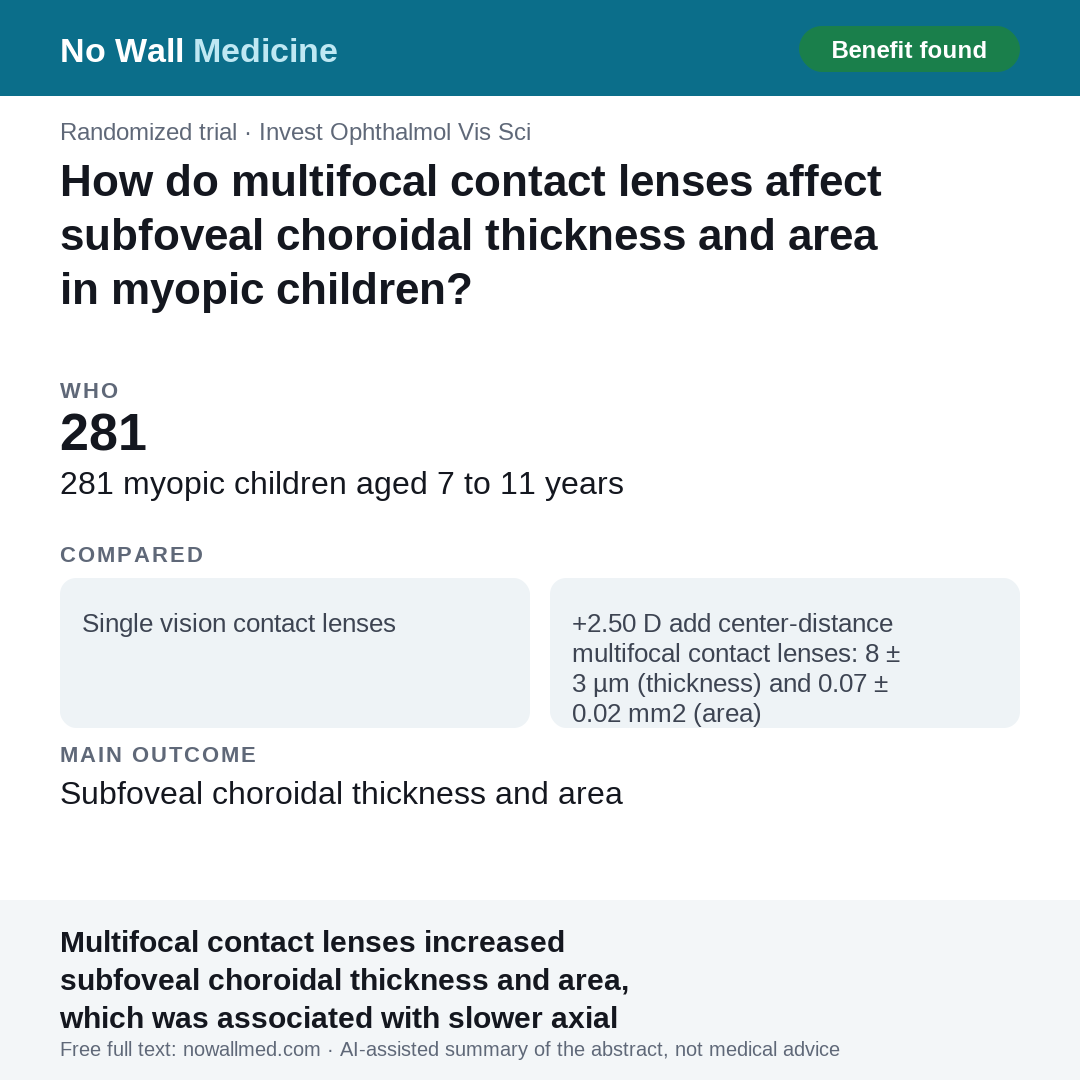
How do multifocal contact lenses affect subfoveal choroidal thickness and area in myopic children?
Who
281
281 myopic children aged 7 to 11 years
Compared
Single vision contact lenses
+2.50 D add center-distance multifocal contact lenses: 8 ± 3 µm (thickness) and 0.07 ± 0.02 mm2 (area)
Main outcome
Subfoveal choroidal thickness and area
Bottom line: Multifocal contact lenses increased subfoveal choroidal thickness and area, which was associated with slower axial elongation.
Limitation: Only a portion of the treatment effect can be accounted for by choroidal parameters.
Invest Ophthalmol Vis Sci · 2025-05-02Download image
Clinical question: How do multifocal contact lenses affect subfoveal choroidal thickness and area in myopic children?
Why it matters: It was unknown how wearing multifocal contact lenses for myopia control affects the thickness and area of the choroid, the vascular layer of the eye.
Key points
- The study followed 281 myopic children aged 7 to 11 years wearing either single vision contact lenses or multifocal contact lenses with a +1.50 D or +2.50 D add.
- After 2 weeks, the +2.50 D multifocal group showed an increase in subfoveal choroidal thickness of 8 ± 3 µm and choroidal area of 0.07 ± 0.02 mm2 compared to single vision lenses.
- Increased choroidal thickness and area after 2 weeks were associated with less axial elongation, which is the lengthening of the eye, over 3 years.
Headline and key points written with AI from the paper’s abstract, with every number checked against it. Read the paper before relying on them.
Was this summary helpful?
Subject terms
Cite this article
Walker MK, Berntsen DA, Robich ML, Fenton RL, Ticak A, Assaad JR. Three-Year Change in Subfoveal Choroidal Thickness and Area With Multifocal Contact Lens Wear in the Bifocal Lenses in Nearsighted Kids (BLINK) Study. Invest Ophthalmol Vis Sci. 2025. doi:10.1167/iovs.66.5.5
Spotted a mistake? Suggest a correction