Different glucose-lowering medications show varying long-term effects on insulin sensitivity and beta-cell function
Longitudinal Effects of Glucose-Lowering Medications on β-Cell Responses and Insulin Sensitivity in Type 2 Diabetes: The GRADE Randomized Clinical Trial
Randomized clinical trialMixed results
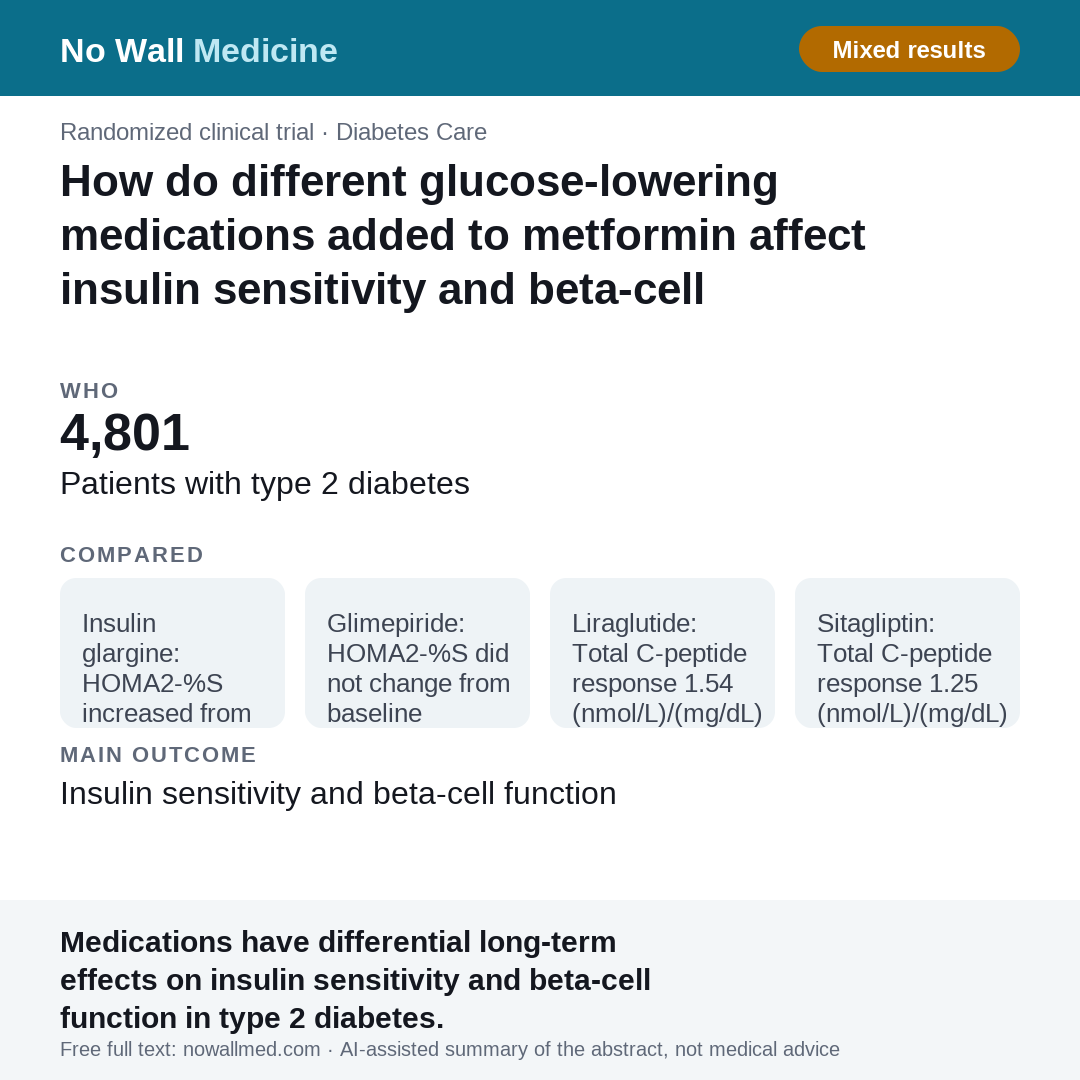
How do different glucose-lowering medications added to metformin affect insulin sensitivity and beta-cell function?
Who
4,801
Patients with type 2 diabetes
Compared
Insulin glargine: HOMA2-%S increased from baseline to year 1
Glimepiride: HOMA2-%S did not change from baseline
Liraglutide: Total C-peptide response 1.54 (nmol/L)/(mg/dL) * 100
Sitagliptin: Total C-peptide response 1.25 (nmol/L)/(mg/dL) * 100
Main outcome
Insulin sensitivity and beta-cell function
Bottom line: Medications have differential long-term effects on insulin sensitivity and beta-cell function in type 2 diabetes.
Diabetes Care · 2024-01-12Download image
Clinical question: How do different glucose-lowering medications added to metformin affect insulin sensitivity and beta-cell function?
Why it matters: It was unknown how different glucose-lowering medications added to metformin affect insulin sensitivity and the function of insulin-producing beta cells over five years.
Key points
- Researchers followed 4,801 people with type 2 diabetes receiving metformin plus insulin glargine, glimepiride, liraglutide, or sitagliptin over 5 years.
- At year 5, the C-peptide index was 0.80 for liraglutide, 0.87 for sitagliptin, 0.74 for glargine, and 0.64 for glimepiride.
- Total C-peptide response at year 5 was highest with liraglutide at 1.54, followed by sitagliptin at 1.25, glargine at 1.02, and glimepiride at 0.87.
Headline and key points written with AI from the paper’s abstract, with every number checked against it. Read the paper before relying on them.
Was this summary helpful?
Subject terms
Cite this article
Rasouli N, Younes N, Ghosh A, et al. Longitudinal Effects of Glucose-Lowering Medications on β-Cell Responses and Insulin Sensitivity in Type 2 Diabetes: The GRADE Randomized Clinical Trial. Diabetes Care. 2024. doi:10.2337/dc23-1070
Spotted a mistake? Suggest a correction