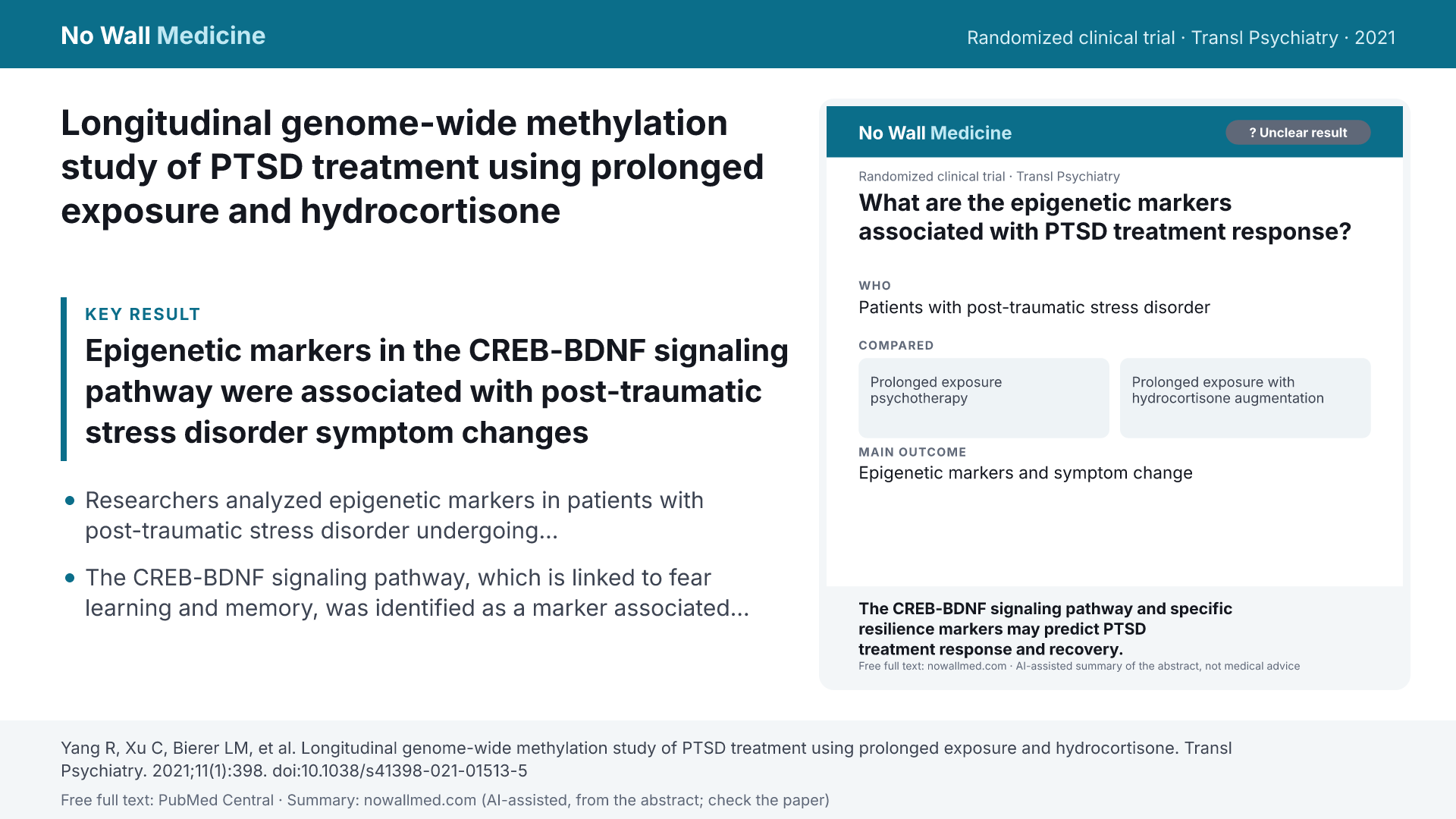
Epigenetic markers in the CREB-BDNF signaling pathway were associated with post-traumatic stress disorder symptom changes
Longitudinal genome-wide methylation study of PTSD treatment using prolonged exposure and hydrocortisone
Randomized clinical trialUnclear result
What are the epigenetic markers associated with PTSD treatment response?
Who
Patients with post-traumatic stress disorder
Compared
Prolonged exposure psychotherapy
Prolonged exposure with hydrocortisone augmentation
Main outcome
Epigenetic markers and symptom change
Bottom line: The CREB-BDNF signaling pathway and specific resilience markers may predict PTSD treatment response and recovery.
Transl Psychiatry · 2021-07-13Download image
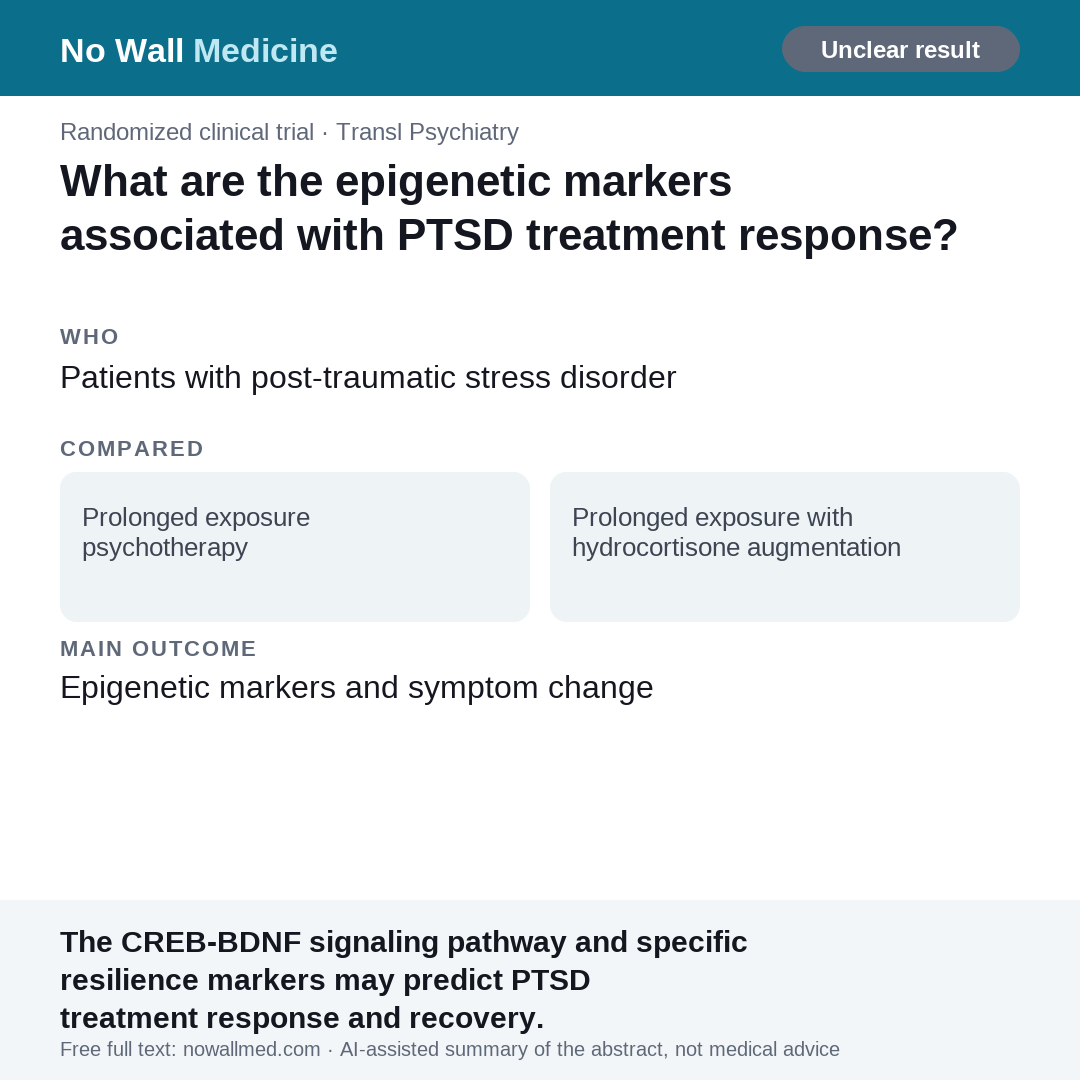
Clinical question: What are the epigenetic markers associated with PTSD treatment response?
Why it matters: It is unknown which epigenetic markers can predict recovery or reflect symptom changes in patients receiving psychotherapy for post-traumatic stress disorder.
Key points
- Researchers analyzed epigenetic markers in patients with post-traumatic stress disorder undergoing prolonged-exposure psychotherapy with or without hydrocortisone augmentation.
- The CREB-BDNF signaling pathway, which is linked to fear learning and memory, was identified as a marker associated with symptom change and severity.
- Decreased methylation levels in the gene body region of FKBP5 were associated with decreasing CAPS scores in treatment responders.
Headline and key points written with AI from the paper’s abstract, with every number checked against it. Read the paper before relying on them.
Was this summary helpful?
Subject terms
Cite this article
Yang R, Xu C, Bierer LM, Flory JD, Gautam A, Bader HN. Longitudinal genome-wide methylation study of PTSD treatment using prolonged exposure and hydrocortisone. Transl Psychiatry. 2021. doi:10.1038/s41398-021-01513-5
Spotted a mistake? Suggest a correction