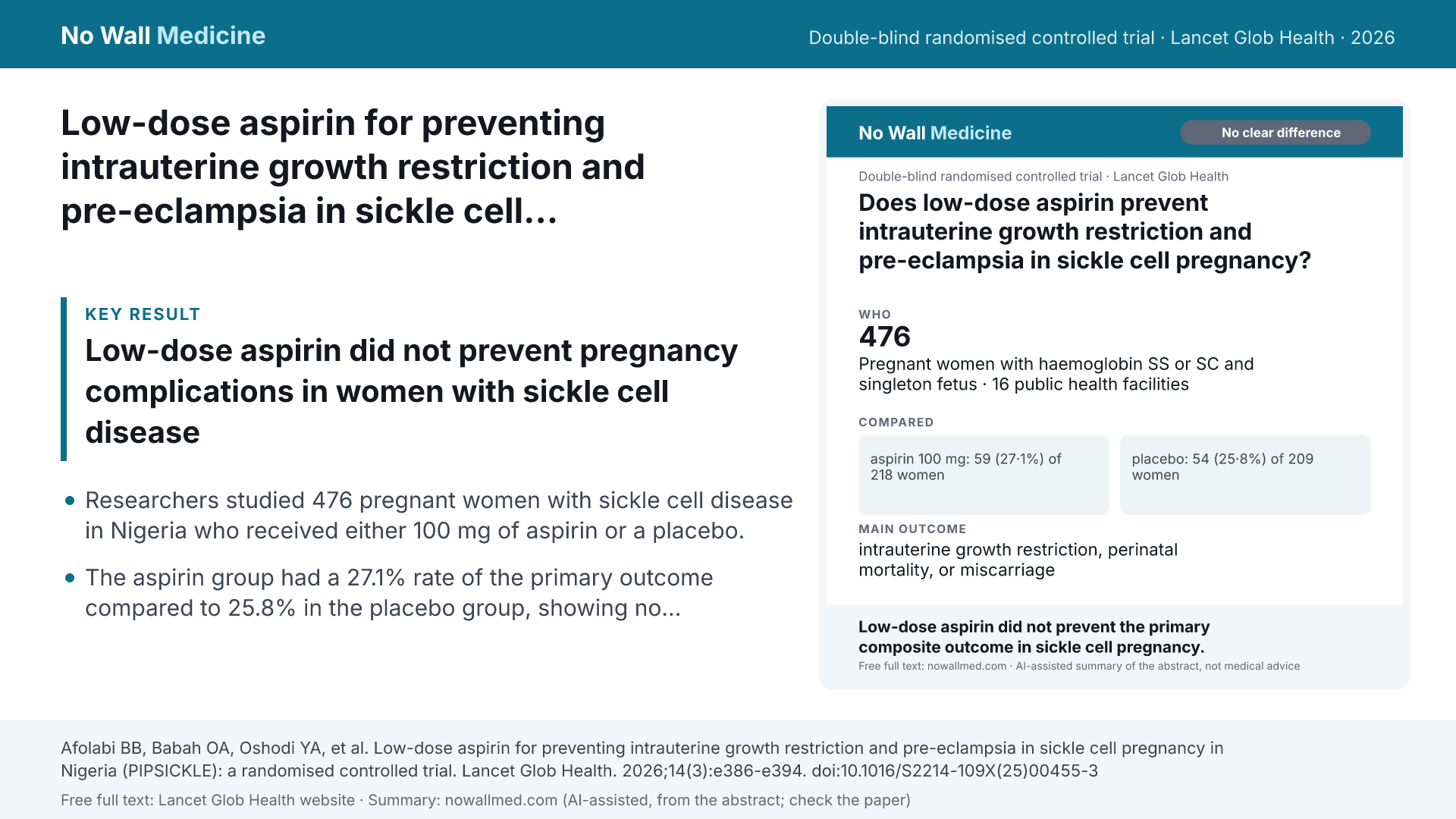
Low-dose aspirin did not prevent pregnancy complications in women with sickle cell disease
Low-dose aspirin for preventing intrauterine growth restriction and pre-eclampsia in sickle cell pregnancy in Nigeria (PIPSICKLE): a randomised controlled trial
Double-blind randomised controlled trialNo clear difference
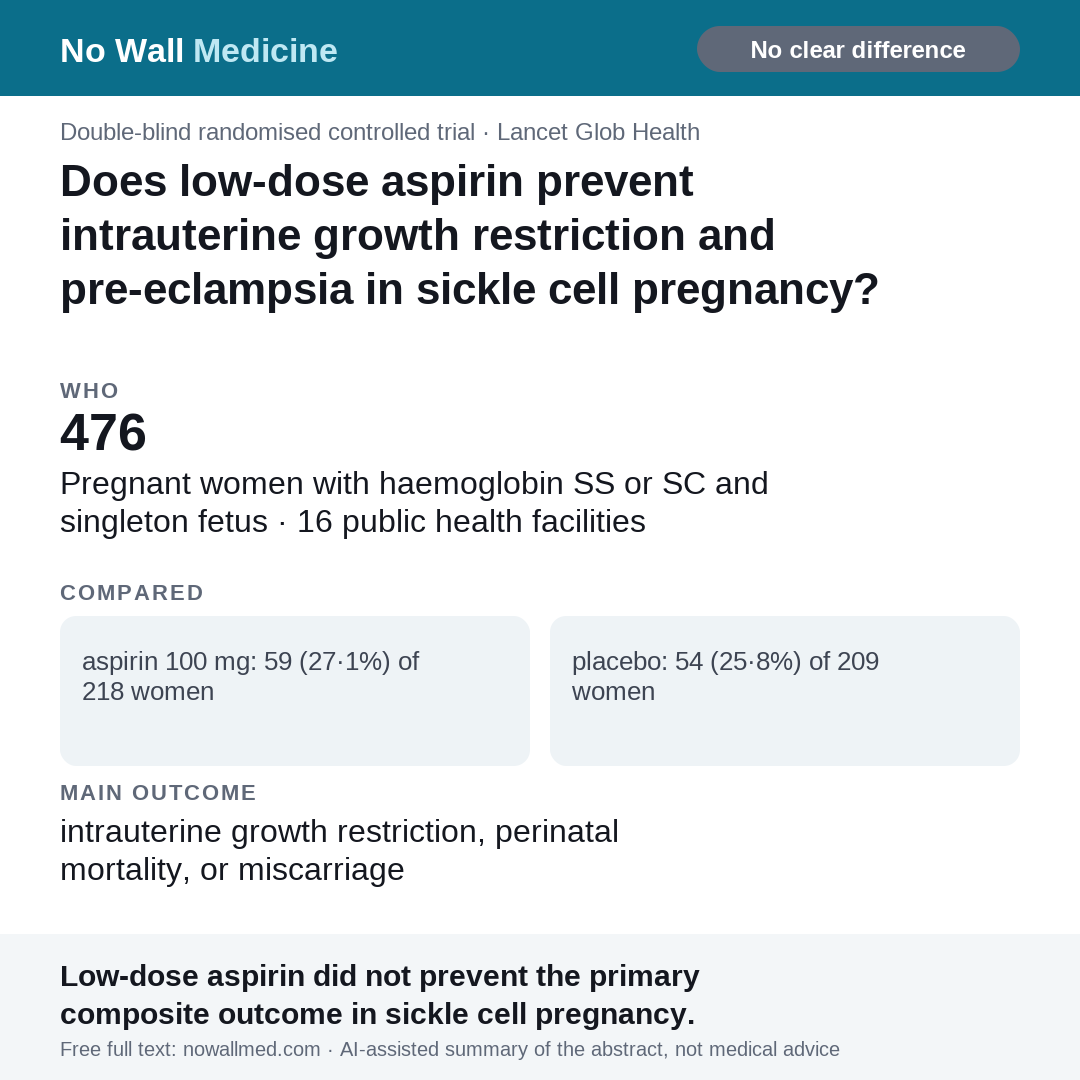
Does low-dose aspirin prevent intrauterine growth restriction and pre-eclampsia in sickle cell pregnancy?
Who
476
Pregnant women with haemoglobin SS or SC and singleton fetus · 16 public health facilities in southwest Nigeria
Compared
aspirin 100 mg: 59 (27·1%) of 218 women
placebo: 54 (25·8%) of 209 women
Main outcome
intrauterine growth restriction, perinatal mortality, or miscarriage
Result: risk ratio 1·05 (95% CI 0·75-1·46)
Bottom line: Low-dose aspirin did not prevent the primary composite outcome in sickle cell pregnancy.
Limitation: conclusion is limited by late initiation of the medication after 16 weeks' gestation in three-quarters of the participants
Funded by: Tertiary Education Trust Fund Nigeria
Lancet Glob Health · 2026-02-20Download image
Clinical question: Does low-dose aspirin prevent intrauterine growth restriction and pre-eclampsia in sickle cell pregnancy?
Why it matters: Pregnant women with sickle cell disease face increased risks of intrauterine growth restriction, pre-eclampsia, and sickle-related conditions, but aspirin effectiveness has not been tested in this population.
Key points
- Researchers studied 476 pregnant women with sickle cell disease in Nigeria who received either 100 mg of aspirin or a placebo.
- The aspirin group had a 27.1% rate of the primary outcome compared to 25.8% in the placebo group, showing no significant difference.
- More sickle-cell crises occurred in the aspirin group than the placebo group, and maternal deaths were 4.2% in the aspirin group versus 0.1% in the placebo group.
Limitation the authors note: The authors state the conclusion is limited by late initiation of the medication after 16 weeks' gestation in three-quarters of the participants.
Headline and key points written with AI from the paper’s abstract, with every number checked against it. Read the paper before relying on them.
Was this summary helpful?
Abstract
Background
Pregnant women with sickle cell disease are at increased risk of intrauterine growth restriction (IUGR), pre-eclampsia, and sickle-related conditions. Low-dose aspirin might reduce some of these complications but has not been tested in sickle cell pregnancy. We aimed to investigate the effectiveness and safety of low-dose aspirin for preventing complications during pregnancy. Methods
In a double-blind randomised controlled trial in 16 public health facilities in southwest Nigeria, pregnant women (aged ≥18 years) with haemoglobin SS (HbSS) or SC (HbSC) and carrying a singleton fetus between 12 weeks' and 28 weeks' gestation received daily 100 mg aspirin or placebo until 36 weeks' gestation or delivery and were monitored until 6 weeks' postpartum. The composite primary outcome comprised IUGR, perinatal mortality, or miscarriage. Analysis was done in the intention-to-treat population. The trial was registered in the Pan African Clinical Trial Registry (PACTR202001787519553) and ClinicalTrials.gov (NCT05253781). Findings
Between July 1, 2020, and May 27, 2024, 619 pregnant women with HbSS and HbSC were screened, of whom 476 eligible women were recruited; 239 received aspirin 100 mg from a median gestational age of 19·0 (16·0-24·0) weeks and 237 received placebo from a median gestational age of 20·5 (15·5-25·0) weeks. 41 withdrew, died, or were lost to follow-up before 36 weeks' gestation. There was no significant difference in the risk of the primary endpoint: 59 (27·1%) of 218 women in the aspirin group versus 54 (25·8%) of 209 women in the placebo group (risk ratio 1·05 [95% CI 0·75-1·46]). More sickle-cell crises occurred with aspirin than with placebo (mean frequency of 32·64 [SD 71·17] per 100 women with aspirin versus 30·38 [75·95] per 100 women with placebo, incidence rate ratio 1·04 [95% CI 1·01-1·08]). There were ten (4·2%) maternal deaths in the aspirin group versus two (0·1%) in the placebo group (risk ratio 4·96 [95% CI 1·18-20·92]). Interpretation
Low-dose aspirin was not beneficial for preventing IUGR, perinatal mortality, or miscarriage in sickle cell pregnancy, although this conclusion is limited by late initiation of the medication after 16 weeks' gestation in three-quarters of the participants. Low-dose aspirin, however, increased sickle-related complications compared with placebo, thus studies to clarify its safety in pregnant women with sickle cell disease are required. Funding
Tertiary Education Trust Fund Nigeria.
Abstract reproduced under the article’s CC BY licence.
Subject terms
Cite this article
Afolabi BB, Babah OA, Oshodi YA, et al. Low-dose aspirin for preventing intrauterine growth restriction and pre-eclampsia in sickle cell pregnancy in Nigeria (PIPSICKLE): a randomised controlled trial. Lancet Glob Health. 2026. doi:10.1016/S2214-109X(25)00455-3
Spotted a mistake? Suggest a correction