Feasibility study shows serial prophylactic exchange blood transfusion can be tested in sickle cell disease pregnancy
Prophylactic exchange transfusion in sickle cell disease pregnancy: a TAPS2 feasibility randomized controlled trial
Randomized controlled trialNo clear difference
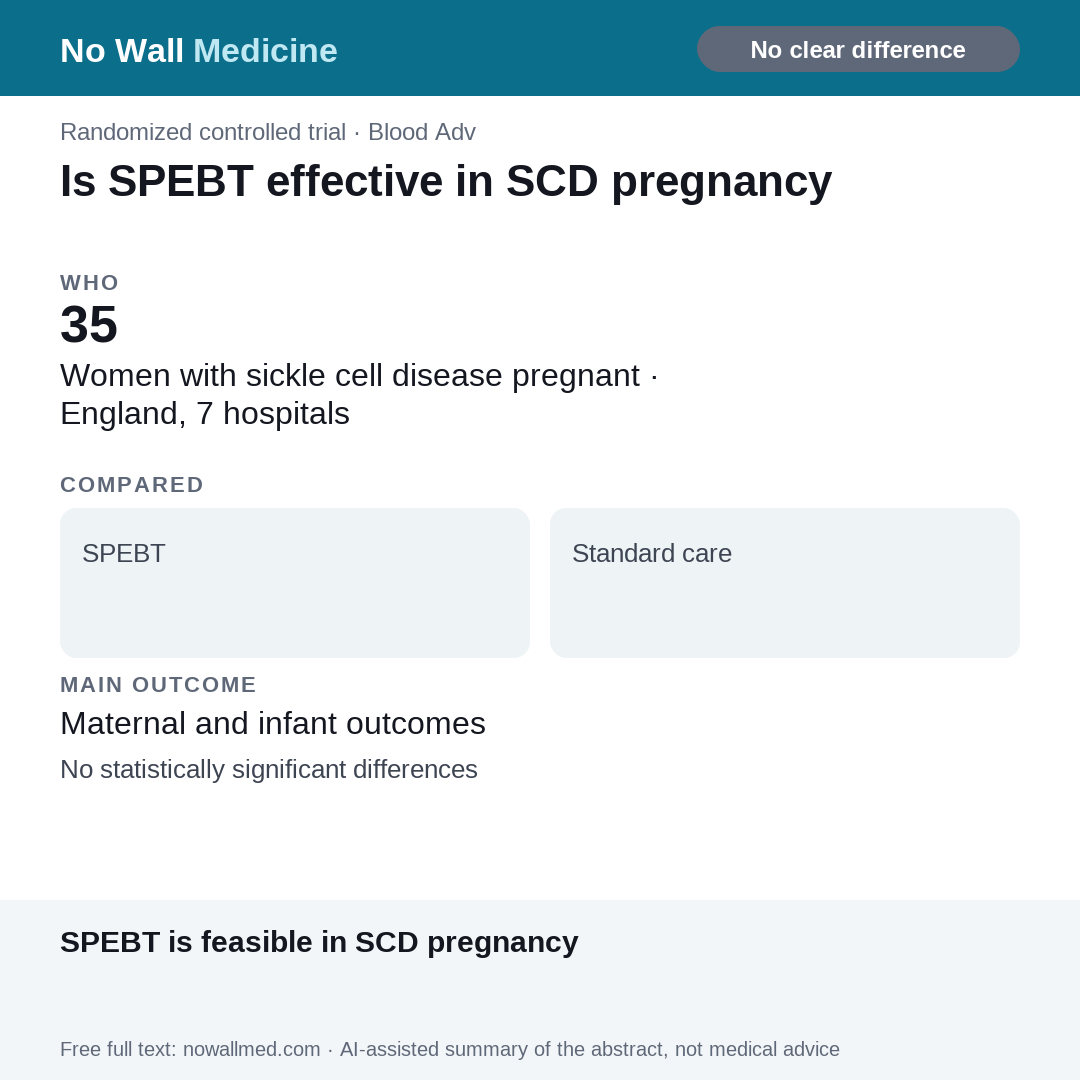
Is SPEBT effective in SCD pregnancy
Who
35
Women with sickle cell disease pregnant · England, 7 hospitals
Compared
SPEBT
Standard care
Main outcome
Maternal and infant outcomes
Result: No statistically significant differences
Bottom line: SPEBT is feasible in SCD pregnancy
Blood Adv · 2024-07-02Download image
Why it matters: It is unknown if a definitive randomized controlled trial of serial prophylactic exchange blood transfusion can be successfully conducted in pregnant women with sickle cell disease.
Key points
- Researchers studied 35 women with sickle cell disease between 6+0 and 18+6 weeks of pregnancy to see if a large trial of serial prophylactic exchange blood transfusion is possible.
- Of the 35 women, 18 were randomized to the intervention group and 17 to standard care, with 39.8% of the 88 eligible women consenting to participate.
- There were no statistically significant differences in maternal, infant, or postnatal outcomes between the two groups.
Headline and key points written with AI from the paper’s abstract, with every number checked against it. Read the paper before relying on them.
Was this summary helpful?
Abstract
Serial prophylactic exchange blood transfusion (SPEBT) is increasingly used in sickle cell disease (SCD) pregnancy, despite a lack of robust evidence. The Transfusion Antenatally in Pregnant Women with Sickle Cell Disease (TAPS2) study assessed the feasibility and acceptability of conducting a definitive randomized controlled trial of SPEBT (intervention) vs standard care (control) in this population. Women aged ≥18 years with SCD, between 6+0 and 18+6 weeks of singleton gestation, were randomized 1:1 every 6 -10 weeks throughout pregnancy in 7 hospitals in England. The main outcomes were recruitment rate (primary outcome), acceptability, and retention. Secondary outcomes were safety and maternal/infant outcomes. In total, 194 women were screened over 42 months (extended because of the pandemic), 88 were eligible, and 35 (39.8%) consented to participate; 18 participants were randomized to intervention, and 17 to control. Follow-up data were collected on all participants. Twelve patients in the intervention group received at least 1 SPEBT, of these, 11 received ≥3. The remaining patient was withdrawn from SPEBT because of transfusion reaction. Sixteen control participants required at least 1 transfusion. There were no statistically significant differences in maternal, infant, and postnatal outcomes. A trend toward a lower incidence of vaso-occlusive crisis, preterm delivery, and improved birthweight was observed in the intervention. The study achieved satisfactory recruitment and retention, confirming its acceptability to participants. TAPS2 demonstrates that it is feasible to perform a definitive international trial of SPEBT in SCD pregnancy. These trials were registered at www.ClinicalTrials.gov as #NCT03975894 and International Standard Randomized Controlled Trial Number (www.isrctn.com; #ISRCTN52684446).
Abstract reproduced under the article’s CC BY NC ND licence.
Subject terms
Cite this article
Oteng-Ntim E, Oakley LL, Robinson V, Brien S, Joseph J, Sharif J. Prophylactic exchange transfusion in sickle cell disease pregnancy: a TAPS2 feasibility randomized controlled trial. Blood Adv. 2024. doi:10.1182/bloodadvances.2024012923
Spotted a mistake? Suggest a correction
Top studies every Monday
The week’s key trials and guidelines in your specialties, plus any topics you follow. By email, free.
Get the weekly digest