Low-dose digoxin showed greater systolic function improvement than beta-blockers in patients with atrial fibrillation
Low-dose digoxin improves cardiac function in patients with heart failure, preserved ejection fraction and atrial fibrillation - the RATE-AF randomized trial
Randomized trialBenefit found
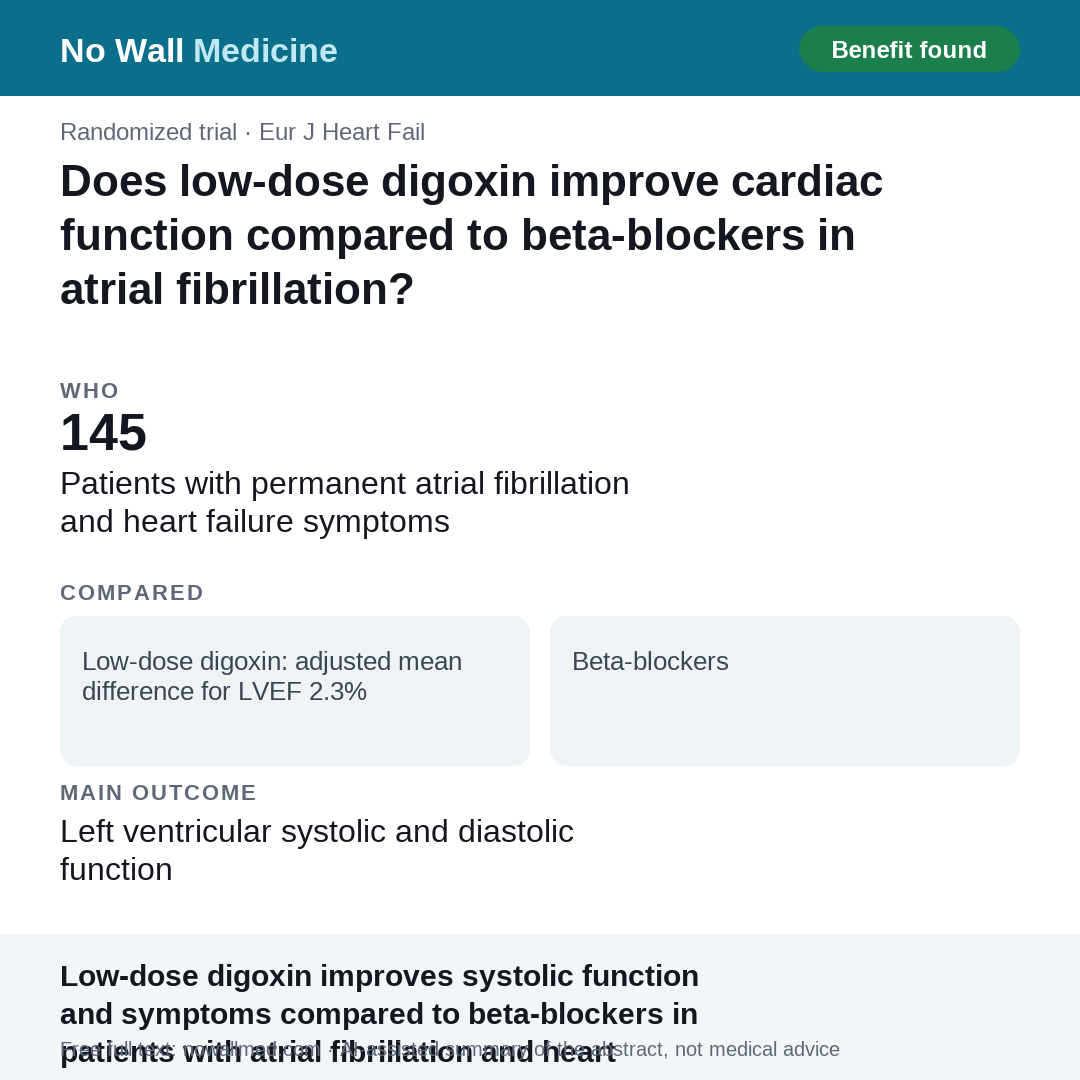
Does low-dose digoxin improve cardiac function compared to beta-blockers in atrial fibrillation?
Who
145
Patients with permanent atrial fibrillation and heart failure symptoms
Compared
Low-dose digoxin: adjusted mean difference for LVEF 2.3%
Beta-blockers
Main outcome
Left ventricular systolic and diastolic function
Result: adjusted mean difference for LVEF 2.3% (95% CI 0.3-4.2)
Bottom line: Low-dose digoxin improves systolic function and symptoms compared to beta-blockers in patients with atrial fibrillation and heart failure.
Eur J Heart Fail · 2025-09-02Download image
Clinical question: Does low-dose digoxin improve cardiac function compared to beta-blockers in atrial fibrillation?
Why it matters: It is unclear how low-dose digoxin compares to beta-blockers regarding heart function in patients with permanent atrial fibrillation and heart failure.
Key points
- Researchers studied 145 patients with permanent atrial fibrillation and heart failure symptoms to compare low-dose digoxin against beta-blockers over 12 months.
- In 119 patients with a left ventricular ejection fraction of 50% or higher, digoxin was associated with a 2.3% greater difference in ejection fraction.
- Digoxin was associated with improved heart failure symptom classes and a lower rate of adverse events compared to beta-blockers.
Headline and key points written with AI from the paper’s abstract, with every number checked against it. Read the paper before relying on them.
Topics
Cite this article
Bunting KV, Champsi A, Gill SK, Saadeh K, Camm AJ, Stanbury M. Low-dose digoxin improves cardiac function in patients with heart failure, preserved ejection fraction and atrial fibrillation - the RATE-AF randomized trial. Eur J Heart Fail. 2025. doi:10.1002/ejhf.70022
Spotted a mistake? Suggest a correction
Top studies every Monday
The week’s key trials and guidelines in your specialties, by email. Free.
Get the weekly digest