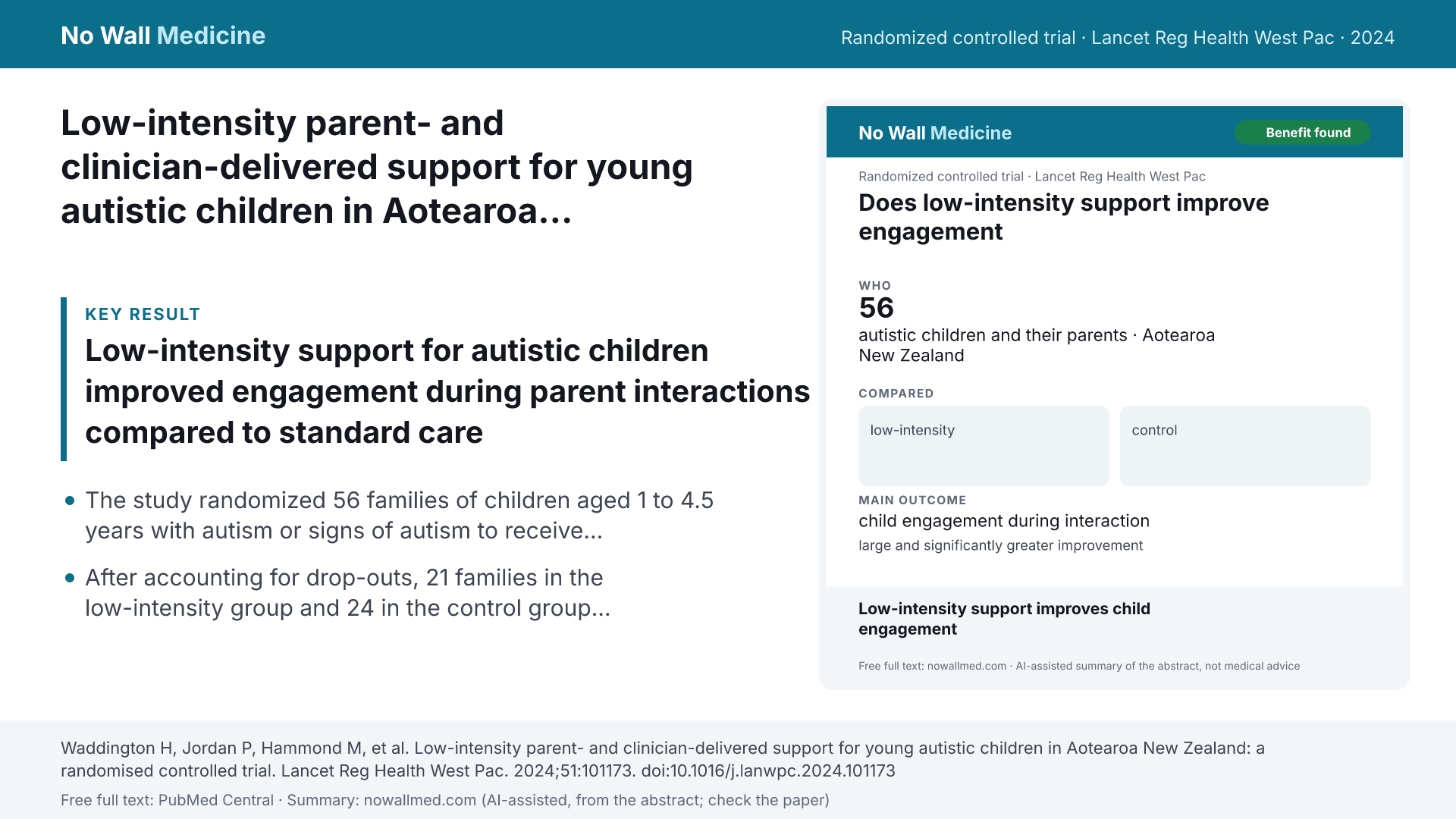
Low-intensity support for autistic children improved engagement during parent interactions compared to standard care
Low-intensity parent- and clinician-delivered support for young autistic children in Aotearoa New Zealand: a randomised controlled trial
Randomized controlled trialBenefit found
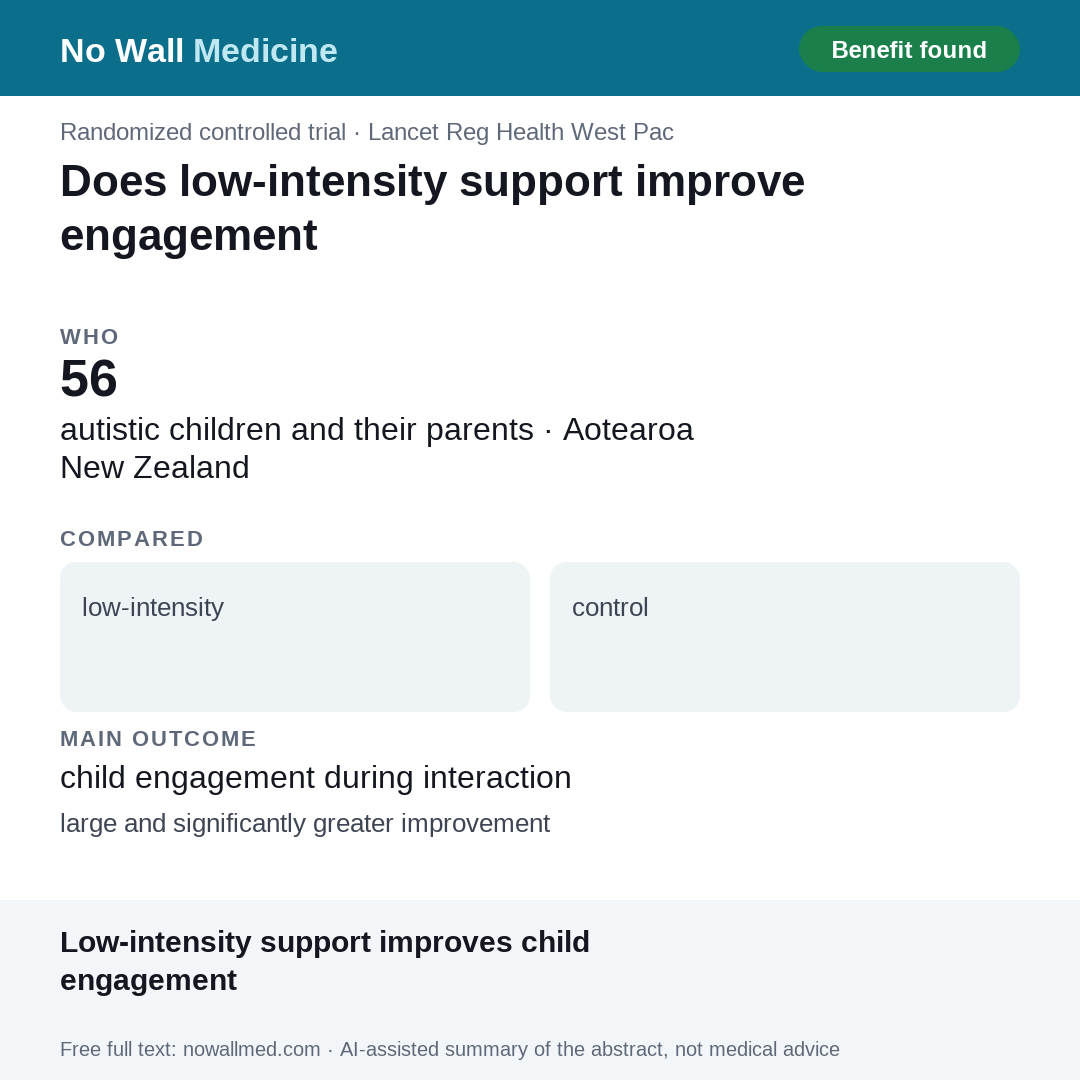
Does low-intensity support improve engagement
Who
56
autistic children and their parents · Aotearoa New Zealand
Compared
low-intensity
control
Main outcome
child engagement during interaction
Result: large and significantly greater improvement
Bottom line: Low-intensity support improves child engagement
Limitation: drop-outs occurred
Funded by: Health Research Council of New Zealand
Lancet Reg Health West Pac · 2024-08-16Download image
Why it matters: It is unknown if a low-intensity program involving both parents and clinicians is effective for autistic children in areas without publicly-funded intensive autism support.
Key points
- The study randomized 56 families of children aged 1 to 4.5 years with autism or signs of autism to receive either low-intensity support or monthly support calls.
- After accounting for drop-outs, 21 families in the low-intensity group and 24 in the control group showed significantly greater improvements in child engagement during parent interactions.
- Two adverse effects related to the support were recorded during the trial.
Headline and key points written with AI from the paper’s abstract, with every number checked against it. Read the paper before relying on them.
Was this summary helpful?
Cite this article
Waddington H, Jordan P, Hammond M, et al. Low-intensity parent- and clinician-delivered support for young autistic children in Aotearoa New Zealand: a randomised controlled trial. Lancet Reg Health West Pac. 2024. doi:10.1016/j.lanwpc.2024.101173
Spotted a mistake? Suggest a correction