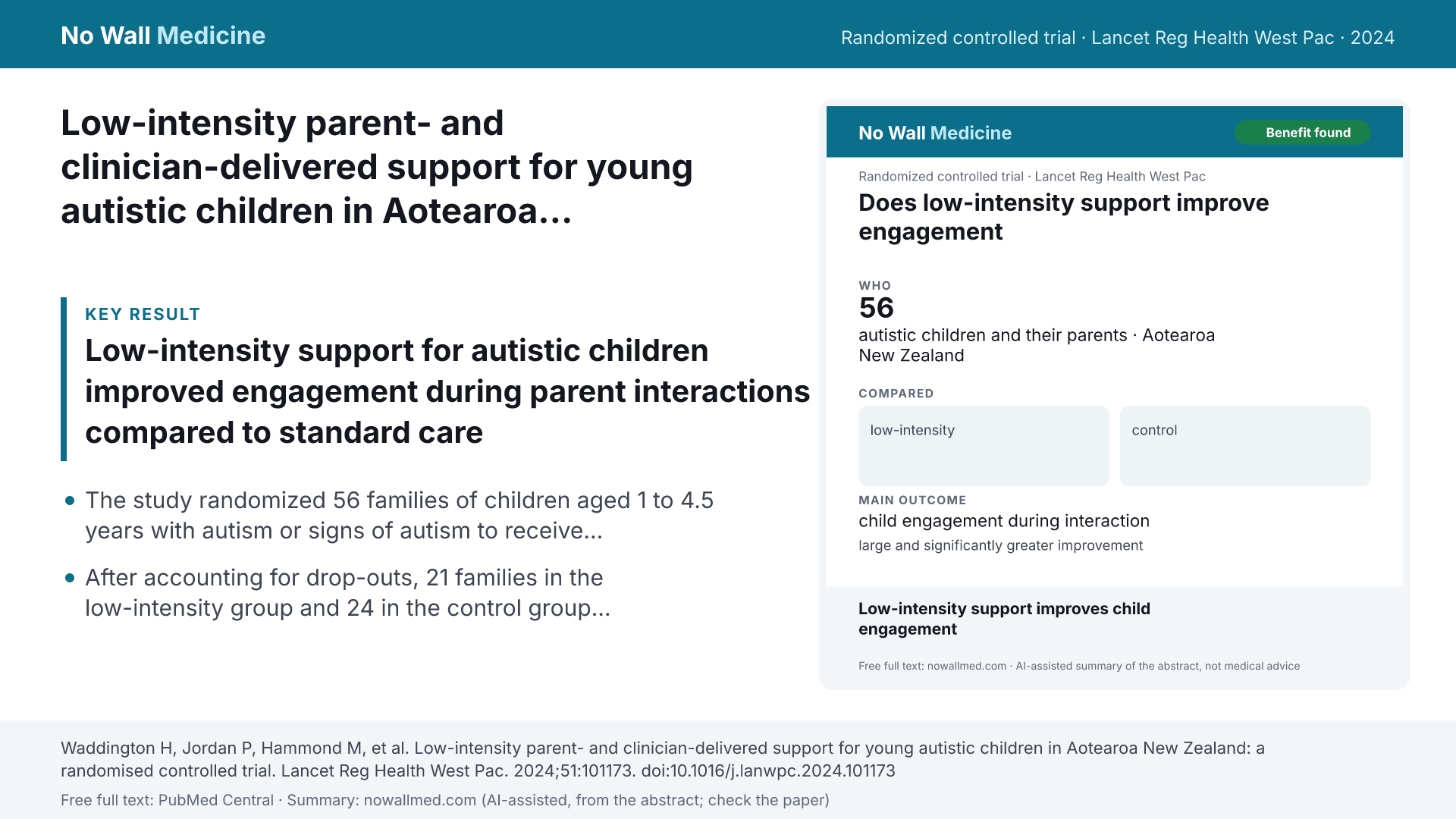
Low-intensity parent- and clinician-delivered support for young autistic children in Aotearoa New Zealand: a randomised controlled trial
Key result: Low-intensity support for autistic children improved engagement during parent interactions compared to standard care
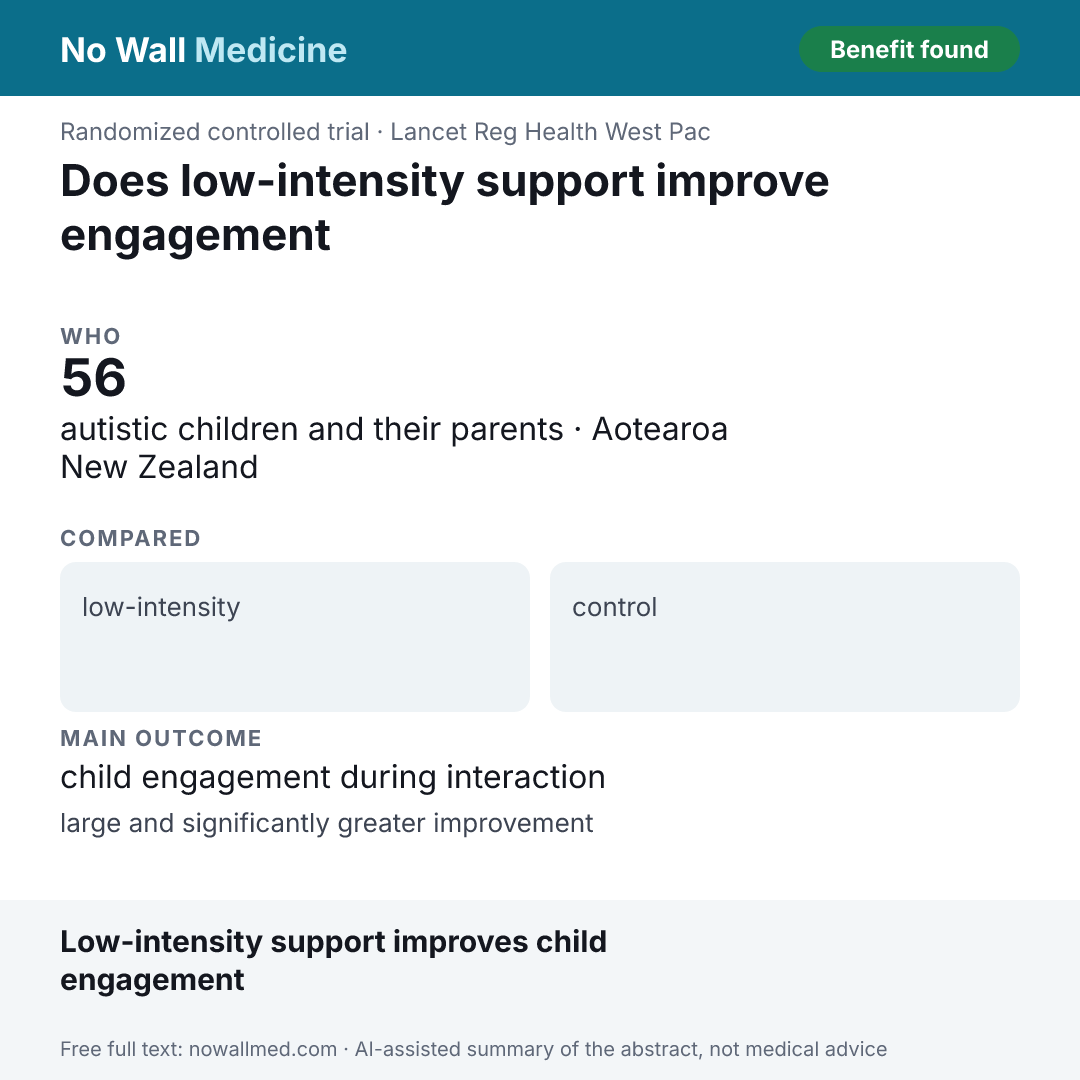
Randomized controlled trialBenefit found
Does low-intensity support improve engagement
Who
56
autistic children and their parents · Aotearoa New Zealand
Compared
low-intensity
control
Main outcome
child engagement during interaction
Result: large and significantly greater improvement
Bottom line: Low-intensity support improves child engagement
Limitation: drop-outs occurred
Funded by: Health Research Council of New Zealand
Lancet Reg Health West Pac · 2024-08-16 · Save PNG
Key points
- The study randomized 56 families of children aged 1 to 4.5 years with autism or signs of autism to receive either low-intensity support or monthly support calls.
- After accounting for drop-outs, 21 families in the low-intensity group and 24 in the control group showed significantly greater improvements in child engagement during parent interactions.
- Two adverse effects related to the support were recorded during the trial.
Discussion prompts
- Would these patients look like yours? Who was left out?
- Is the main outcome one that matters to patients?
- Is the difference large enough to change what you do?
Cite: Waddington H, Jordan P, Hammond M, et al. Low-intensity parent- and clinician-delivered support for young autistic children in Aotearoa New Zealand: a randomised controlled trial. Lancet Reg Health West Pac. 2024;51:101173. doi:10.1016/j.lanwpc.2024.101173
Free full text: PubMed Central · Summary and visual abstract: nowallmed.com/a/low-intensity-parent-and-clinician-delivered-support-for-young-dejv61/ (AI-assisted from the abstract; check the paper before relying on it).