Low-load blood flow restriction training and high-load strength training showed similar leg strength gains in COPD patients
Low-load blood flow restriction strength training in patients with COPD: a randomised single-blind pilot study
Randomised single-blind pilot studyNo clear difference
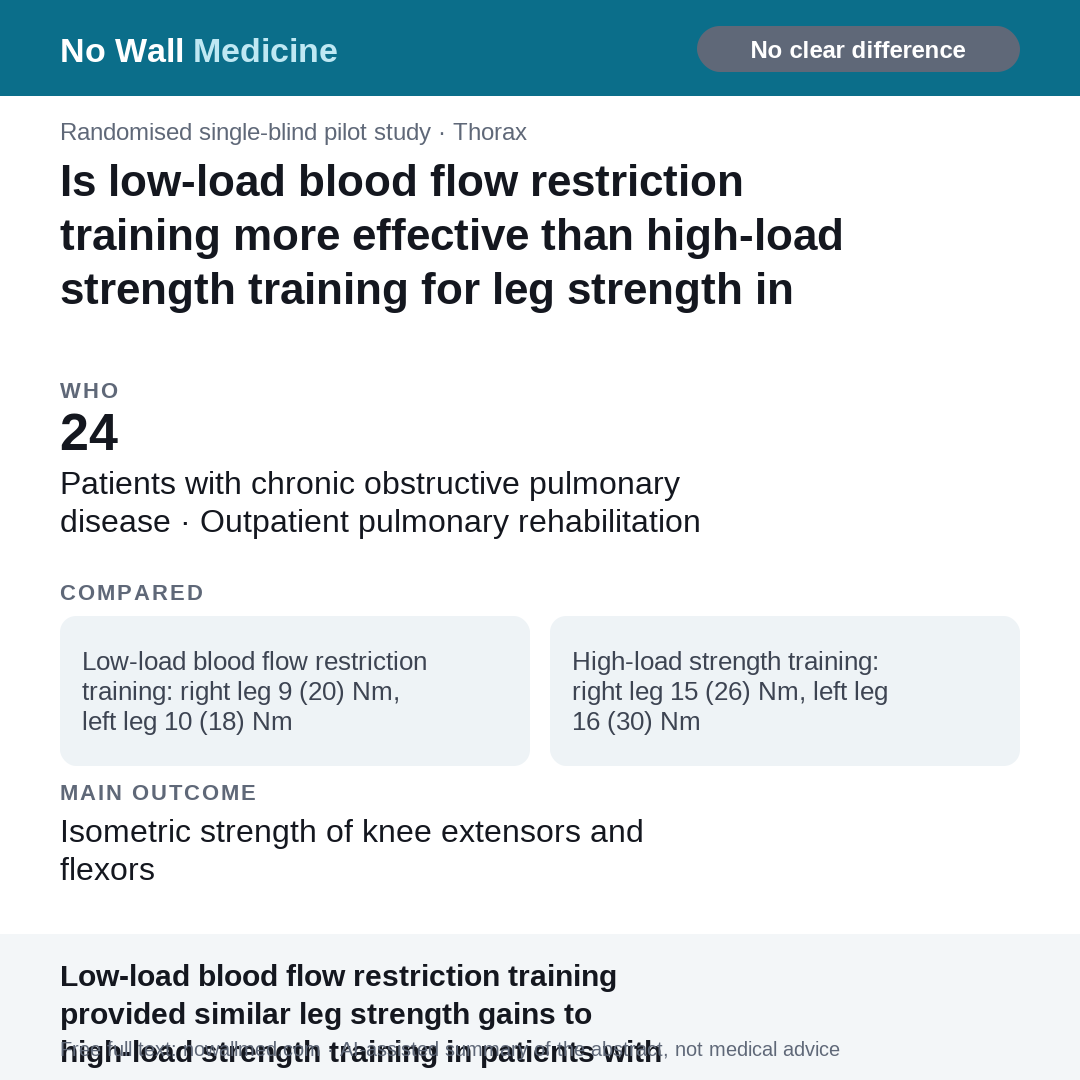
Is low-load blood flow restriction training more effective than high-load strength training for leg strength in COPD?
Who
24
Patients with chronic obstructive pulmonary disease · Outpatient pulmonary rehabilitation
Compared
Low-load blood flow restriction training: right leg 9 (20) Nm, left leg 10 (18) Nm
High-load strength training: right leg 15 (26) Nm, left leg 16 (30) Nm
Main outcome
Isometric strength of knee extensors and flexors
Result: right leg mean difference= -6.4, 95% CI= -13.20 to 25.92 Nm
Bottom line: Low-load blood flow restriction training provided similar leg strength gains to high-load strength training in patients with COPD.
Thorax · 2024-03-15Download image
Clinical question: Is low-load blood flow restriction training more effective than high-load strength training for leg strength in COPD?
Why it matters: It is unknown whether low-load strength training using blood flow restriction is as effective as traditional high-load training for improving leg strength in patients with chronic obstructive pulmonary disease.
Key points
- Researchers randomized 30 participants with chronic obstructive pulmonary disease to either low-load blood flow restriction training or high-load strength training for 24 sessions.
- Both groups showed clinically relevant improvements in isometric knee extensor strength, with no statistically significant differences found between the two training methods.
- The low-load blood flow restriction group showed clinically relevant improvements in 1 minute sit-to-stand test performance and daily physical activity steps compared to the high-load group.
Headline and key points written with AI from the paper’s abstract, with every number checked against it. Read the paper before relying on them.
Was this summary helpful?
Abstract
Objective
The objective of this study is to compare the effectiveness of lower limb low-load blood flow restriction training (LL-BFRT) with high-load strength training (HL-ST) as part of an outpatient pulmonary rehabilitation programme on leg strength in patients with chronic obstructive pulmonary disease (COPD). Methods
Participants were randomised to LL-BFRT or HL-ST (24 sessions). LL-BFRT was done at 30% 1-repetition maximum (1-RM) with 70% arterial occlusion pressure. HL-ST was done at 70% 1-RM. Primary outcome was isometric strength of knee extensors and flexors. Secondary outcomes were 1-RM, functional exercise capacity, physical activity, symptom burden and health-related quality of life. Perceptions of dyspnoea and leg fatigue were recorded after every exercise. We compared groups with t-tests. Results
We included 30 participants (13 women, 17 men, 64 (9) years, forced expiratory volume in 1 s 47 (18)% pred.), 24 completed the study. Isometric knee extensor strength improved to a clinically relevant degree in both legs in both groups (LL-BFRT: right leg 9 (20) Nm, left leg 10 (18) Nm; HL-ST: right leg 15 (26) Nm, left leg 16 (30) Nm, data are mean (SD)), without statistically significant or clinically relevant between-group differences (right leg mean difference= -6.4, 95% CI= -13.20 to 25.92 Nm, left leg mean difference= -5.6, 95% CI= -15.44 to 26.55 Nm). 1 min sit-to-stand test performance improved to a clinically relevant degree only in the LL-BFRT group (4 (4) vs 1 (5) repetitions). Interestingly, physical activity improved to a clinically relevant degree only in the LL-BFRT group (1506 (2441) vs -182 (1971) steps/day). LL-BFRT lowered perceived in-exercise dyspnoea and increased leg fatigue compared with HL-ST in the initial 12 trainings. Conclusion
In patients with stable COPD undergoing outpatient pulmonary rehabilitation, LL-BFRT was not superior to HL-ST in improving leg strength. LL-BFRT led to similar strength gains as HL-ST while reducing perceptions of dyspnoea in the initial training phase. Trial registration number
NCT04151771.
Abstract reproduced under the article’s CC BY NC licence.
Subject terms
Cite this article
Kohlbrenner D, Kuhn M, Manettas A, Aregger C, Peterer M, Greco N. Low-load blood flow restriction strength training in patients with COPD: a randomised single-blind pilot study. Thorax. 2024. doi:10.1136/thorax-2023-220546
Spotted a mistake? Suggest a correction
Top studies every Monday
The week’s key trials and guidelines in your specialties, plus any topics you follow. By email, free.
Get the weekly digest