Respiratory distress symptom intervention improved breathlessness and cough in patients with lung cancer
Respiratory distress symptom intervention for non-pharmacological management of the lung cancer breathlessness-cough-fatigue symptom cluster: randomised controlled trial
Single blind, pragmatic, randomised controlled trialBenefit found
Is respiratory distress symptom intervention effective for managing lung cancer symptom clusters?
Who
263
People with lung cancer experiencing breathlessness, cough, and fatigue · Eight centres in England, United Kingdom
Compared
respiratory distress symptom intervention: D-12 -4.13, MCLC -5.49, FACIT-F 4.91
standard care
Main outcome
Change in breathlessness, cough, and fatigue at 12 weeks
Bottom line: Respiratory distress symptom intervention is a clinically effective, low-risk management for lung cancer symptom clusters.
Limitation: The study experienced high attrition of 41.4%.
BMJ Support Palliat Care · 2024-01-08Download image
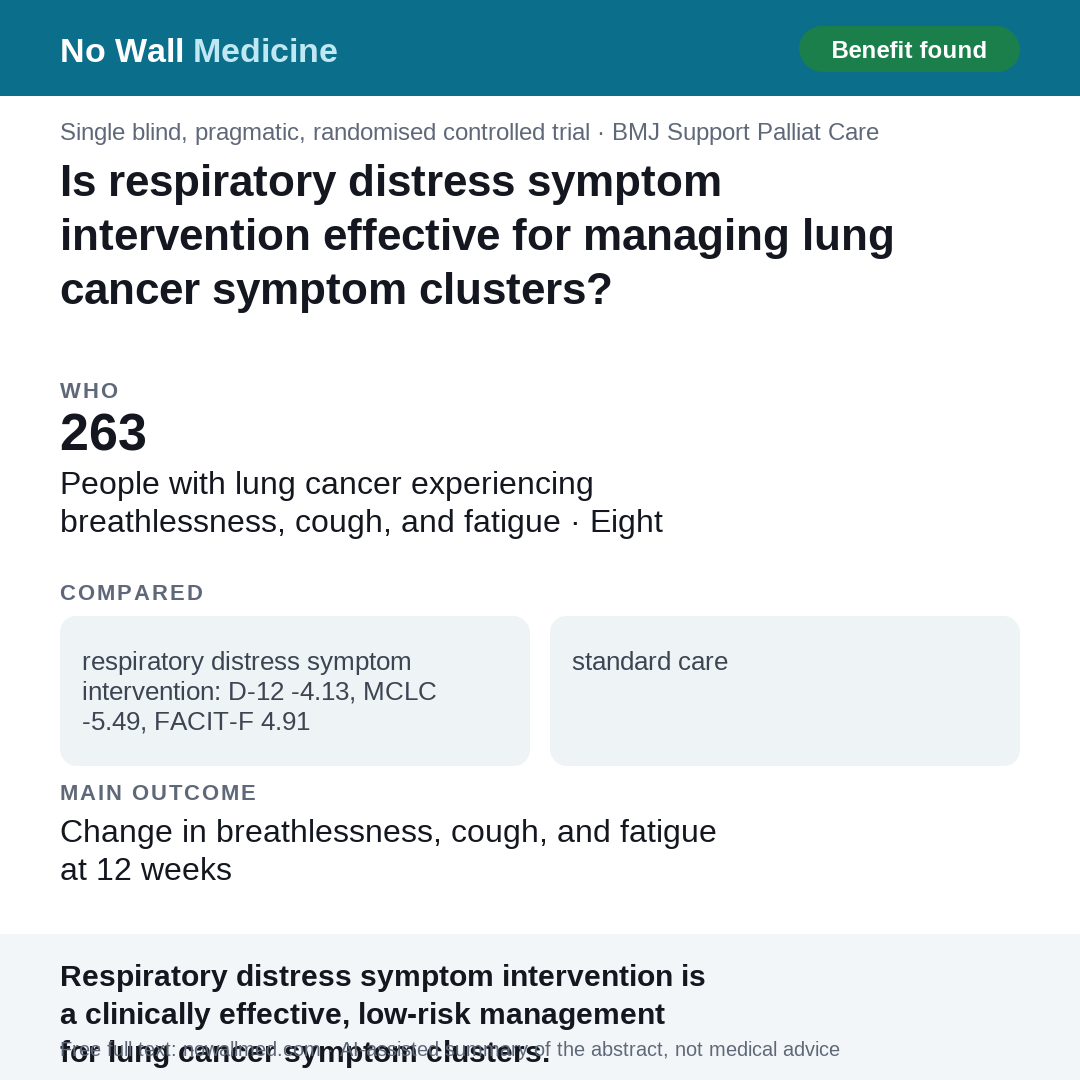
Clinical question: Is respiratory distress symptom intervention effective for managing lung cancer symptom clusters?
Why it matters: It was unknown if a specific non-pharmacological intervention could effectively manage the cluster of breathlessness, cough, and fatigue in lung cancer patients.
Key points
- Researchers conducted a randomized controlled trial with 263 lung cancer patients, comparing a respiratory distress symptom intervention to standard care.
- The intervention group showed statistically significant improvements in breathlessness (D-12) and cough (MCLC) compared to the control group.
- The intervention achieved the minimal clinically important difference for breathlessness at -4.13, cough at -5.49, and fatigue at 4.91.
Limitation the authors note: The study experienced a high attrition rate of 41.4%.
Headline and key points written with AI from the paper’s abstract, with every number checked against it. Read the paper before relying on them.
Was this summary helpful?
Abstract
Objectives
In lung cancer, three prominent symptoms, such as breathlessness, cough and fatigue, are closely related with each other forming a 'respiratory distress symptom cluster'. The aim of this study was to determine the clinical and cost-effectiveness of the respiratory distress symptom intervention (RDSI) for the management of this symptom cluster in people with lung cancer. Methods
A single blind, pragmatic, randomised controlled trial conducted in eight centres in England, UK. A total of 263 patients with lung cancer were randomised, including 132 who received RDSI and 131 who received standard care. To be eligible, participants self-reported adverse impact in daily life from at least two of the three symptoms, in any combination. Outcomes were change at 12 weeks for each symptom within the cluster, including Dyspnoea-12 (D-12), Manchester Cough in Lung Cancer (MCLC) and Functional Assessment of Chronic Illness-Fatigue. Results
At baseline, nearly 60% of participants reported all three symptoms. At trial completion the total trial attrition was 109 (41.4%). Compared with the control group, the RDSI group demonstrated a statistically significant improvement in D-12 (p=0.007) and MCLC (p<0.001). The minimal clinically important difference MCID) was achieved for each outcome: D-12 -4.13 (MCID >3), MCLC -5.49 (MCID >3) and FACIT-F 4.91 (MCID >4). Conclusion
RDSI is a clinically effective, low-risk intervention to support the management of the respiratory distress symptom cluster in lung cancer. However, the study did experience high attrition, which needs to be taken onto consideration when interpreting these results. Trial registration number
NCT03223805.
Abstract reproduced under the article’s CC BY licence.
Subject terms
Cite this article
Yorke J, Johnson MJ, Punnett G, Smith J, Blackhall F, Lloyd Williams M. Respiratory distress symptom intervention for non-pharmacological management of the lung cancer breathlessness-cough-fatigue symptom cluster: randomised controlled trial. BMJ Support Palliat Care. 2024. doi:10.1136/spcare-2022-003924
Spotted a mistake? Suggest a correction
Top studies every Monday
The week’s key trials and guidelines in your specialties, plus any topics you follow. By email, free.
Get the weekly digest