Lower extremity reamputation in people with diabetes: a systematic review and meta-analysis
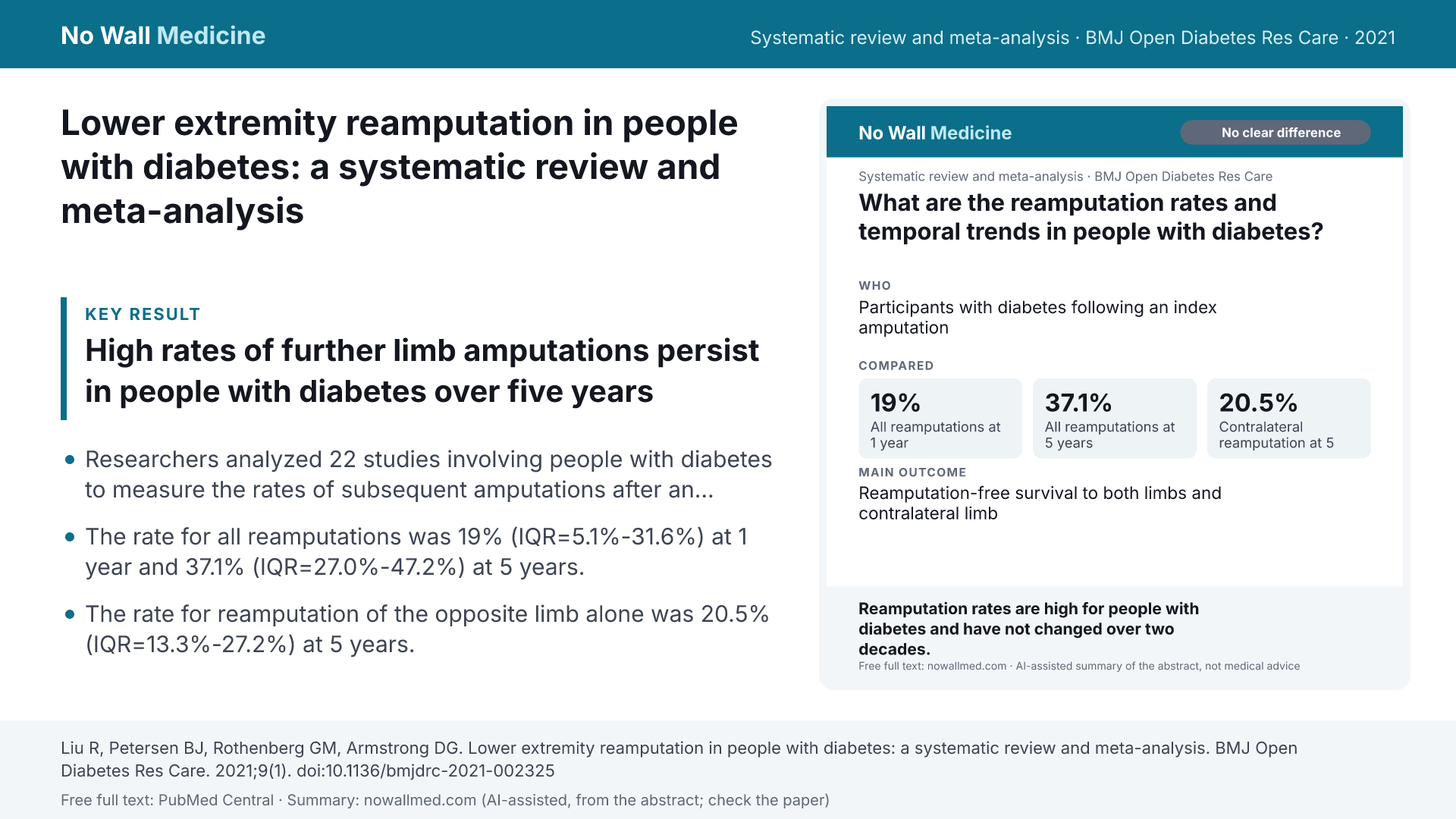
Key result: High rates of further limb amputations persist in people with diabetes over five years
Systematic review and meta-analysisNo clear difference
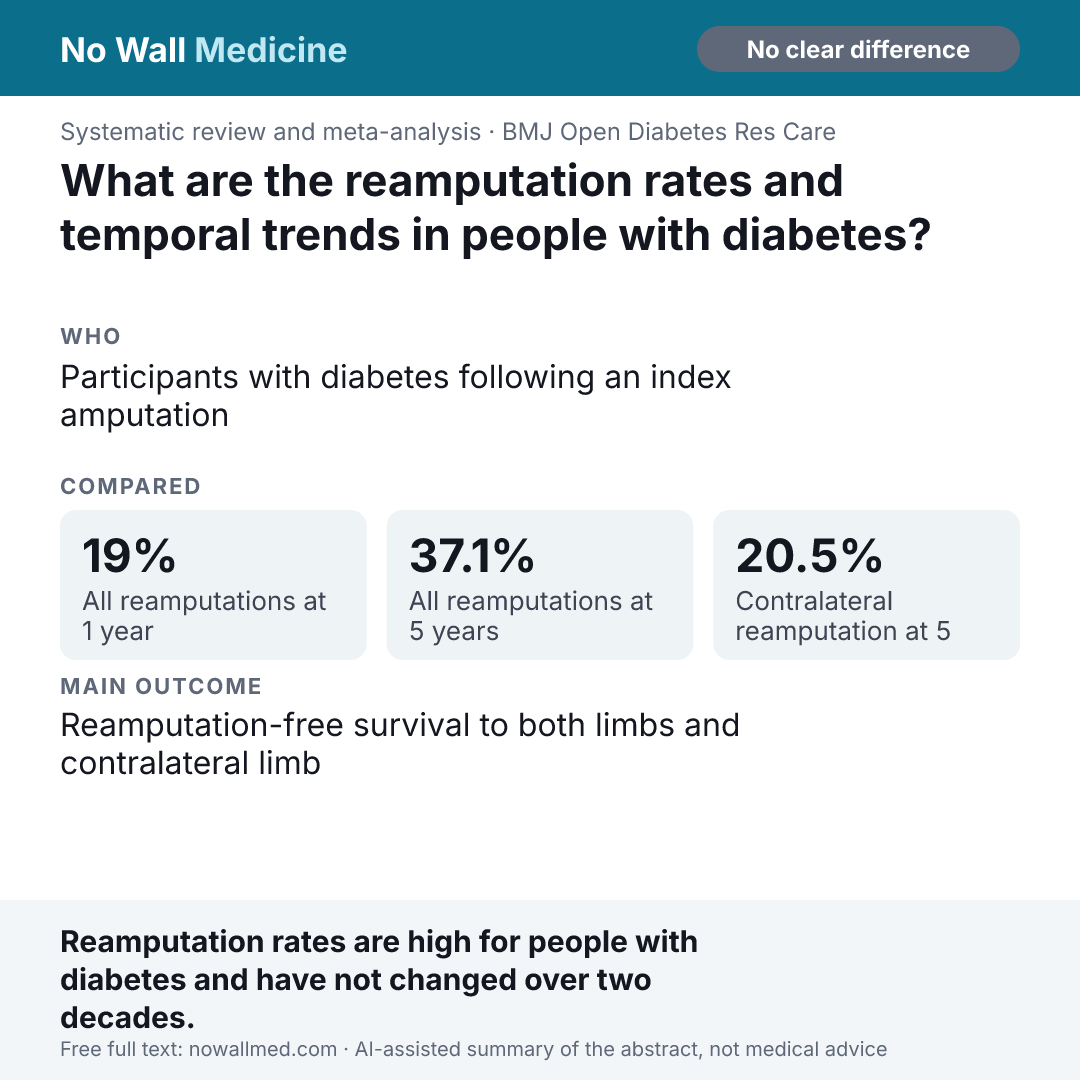
What are the reamputation rates and temporal trends in people with diabetes?
Who
Participants with diabetes following an index amputation
Compared
19%All reamputations at 1 year (IQR=5.1%-31.6%)
37.1%All reamputations at 5 years (IQR=27.0%-47.2%)
20.5%Contralateral reamputation at 5 years (IQR=13.3%-27.2%)
Main outcome
Reamputation-free survival to both limbs and contralateral limb
Bottom line: Reamputation rates are high for people with diabetes and have not changed over two decades.
BMJ Open Diabetes Res Care · 2021-06-11 · Save PNG
Key points
- Researchers analyzed 22 studies involving people with diabetes to measure the rates of subsequent amputations after an initial procedure.
- The rate for all reamputations was 19% (IQR=5.1%-31.6%) at 1 year and 37.1% (IQR=27.0%-47.2%) at 5 years.
- The rate for reamputation of the opposite limb alone was 20.5% (IQR=13.3%-27.2%) at 5 years.
Discussion prompts
- Would these patients look like yours? Who was left out?
- Is the main outcome one that matters to patients?
- Is the difference large enough to change what you do?
Cite: Liu R, Petersen BJ, Rothenberg GM, Armstrong DG. Lower extremity reamputation in people with diabetes: a systematic review and meta-analysis. BMJ Open Diabetes Res Care. 2021;9(1). doi:10.1136/bmjdrc-2021-002325
Free full text: PubMed Central · Summary and visual abstract: nowallmed.com/a/lower-extremity-reamputation-in-people-with-diabetes-a-systematic-1yqxoc3/ (AI-assisted from the abstract; check the paper before relying on it).