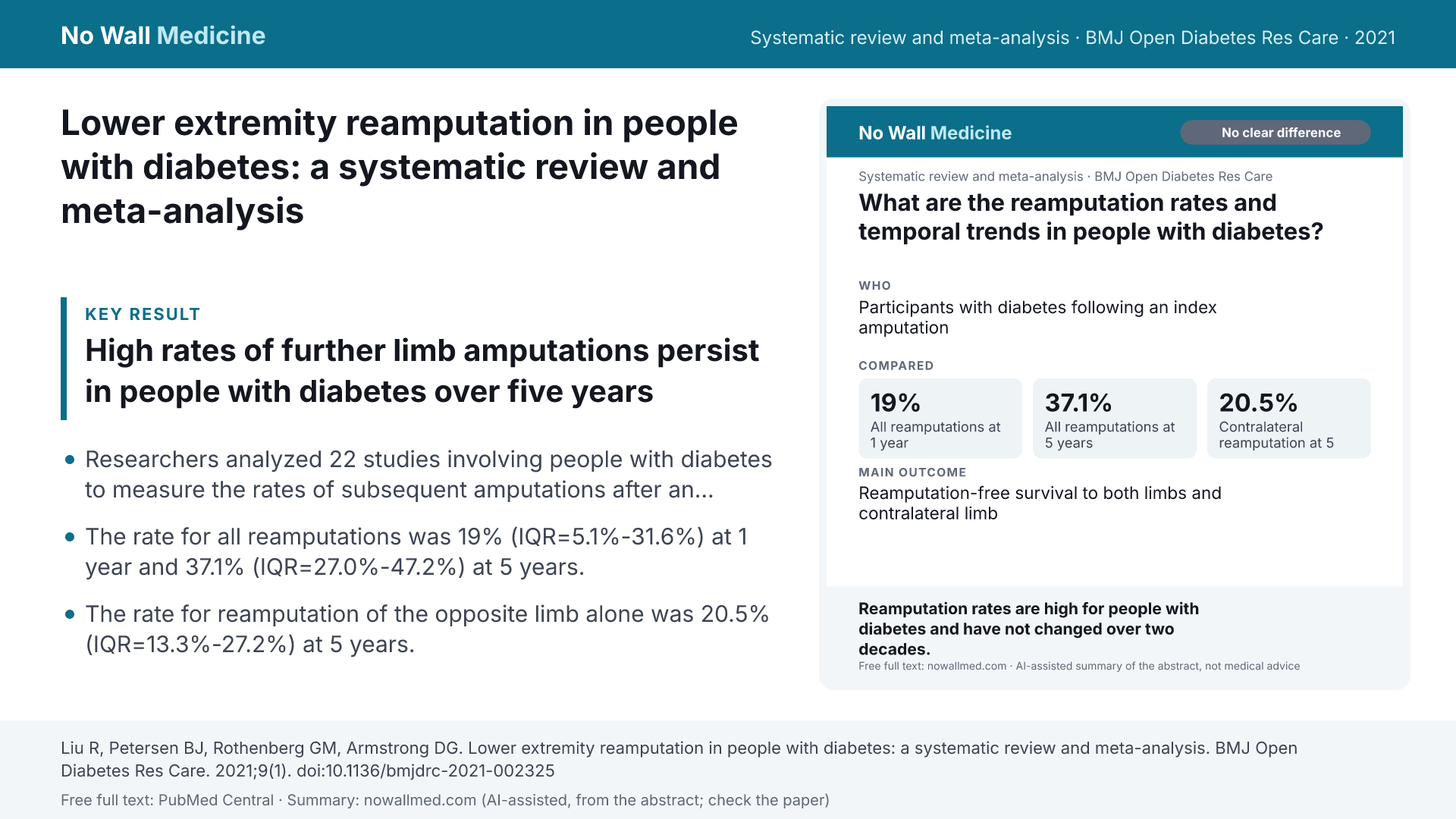
High rates of further limb amputations persist in people with diabetes over five years
Lower extremity reamputation in people with diabetes: a systematic review and meta-analysis
Systematic review and meta-analysisNo clear difference
What are the reamputation rates and temporal trends in people with diabetes?
Who
Participants with diabetes following an index amputation
Compared
19%All reamputations at 1 year (IQR=5.1%-31.6%)
37.1%All reamputations at 5 years (IQR=27.0%-47.2%)
20.5%Contralateral reamputation at 5 years (IQR=13.3%-27.2%)
Main outcome
Reamputation-free survival to both limbs and contralateral limb
Bottom line: Reamputation rates are high for people with diabetes and have not changed over two decades.
BMJ Open Diabetes Res Care · 2021-06-11 · Save PNG
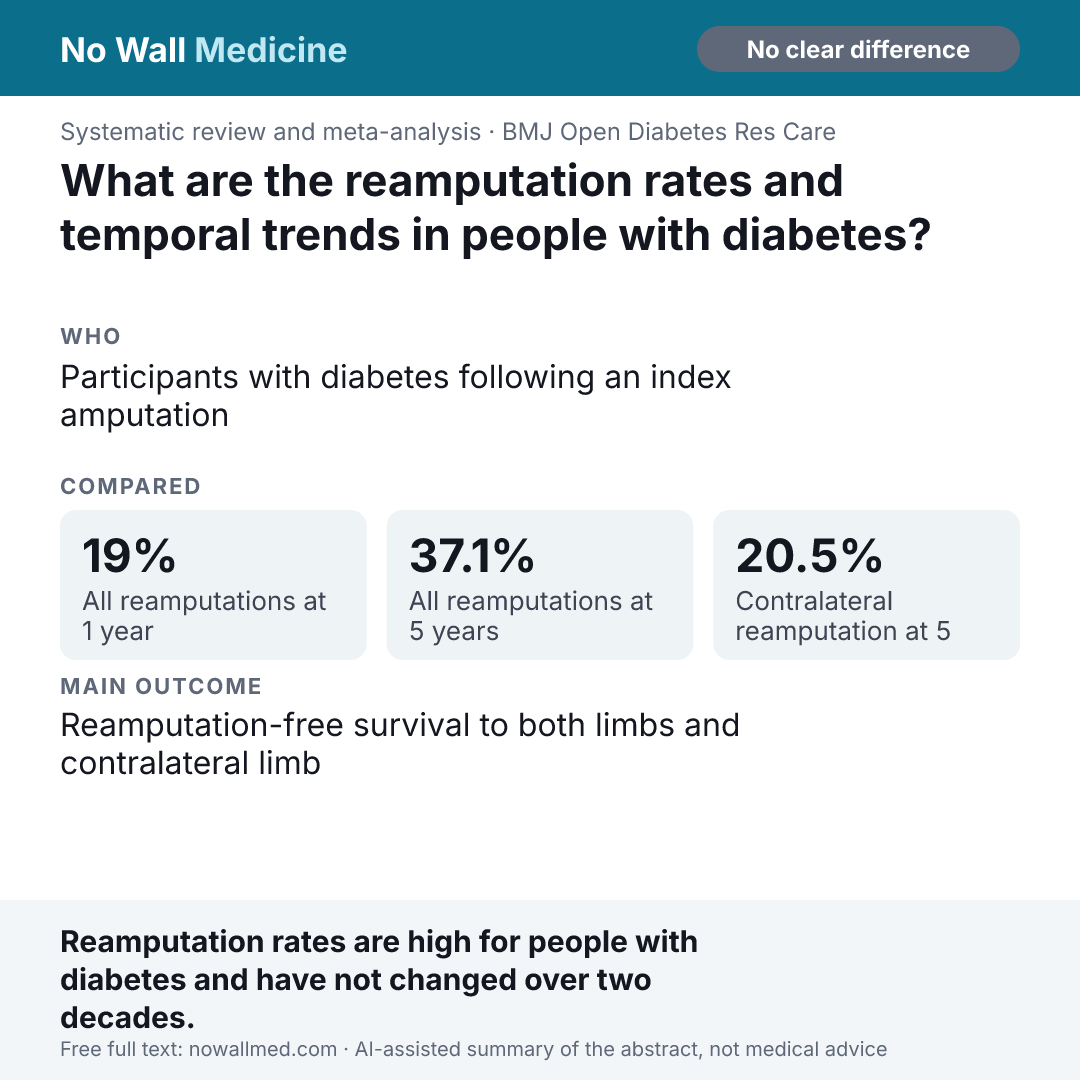
Clinical question: What are the reamputation rates and temporal trends in people with diabetes?
Key points
- Researchers analyzed 22 studies involving people with diabetes to measure the rates of subsequent amputations after an initial procedure.
- The rate for all reamputations was 19% (IQR=5.1%-31.6%) at 1 year and 37.1% (IQR=27.0%-47.2%) at 5 years.
- The rate for reamputation of the opposite limb alone was 20.5% (IQR=13.3%-27.2%) at 5 years.
Headline and key points written with AI from the paper’s abstract, with every number checked against it. Read the paper before relying on them.
Was this summary helpful?
Abstract
In this study, we determined the reamputation-free survival to both limbs and to the contralateral limb only following an index amputation of any-level and assessed whether reamputation rates have changed over time. We completed a systematic search using PubMed and screened a total of 205 articles for data on reamputation rates. We reported qualitative characteristics of 56 studies that included data on reamputation rates and completed a meta-analysis on 22 of the studies which enrolled exclusively participants with diabetes. The random-effects meta-analysis fit a parametric survival distribution to the data for reamputations to both limbs and to the contralateral limb only. We assessed whether there was a temporal trend in the reamputation rate using the Mann-Kendall test. Incidence rates were high for reamputation to both limbs and to the contralateral limb only. At 1 year, the reamputation rate for all contralateral and ipsilateral reamputations was found to be 19% (IQR=5.1%-31.6%), and at 5 years, it was found to be 37.1% (IQR=27.0%-47.2%). The contralateral reamputation rate at 5 years was found to be 20.5% (IQR=13.3%-27.2%). We found no evidence of a trend in the reamputation rates over more than two decades of literature analyzed. The incidence of lower extremity reamputation is high among patients with diabetes who have undergone initial amputations secondary to diabetes, and rates of reamputation have not changed over at least two decades.
Abstract reproduced under the article’s CC BY NC licence.
Subject terms
Headline, design, result, key points, caveat and citation as plain text.
Cite this article
Liu R, Petersen BJ, Rothenberg GM, Armstrong DG. Lower extremity reamputation in people with diabetes: a systematic review and meta-analysis. BMJ Open Diabetes Res Care. 2021. doi:10.1136/bmjdrc-2021-002325
Spotted a mistake? Suggest a correction