Lower or higher oxygenation targets in the intensive care unit: an individual patient data meta-analysis
Individual patient data meta-analysisNo clear difference
Does targeting 8-12 kilopascals of arterial oxygen pressure affect mortality or life support?
Who
Adult intensive care unit patients with acute hypoxemic respiratory failure
Compared
40.4%8 kilopascals group (724/1792)
40.9%12 kilopascals group (733/1793)
Main outcome
90-day all-cause mortality and days alive without life support
Result: risk ratio 0.99 (95% CI 0.92-1.07)
Bottom line: Targeting 8-12 kilopascals of arterial oxygen pressure showed no overall difference in mortality or days alive without life support.
Intensive Care Med · 2024-07-11Download image
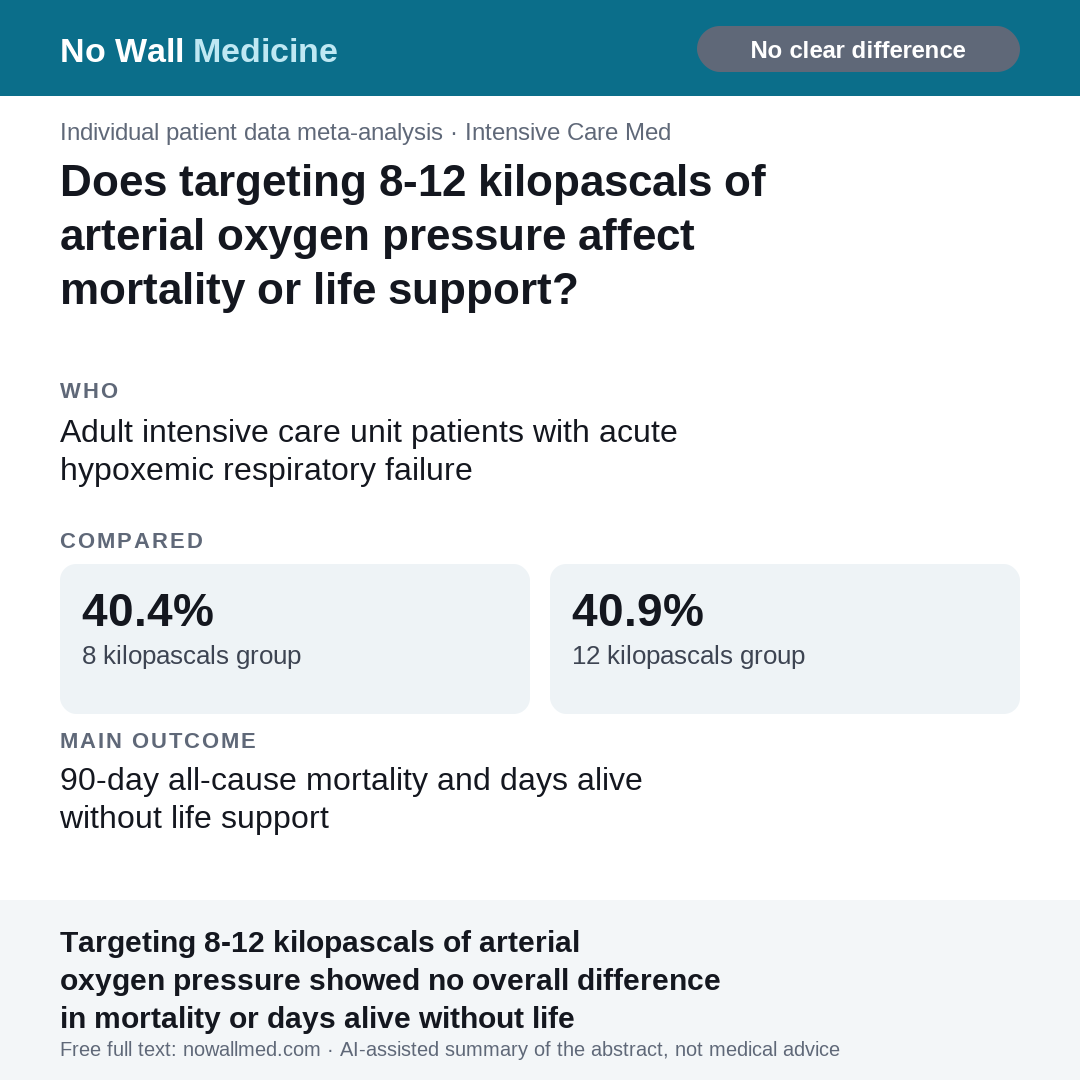
Clinical question: Does targeting 8-12 kilopascals of arterial oxygen pressure affect mortality or life support?
Abstract
Purpose
Optimal oxygenation targets for patients with acute hypoxemic respiratory failure in the intensive care unit (ICU) are not clearly defined due to substantial variability in design of previous trials. This study aimed to perform a pre-specified individual patient data meta-analysis of the Handling Oxygenation Targets in the ICU (HOT-ICU) and the Handling Oxygenation Targets in coronavirus disease 2019 (COVID-19) (HOT-COVID) trials to compare targeting a partial pressure of arterial oxygen (PaO2) of 8-12 kPa in adult ICU patients, assessing both benefits and harms. Methods
We assessed 90-day all-cause mortality and days alive without life support in 90 days using a generalised mixed model. Heterogeneity of treatment effects (HTE) was evaluated in 14 subgroups, and results graded using the Instrument to assess the Credibility of Effect Modification Analyses (ICEMAN). Results
At 90 days, mortality was 40.4% (724/1792) in the 8 kPa group and 40.9% (733/1793) in the 12 kPa group (risk ratio, 0.99; 95% confidence interval [CI] 0.92-1.07; P = 0.80). No difference was observed in number of days alive without life support. Subgroup analyses indicated more days alive without life support in COVID-19 patients targeting 8 kPa (P = 0.04) (moderate credibility), and lower mortality (P = 0.03) and more days alive without life support (P = 0.02) in cancer-patients targeting 12 kPa (low credibility). Conclusion
This study reported no overall differences comparing a PaO2 target of 8-12 kPa on mortality or days alive without life support in 90 days. Subgroup analyses suggested HTE in patients with COVID-19 (moderate credibility) and cancer (low credibility).
Subject terms
Cite this article
Nielsen FM, Klitgaard TL, Bruun NH, Møller MH, Schjørring OL, Rasmussen BS. Lower or higher oxygenation targets in the intensive care unit: an individual patient data meta-analysis. Intensive Care Med. 2024. doi:10.1007/s00134-024-07523-3
Spotted a mistake? Suggest a correction
Top studies every Monday
The week’s key trials and guidelines in your specialties, plus any topics you follow. By email, free.
Get the weekly digest