Lung- and Diaphragm-Protective Ventilation by Titrating Inspiratory Support to Diaphragm Effort: A Randomized Clinical Trial
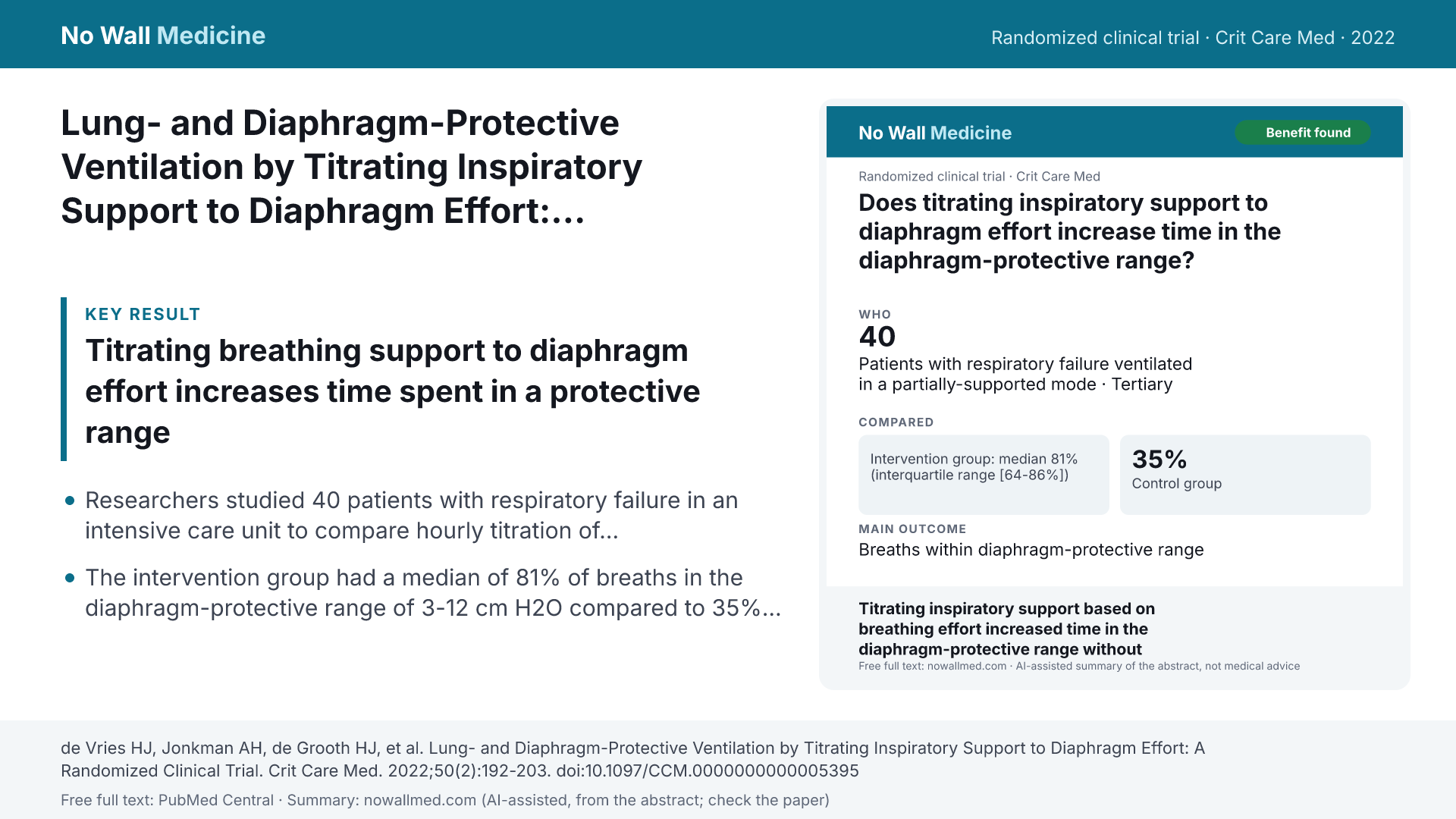
Key result: Titrating breathing support to diaphragm effort increases time spent in a protective range
Randomized clinical trialBenefit found
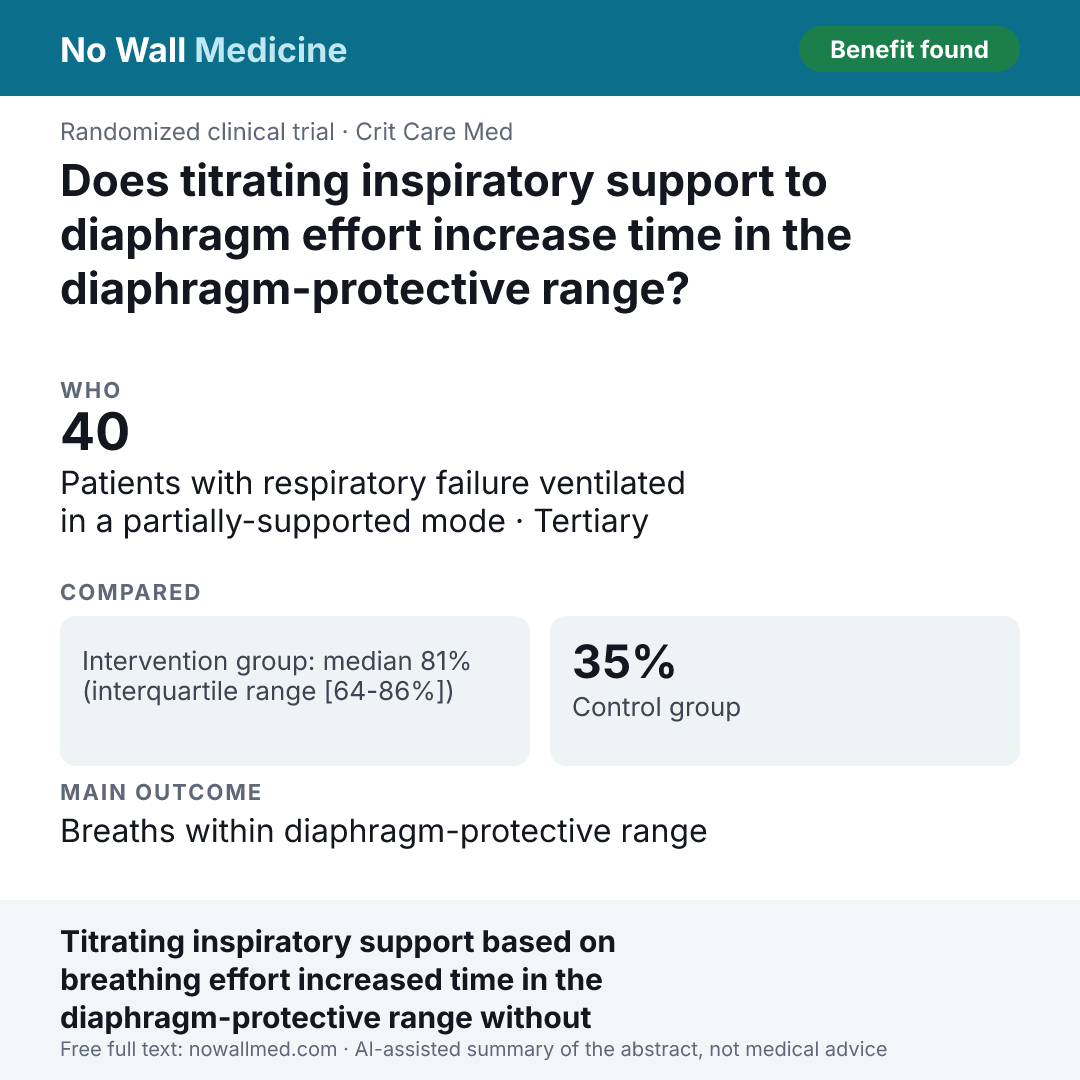
Does titrating inspiratory support to diaphragm effort increase time in the diaphragm-protective range?
Who
40
Patients with respiratory failure ventilated in a partially-supported mode · Tertiary academic hospital in the Netherlands
Compared
Intervention group: median 81% (interquartile range [64-86%])
35%Control group (interquartile range [16-60%])
Main outcome
Breaths within diaphragm-protective range
Bottom line: Titrating inspiratory support based on breathing effort increased time in the diaphragm-protective range without compromising lung-protective ventilation.
Crit Care Med · 2022-01-31 · Save PNG
Key points
- Researchers studied 40 patients with respiratory failure in an intensive care unit to compare hourly titration of inspiratory support against standard care.
- The intervention group had a median of 81% of breaths in the diaphragm-protective range of 3-12 cm H2O compared to 35% in the control group.
- There were no differences between groups in dynamic transpulmonary pressures or tidal volumes, which were 20.5 ± 7.1 vs 18.5 ± 7.0 cm H2O and 7.56 ± 1.47 vs 7.54 ± 1.22 mL/kg.
Discussion prompts
- Would these patients look like yours? Who was left out?
- Is the main outcome one that matters to patients?
- Is the difference large enough to change what you do?
Cite: de Vries HJ, Jonkman AH, de Grooth HJ, et al. Lung- and Diaphragm-Protective Ventilation by Titrating Inspiratory Support to Diaphragm Effort: A Randomized Clinical Trial. Crit Care Med. 2022;50(2):192-203. doi:10.1097/CCM.0000000000005395
Free full text: PubMed Central · Summary and visual abstract: nowallmed.com/a/lung-and-diaphragm-protective-ventilation-by-titrating-inspiratory-jyor87/ (AI-assisted from the abstract; check the paper before relying on it).