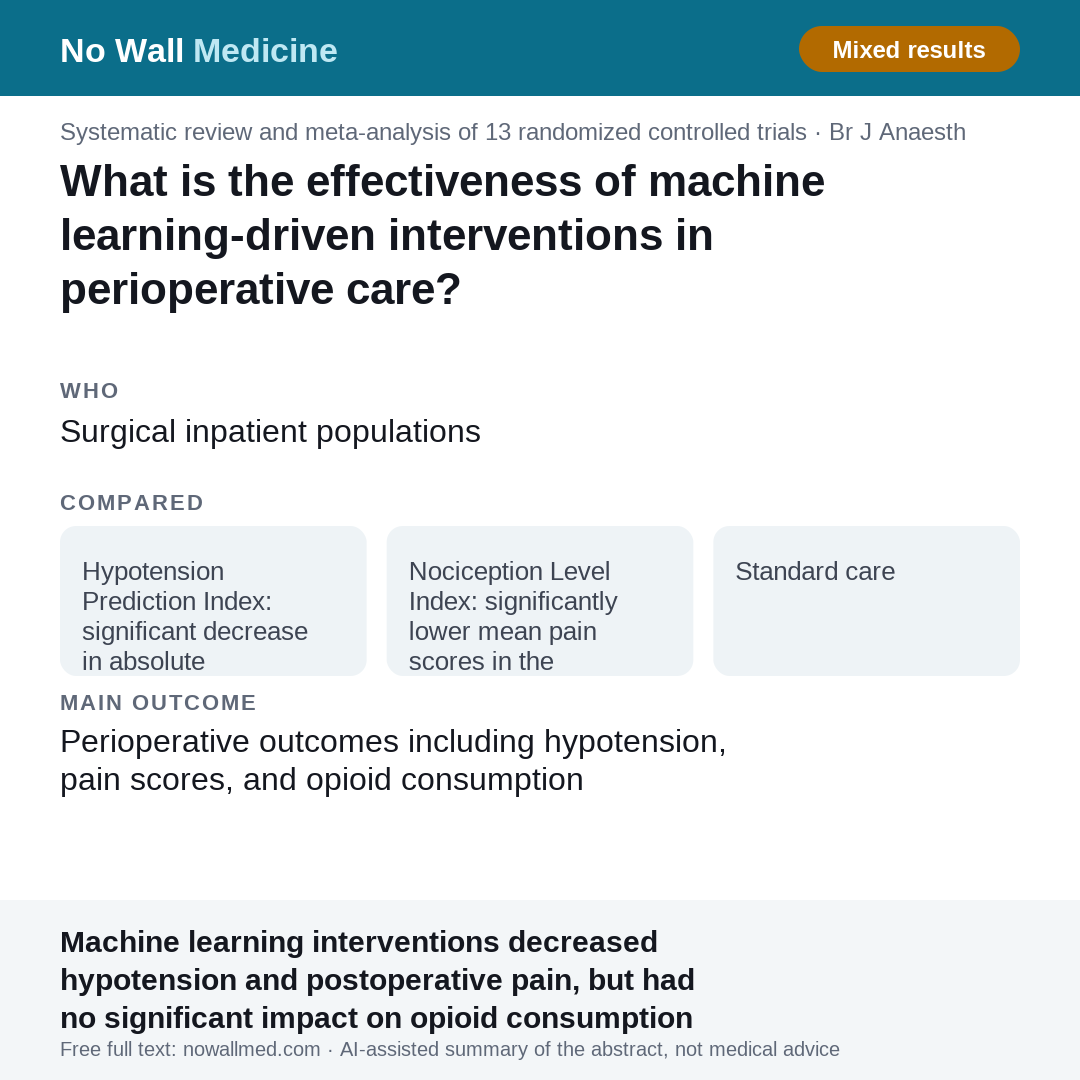
Machine learning tools decreased hypotension and pain scores in surgical patients during perioperative care
Machine learning-augmented interventions in perioperative care: a systematic review and meta-analysis
Systematic review and meta-analysis of 13 randomized controlled trialsMixed results
What is the effectiveness of machine learning-driven interventions in perioperative care?
Who
Surgical inpatient populations
Compared
Hypotension Prediction Index: significant decrease in absolute hypotension (n=421, P=0.003, I2=75%) and relative hypotension (n=208, P<0.0001, I2=0%)
Nociception Level Index: significantly lower mean pain scores in the post-anaesthesia care unit (n=191, P=0.004, I2=19%)
Standard care
Main outcome
Perioperative outcomes including hypotension, pain scores, and opioid consumption
Bottom line: Machine learning interventions decreased hypotension and postoperative pain, but had no significant impact on opioid consumption or hospital stay.
Br J Anaesth · 2024-09-24Download image
Clinical question: What is the effectiveness of machine learning-driven interventions in perioperative care?
Why it matters: The cumulative effectiveness of machine learning-driven interventions on outcomes in perioperative settings was unknown.
Key points
- Researchers analyzed 13 randomized controlled trials involving machine learning interventions like the Hypotension Prediction Index and Nociception Level Index in surgical patients.
- The Hypotension Prediction Index was associated with a decrease in absolute hypotension (n=421, P=0.003, I2=75%) and relative hypotension (n=208, P<0.0001, I2=0%).
- The Nociception Level Index was associated with lower mean pain scores in the post-anesthesia care unit (n=191, P=0.004, I2=19%) but had no significant impact on opioid consumption.
Headline and key points written with AI from the paper’s abstract, with every number checked against it. Read the paper before relying on them.
Topics
Cite this article
Mehta D, Gonzalez XT, Huang G, Abraham J. Machine learning-augmented interventions in perioperative care: a systematic review and meta-analysis. Br J Anaesth. 2024. doi:10.1016/j.bja.2024.08.007
Spotted a mistake? Suggest a correction
Top studies every Monday
The week’s key trials and guidelines in your specialties, plus any topics you follow. By email, free.
Get the weekly digest