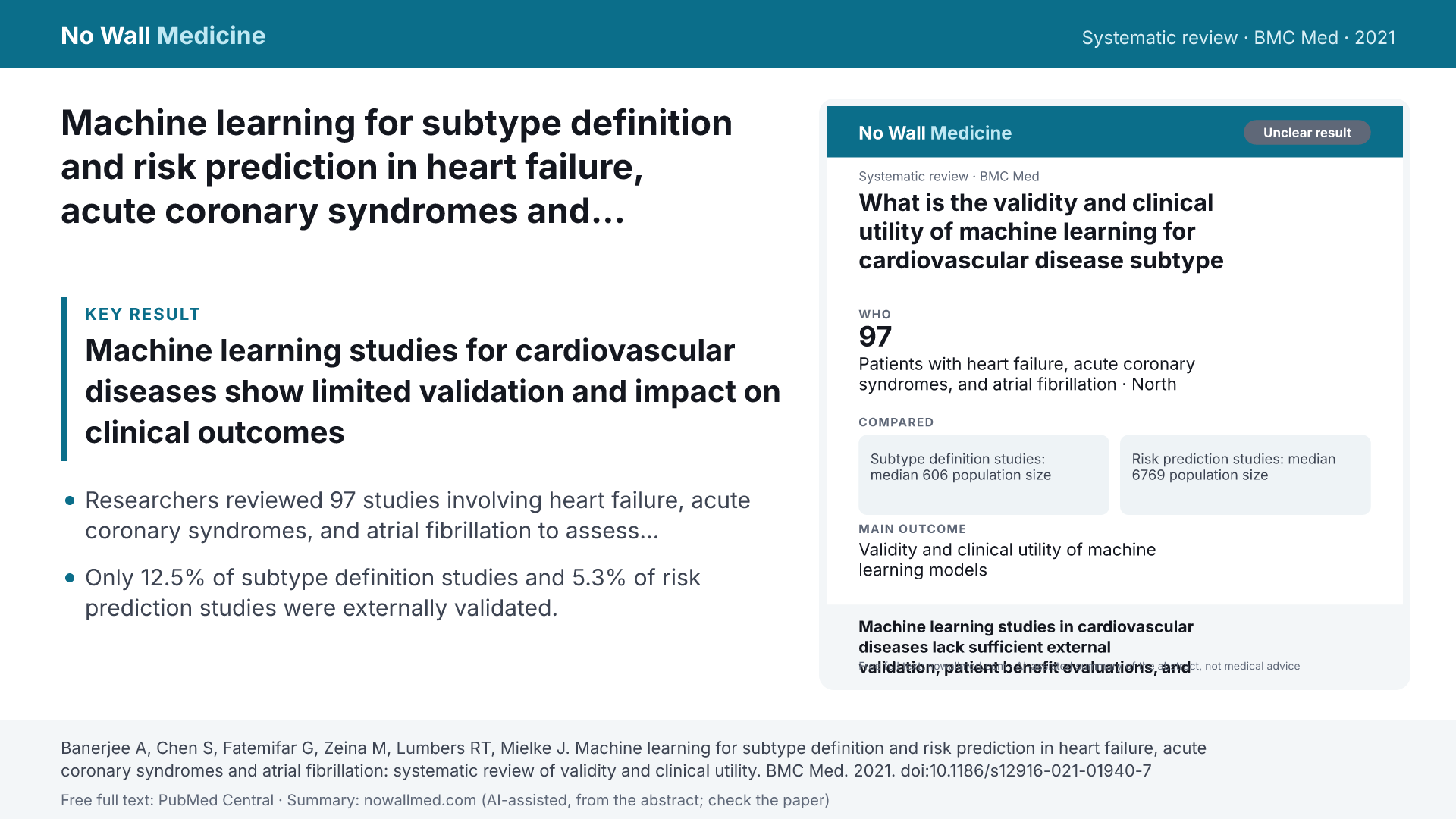
Machine learning studies for cardiovascular diseases show limited validation and impact on clinical outcomes
Machine learning for subtype definition and risk prediction in heart failure, acute coronary syndromes and atrial fibrillation: systematic review of validity and clinical utility
Systematic reviewUnclear result
What is the validity and clinical utility of machine learning for cardiovascular disease subtype definition and risk prediction?
Who
97
Patients with heart failure, acute coronary syndromes, and atrial fibrillation · North America and other locations
Compared
Subtype definition studies: median 606 population size
Risk prediction studies: median 6769 population size
Main outcome
Validity and clinical utility of machine learning models
Bottom line: Machine learning studies in cardiovascular diseases lack sufficient external validation, patient benefit evaluations, and cost-effectiveness assessments.
Limitation: Limited by number and type of covariates, machine learning methods, population size, and focus on single diseases.
BMC Med · 2021-04-06Download image
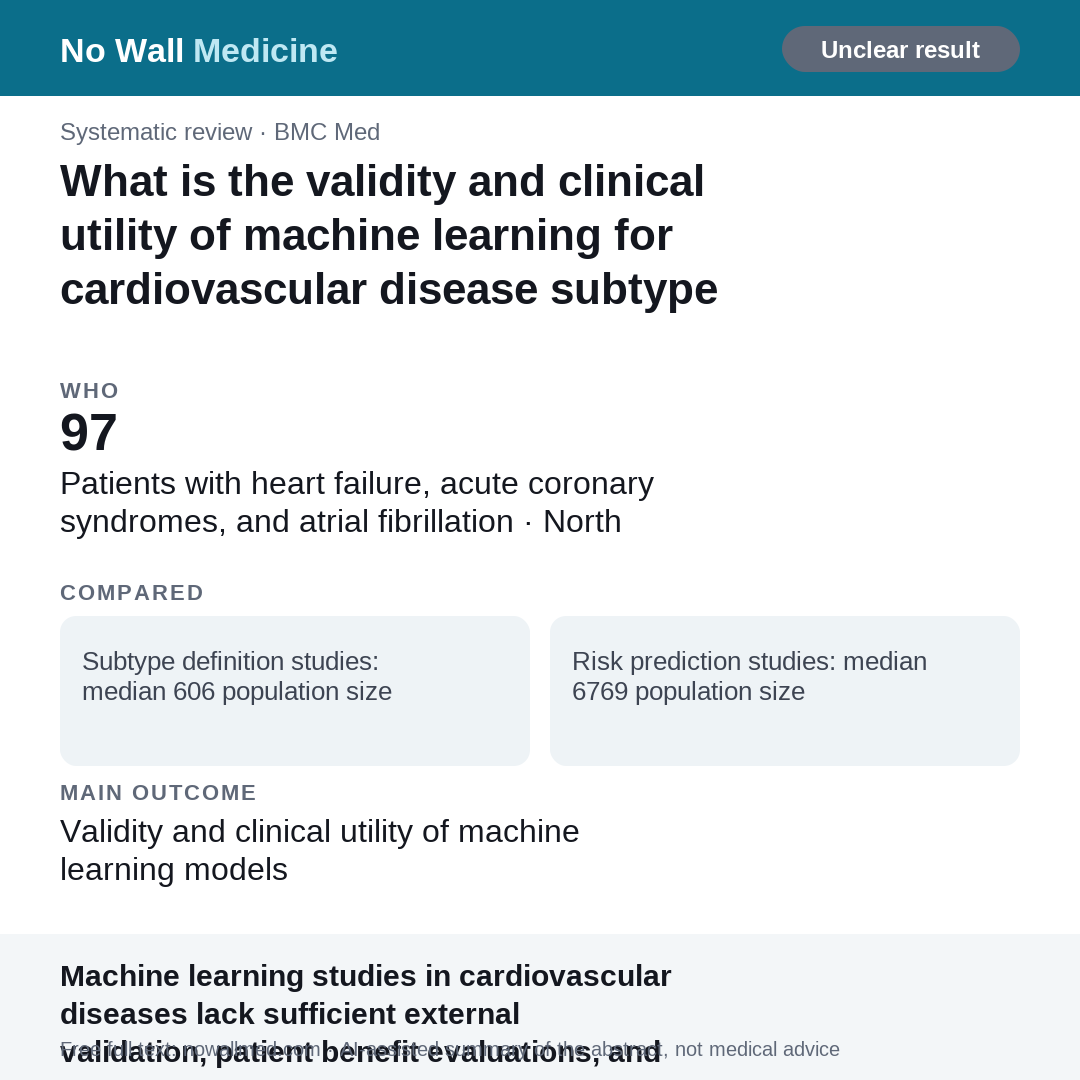
Clinical question: What is the validity and clinical utility of machine learning for cardiovascular disease subtype definition and risk prediction?
Why it matters: It is unknown how machine learning models for subtype definition and risk prediction in cardiovascular diseases perform regarding clinical utility and implementation.
Key points
- Researchers reviewed 97 studies involving heart failure, acute coronary syndromes, and atrial fibrillation to assess machine learning for subtype definition and risk prediction.
- Only 12.5% of subtype definition studies and 5.3% of risk prediction studies were externally validated.
- While 32.5% of subtype definition studies and 91.2% of risk prediction studies improved outcome prediction, no studies evaluated effectiveness or cost-effectiveness.
Limitation the authors note: The included studies were mostly from North America, focused on single diseases rather than multimorbidity, and lacked evaluations of effectiveness or cost-effectiveness.
Headline and key points written with AI from the paper’s abstract, with every number checked against it. Read the paper before relying on them.
Was this summary helpful?
Subject terms
Cite this article
Banerjee A, Chen S, Fatemifar G, Zeina M, Lumbers RT, Mielke J. Machine learning for subtype definition and risk prediction in heart failure, acute coronary syndromes and atrial fibrillation: systematic review of validity and clinical utility. BMC Med. 2021. doi:10.1186/s12916-021-01940-7
Spotted a mistake? Suggest a correction