Machine learning models show moderate accuracy for predicting delayed cerebral ischemia after subarachnoid hemorrhage
Machine Learning for the Early Prediction of Delayed Cerebral Ischemia in Patients With Subarachnoid Hemorrhage: Systematic Review and Meta-Analysis
Systematic review and meta-analysisBenefit found
What is the predictive accuracy of machine learning models for delayed cerebral ischemia?
Who
16294
Patients with subarachnoid hemorrhage
Compared
All machine learning models training set: concordance index 0.786 (95% CI 0.737-0.835)
All machine learning models validation set: concordance index 0.767 (95% CI 0.741-0.793)
Main outcome
prediction accuracy of delayed cerebral ischemia
Result: concordance index 0.786 (95% CI 0.737-0.835) in training set
Bottom line: Machine learning models show desirable power for early prediction of delayed cerebral ischemia after subarachnoid hemorrhage.
Limitation: enhancing the prediction sensitivity of these models is challenging
J Med Internet Res · 2025-01-20Download image
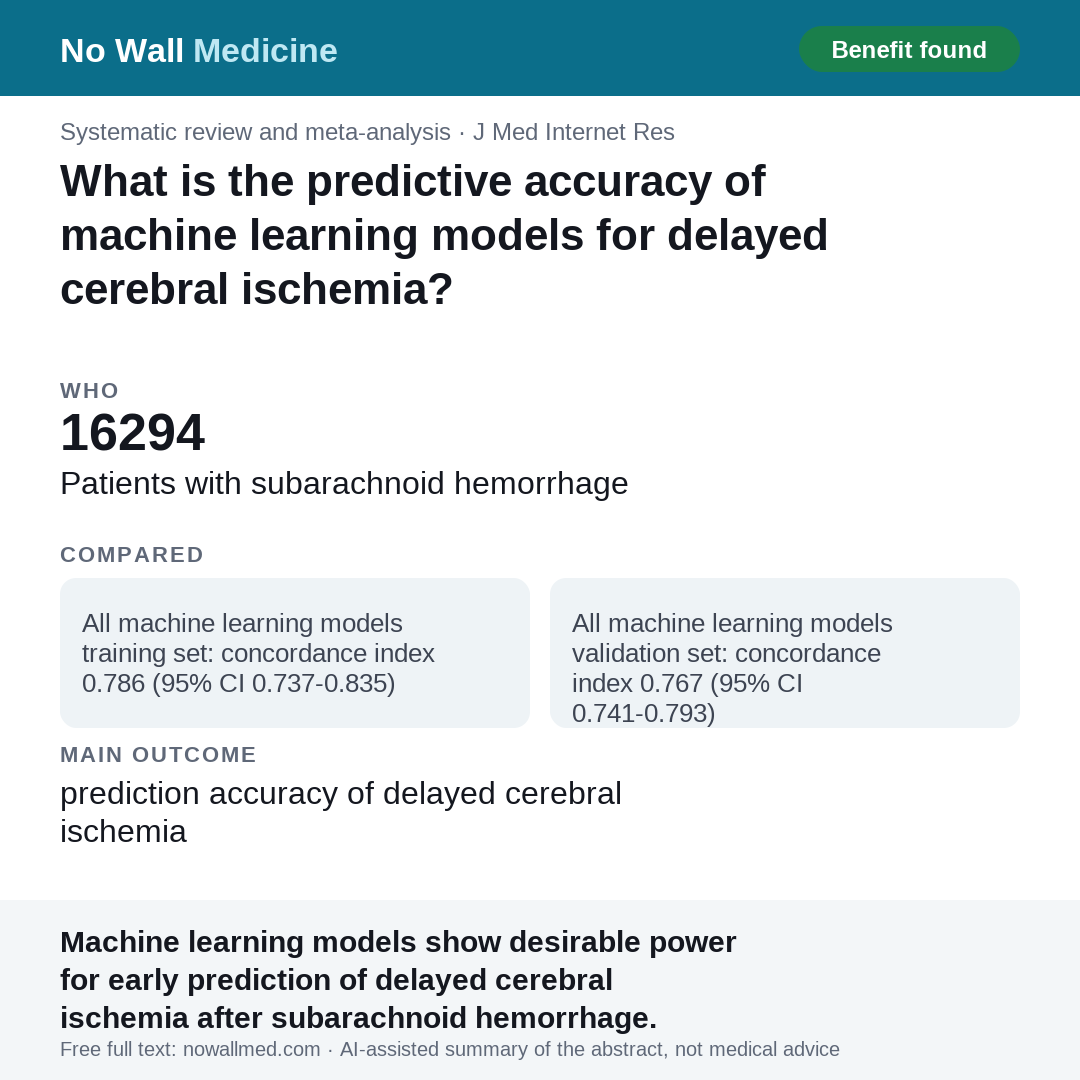
Clinical question: What is the predictive accuracy of machine learning models for delayed cerebral ischemia?
Why it matters: Systematic evidence regarding the predictive accuracy of machine learning models for early noninvasive detection of delayed cerebral ischemia was lacking.
Key points
- Researchers analyzed 48 studies involving 16,294 patients with subarachnoid hemorrhage and 71 machine learning models.
- In training sets, all models had a pooled concordance index of 0.786, a sensitivity of 0.77, and a specificity of 0.83.
- In validation sets, all models had a pooled concordance index of 0.767, a sensitivity of 0.66, and a specificity of 0.78.
Headline and key points written with AI from the paper’s abstract, with every number checked against it. Read the paper before relying on them.
Was this summary helpful?
Subject terms
Cite this article
Zhang H, Zou P, Luo P, Jiang X. Machine Learning for the Early Prediction of Delayed Cerebral Ischemia in Patients With Subarachnoid Hemorrhage: Systematic Review and Meta-Analysis. J Med Internet Res. 2025. doi:10.2196/54121
Spotted a mistake? Suggest a correction
Top studies every Monday
The week’s key trials and guidelines in your specialties, plus any topics you follow. By email, free.
Get the weekly digest