Machine learning models showed high accuracy in predicting kidney transplant graft survival in meta-analysis
Machine learning models in predicting graft survival in kidney transplantation: meta-analysis
Meta-analysis of 27 studiesBenefit found
How well do machine learning models predict kidney graft survival?
Who
Patients undergoing kidney transplantation
Compared
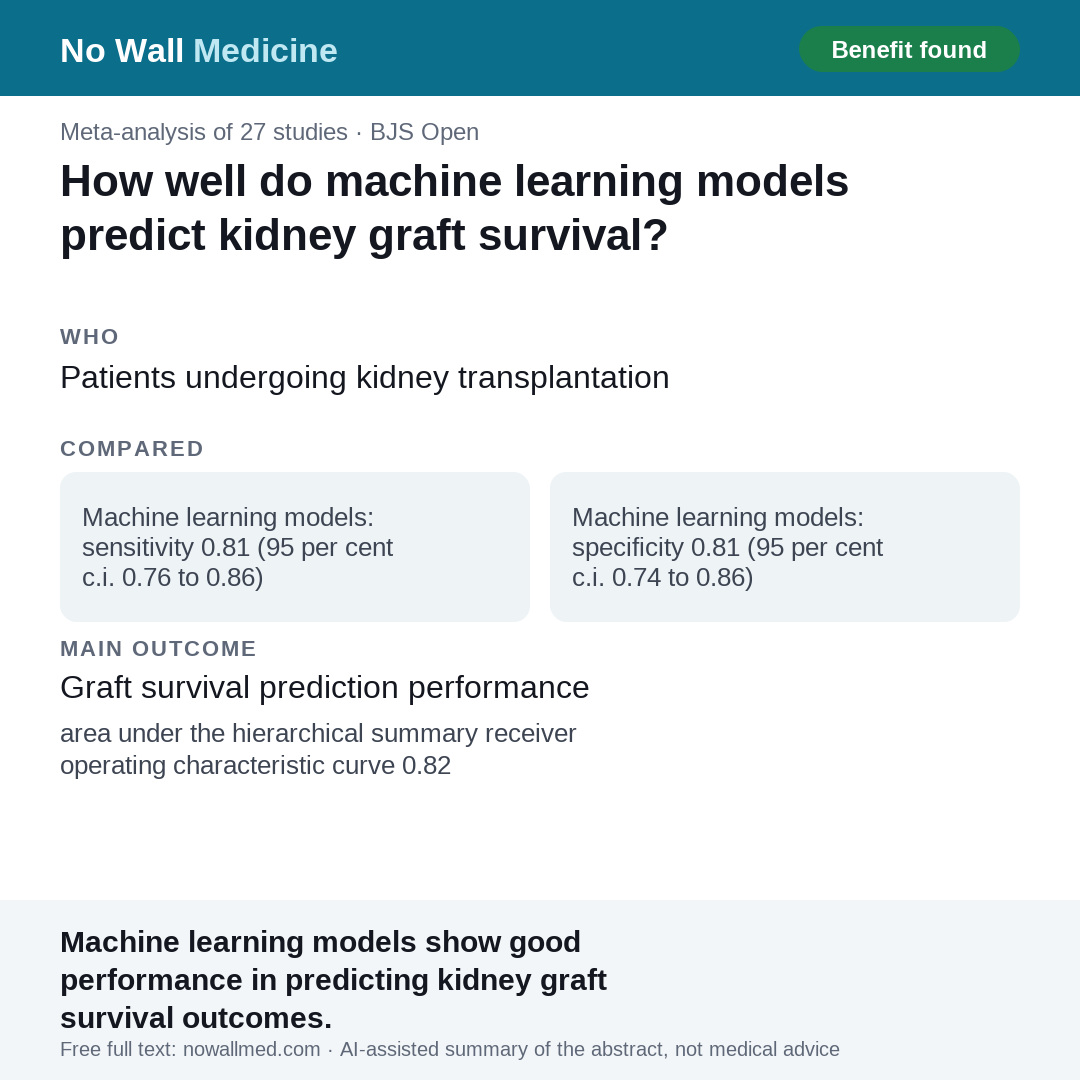
Machine learning models: sensitivity 0.81 (95 per cent c.i. 0.76 to 0.86)
Machine learning models: specificity 0.81 (95 per cent c.i. 0.74 to 0.86)
Main outcome
Graft survival prediction performance
Result: area under the hierarchical summary receiver operating characteristic curve 0.82
Bottom line: Machine learning models show good performance in predicting kidney graft survival outcomes.
Limitation: Five studies had a high risk of bias and three had unclear risk.
BJS Open · 2023-03-29Download image
Clinical question: How well do machine learning models predict kidney graft survival?
Why it matters: The frequent occurrence of kidney allograft failure, which is the loss of a transplanted kidney, remains a significant clinical challenge.
Key points
- Researchers analyzed 31 studies and performed a meta-analysis on 27 studies involving 29 different machine learning models used to predict kidney graft survival.
- The overall model had an area under the hierarchical summary receiver operating characteristic curve of 0.82, with a sensitivity of 0.81 and a specificity of 0.81.
- Nine studies compared the performance of these machine learning models against traditional regression methods, which are standard statistical techniques used to model relationships between variables.
Limitation the authors note: Five studies had a high risk of bias and three studies had an unclear risk of bias.
Headline and key points written with AI from the paper’s abstract, with every number checked against it. Read the paper before relying on them.
Was this summary helpful?
Subject terms
Cite this article
Ravindhran B, Chandak P, Schafer N, Kundalia K, Hwang W, Antoniadis S. Machine learning models in predicting graft survival in kidney transplantation: meta-analysis. BJS Open. 2023. doi:10.1093/bjsopen/zrad011
Spotted a mistake? Suggest a correction
Top studies every Monday
The week’s key trials and guidelines in your specialties, plus any topics you follow. By email, free.
Get the weekly digest